Business Name Trademark: What Owners Should Know First
Business Name Trademark: What Owners Should Know First

1. What a Business Name Trademark Really Protects (and What It Doesn't)
A trademark is a word, name, logo, or slogan that identifies the source of goods or services. It is not the same as your business entity name, your domain name, or your social handle. For example, "Apple®" is a registered mark for computers and software, "Apple Inc." is the legal entity, and apple.com is just a web address. Each serves a different purpose.
When you register an LLC or DBA with a state Secretary of State, you secure that name within that state only. General law does not automatically provide trademark rights. To get nationwide protection, you need federal trademark registration through the United States Patent and Trademark Office, an agency of the department of commerce that operates under a dot gov website marked by the u.s flag.
Common-law rights arise from actual use in commerce but are geographically limited. A federal registration gives you legal presumption of ownership, the right to use the ® symbol, notice to the public, and the ability to sue for infringement in court. A trademark provides exclusive ownership rights for your brand name, prevents others from using similar marks, and establishes brand recognition. It does not protect creative works as copyrights do, and it does not protect inventions-that's the role of a patent.
Throughout this page, you will see terms like trademark registration, trademark filing, trademark application, and states patent and trademark laws. Understanding these is essential before you file.
Ready to trademark a business name, logo, course, or podcast? Start a trademark review.
2. Can You Trademark Your Business Name, Logo, Product, Course, or Podcast?
You can register many brand assets if they meet USPTO standards. When you select your trademark type, options include name, logo, sound, or slogan.
The key factor is distinctiveness. Marks fall on a spectrum: generic names cannot be trademarked (e.g., "Shoes" for shoes), descriptive marks like "Computer Repair Store" need proof of secondary meaning, while suggestive, arbitrary, or fanciful marks like "Netflix®" enjoy strong protection. Evaluate distinctiveness to ensure your mark is not merely descriptive.

Here are categories owners commonly ask about:
- A business name like "Sunrise Dental Care®" for dental services
- A logo such as a stylized sun design used on signage and your website
- A product or service name like a signature online course title
- A podcast name for a weekly show about startup law
- A membership or program name for a paid mastermind
Not everything can be trademarked.
In your trademark application, you must identify specific goods and services. Trademark rights are tied to specific categories called classes-for example, Class 41 for coaching services or Class 9 for software. Vague descriptions risk refusal.
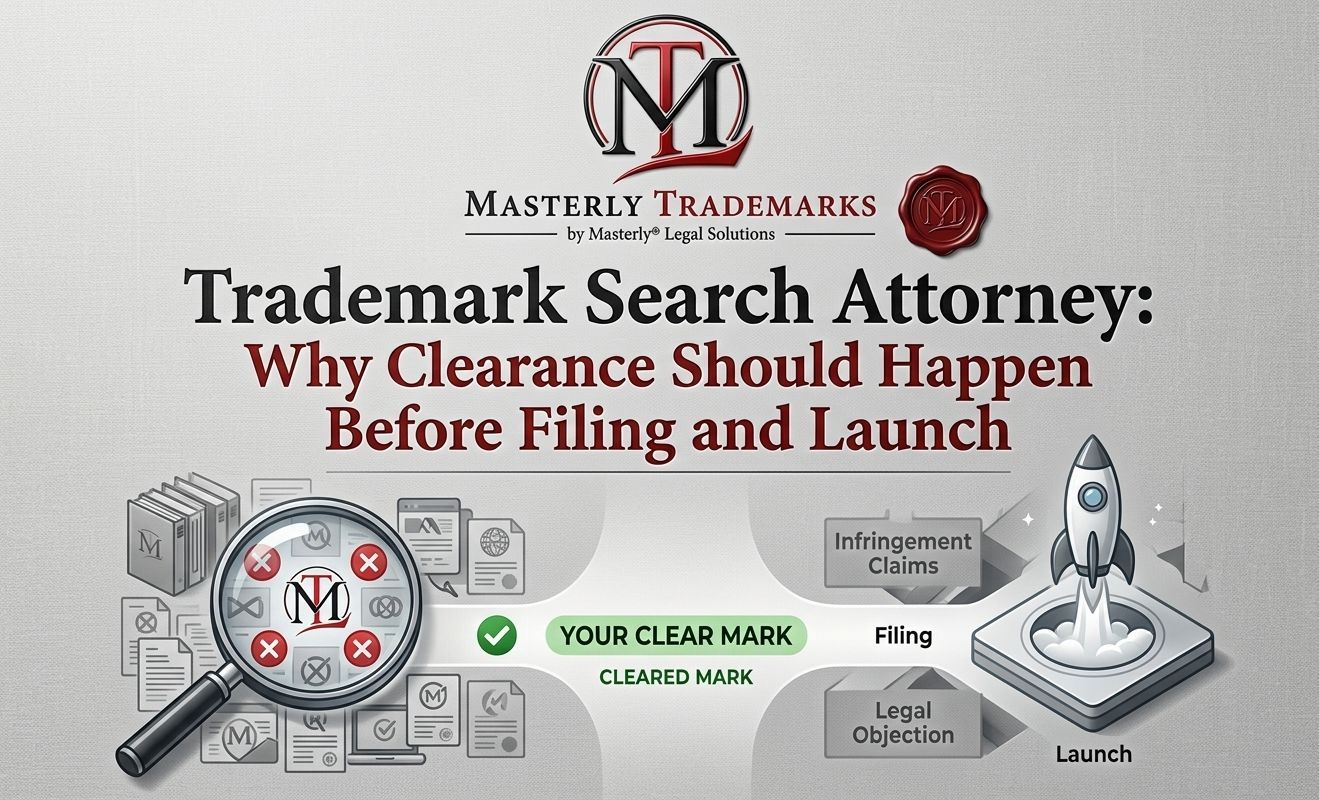
Conduct a search for existing trademarks before choosing a business name. Trademark registration can be blocked by similar existing trademarks that create a likelihood of confusion for customers.
3. How to Trademark a Business Name: Step-by-Step Filing Timeline
Trademarking a business name in the United States involves a structured process through the USPTO. Here is a chronological overview.
Step 1: Preliminary search. Use the free USPTO Trademark Electronic Search System (TESS) to search for similar marks before filing your trademark. DIY searches have limitations-they miss state registrations and common-law uses. A comprehensive search through an attorney or professional vendor reduces risk.
Step 2: Define goods, services, and classes. Choose the correct Nice Classification. Examples: clothing falls under Class 25, software under Class 9, educational services under Class 41. Precise language affects both approval and long-term enforcement.
Step 3: File with the USPTO. The base government fee is $350 per class. You must choose between a "use in commerce" basis (already operating) or "intent to use" (planned launch, with a later Statement of Use). Accurate ownership information and specimens are critical. A trademark application can be rejected if improperly filed.
Step 4: Examination. A USPTO examining attorney reviews your application. Common office action issues include likelihood of confusion, merely descriptive findings, or specimen problems. You typically have six months to submit a response or risk abandonment. The waiting period can feel long.
Step 5: Publication and registration. If approved, the mark is published in the Official Gazette for a 30-day opposition period. For intent-to-use filings, a notice of allowance issues first, and you must file a Statement of Use. Only after registration can you use ®.
The trademarking process typically takes 8 to 12 months from application to registration. Trademark registration protects your brand from infringement and can serve as a valuable intangible asset.

4. Why Work with a U.S.-Licensed Trademark Attorney?
Trademark law is technical. Small errors-wrong owner name, vague goods description, bad specimen-can permanently weaken or destroy rights in your brand. Working with the right attorney matters, and their competency in this area is non-negotiable.
Non-U.S. owners must hire counsel. If you are based outside the United States, the patent and trademark office requires that a U.S.-licensed attorney file on your behalf. Only licensed attorneys who practice law in a U.S. state or territory are authorized to represent trademark matters at the USPTO. Non-lawyer filing services cannot offer legal assistance or guidance on your questions.
What an attorney does. A qualified attorney can conduct a comprehensive clearance search for trademarks, draft the application with precise goods and services descriptions, and respond to office actions with knowledge of examination standards. They also advise on proper use of ™ and ® symbols, represent clients in opposition and cancellation proceedings, and help you choose the right enforcement strategy. An attorney helps monitor and enforce trademark rights effectively.
Vetting your attorney. Confirm their experience with USPTO prosecution and TTAB litigation. Check state bar membership and disciplinary history. Watch for red flags: private "registries" that offer no real protection, unrealistic guarantees, or requests to share your USPTO login credentials. The USPTO's Office of Enrollment and Discipline can sanction unauthorized practitioners, so users should be cautious.
A U.S.-licensed attorney can represent you at the USPTO and ensure your order of filings is correct from day one. Start a trademark review to see if your business name, logo, or product title is ready to file.
5. After Registration: Maintaining, Enforcing, and Monetizing Your Trademark
Registration is the beginning of brand protection, not the end. Trademark owners must maintain and actively use the mark to keep it alive.
Maintenance deadlines. Between the 5th and 6th year after registration, you must file a Section 8 Declaration of Use and optionally a Section 15 Declaration of Incontestability. Section 9 renewals are due every 10 years. Missing these deadlines can result in cancellation-a costly mistake that no amount of re-filing can easily fix.
Enforcement. Monitor for infringement using watch services, marketplace checks, and domain monitoring. Typical enforcement steps include sending a demand letter, filing platform takedowns, and pursuing opposition or cancellation. A federal trademark registration allows you to sue for infringement in court, and registered marks can be enforced with customs authorities to stop counterfeiting.
International expansion. You can choose from 180+ countries to file your trademark using a U.S. registration as a basis under the Madrid Protocol. Common next markets include Canada, the EU, the UK, and Mexico. Recommend working through local counsel for foreign filings.
Commercialization. A registered trademark can be an intangible asset that increases your company's value. You can license your mark to franchisees or affiliates under quality-control provisions, or assign it in mergers and brand carve-outs. Written agreements should reference correct registration numbers and identify the relevant patent and trademark office in each jurisdiction.
A thoughtful trademark strategy helps you protect brand equity and align naming decisions with long-term business plans. Whether you are launching a new product line or scaling services internationally, the right form of protection makes the difference.
Start a trademark review today to secure your brand before investing further in branding, packaging, or marketing. Protect your business name and gain peace of mind with expert guidance.
Contact us today at (972) 236-5051 to schedule your free consultation and discover how monitoring can protect your trademark rights.
You might also like