Copyright Attorney Help for Creators, Authors, and Course Owner
If you create online courses, write books, host a podcast, or sell digital products, your work has value worth protecting. A copyright attorney protects rights related to original creative works and helps you keep control of what you've built. This guide walks through when legal help matters most, what attorneys actually do for creators, and how to make smart decisions about protecting your content.
Quick Answers: When Do You Need a Copyright Attorney?
Hiring a copyright attorney involves assessing specific legal needs, and for many creators the need arrives sooner than expected. Copyright protects original works as soon as they are created, but protection alone doesn't stop bad actors.
Here are clear situations where a copyright attorney is most helpful:
- Someone reproduced your online course and is reselling it on another platform
- A publisher contract demands all rights in all formats, in perpetuity
- A DMCA takedown request was filed and ignored
- You're licensing your podcast for international distribution
- You're co-writing a book or course and need ownership clarified
- A brand deal or sponsorship bundles your music, video, and written content without clear terms
- Revenue from your creative works is significant or recurring
There's a practical line between everyday DIY steps and higher-risk scenarios. Filing a basic copyright registration or using a standard template for a small project is something most creators can handle. But when you're planning a six-figure course launch, negotiating streaming deals, or managing content across large audiences, professional counsel pays for itself.
Consulting a copyright attorney early can prevent expensive disputes later, especially when long-term royalties or recurring revenue are at stake.

Copyright Law Basics for Creators
Copyright is a form of intellectual property that automatically protects original works fixed in a tangible form under U.S. law. The
Copyright Act of 1976, effective January 1, 1978, established the modern framework, though the first federal copyright law was passed in 1790. US copyright law protects original works upon creation without registration.
The scope of copyright law includes literature, software, music, and art. For creators specifically, protected creative works include:
- Online course modules (video, slides, scripts)
- Membership site content and coaching frameworks
- YouTube videos, podcasts, and ebooks
- Music, photographs, and architectural works
- Templates, software code, and digital content
Copyright does not protect ideas, only their expression. Your exact course videos are protected, but the general concept of "how to start a podcast" is not. Methods, systems, and facts also fall outside copyright protection.
Copyright protects original works of authorship automatically. Copyright protection lasts for the author's life plus 70 years for works created after January 1, 1978. For works made for hire or company-owned content, the term is generally 95 years from publication or 120 years from creation, whichever is shorter.
Copyright applies to various creative works like music and literature across the globe. The Berne Convention was established in 1886 for copyright protection and ensures automatic protection across signatory nations. In the EU, copyright lasts 70 years after the author's death. Canada's copyright duration increased to 70 years after the author's death in 2022. Australia's copyright law protects works automatically since 1968, and UK copyright law automatically protects original works without registration. In the US, copyright applies automatically upon public release, though enforcement procedures differ by country and may need attorney guidance.
What Does a Copyright Attorney Do?
A copyright attorney focuses on copyright law and adjacent intellectual property issues for creative businesses. Specialization in copyright law is crucial for effective representation, because the legal landscape is nuanced and constantly evolving.
Here's what they handle in practice:
- Advising on ownership of original works across collaborations and employment
- Explaining fair use boundaries for specific projects
- Managing copyright registration with the Copyright Office
- Drafting and negotiating licensing agreements to define content usage
- Responding to infringement through demand letters, DMCA takedowns, and litigation
- Preparing work-for-hire agreements to clarify ownership
Copyright attorneys often coordinate with other IP disciplines. A course name or podcast title may need trademarks protection, proprietary software might involve patents, and internal frameworks could qualify as trade secrets. Businesses rely on copyright attorneys to manage their intellectual property portfolios across these categories.
For creators, attorneys translate complex legal concepts into practical strategic decision making: pricing rights, defining usage rights, and setting realistic enforcement strategies. Negotiating contracts is a key responsibility of copyright attorneys, and they help you understand what you're giving away before you sign.
Some attorneys litigate in federal court, while others focus on counseling, contracts, and risk prevention. Before engaging someone, clarify whether you need a litigator or a transactional attorney, as most creator situations start with prevention and negotiation.
Common Situations Where Creators Should Call a Copyright Attorney
Think of this as a checklist for recognizing when professional help is the right move. Creators seek copyright protection to address unauthorized reproductions of their work, and these scenarios come up more often than you'd expect.
For course creators and educators:
- A former collaborator reposts your 2025 course viadeos on Udemy or Skillshare without permission
- A corporate client wants to license your training content across global offices with multi-year renewals
- Graded assignments or proprietary frameworks you created are being reproduced elsewhere
For authors:
- A 2024 self-publishing contract demands all rights in all formats, in perpetuity
- An anthology deal seeks exclusive rights over all derivative works forever
For musicians and podcasters:
- Your 2023 podcast episodes are re-uploaded to another channel with ads running against them
- A streaming sync license negotiation for film or video games needs review
- Musical compositions are sampled without authorization
For digital product creators:
- Templates, code, or photographs you sell are being distributed on piracy sites
- A platform suspends your account after a copyright strike you believe is false
Escalation triggers include substantial revenue at risk, international distribution, use by a large platform, or conflicts involving multiple copyright owners. Cease-and-desist letters are commonly issued in copyright infringement cases as a first formal step.
When a dispute crosses jurisdictions-for example, a U.S. creator and an EU-based platform reselling a 2026 course-a copyright attorney can coordinate cross-border enforcement strategy.
Determining Who Owns the Copyright in Your Work
The copyright owner is usually the human who created the work. But contracts, employment relationships, and collaboration can shift ownership in ways that surprise creators.
Under the work-made-for-hire doctrine, content created by an employee within the scope of their employment is owned by the employer. For example, if you produced a company's internal training library in 2024 as a salaried employee, that organization likely owns the copyright. For independent contractors, only certain categories of commissioned work qualify as work for hire, and only with a signed written agreement.
Common problem areas include:
- Ghostwriters for 2023 books where no written assignment exists
- Video editors for a 2025 YouTube series whose edits contribute creative input
- Course co-creators where one person records video and the other handles audio
- Joint podcasts where hosts contribute separately but never signed an agreement
Without clear contracts, collaborators may be considered joint copyright owners, each with independent rights to use, license, or enforce the work. This can complicate licensing and make enforcement messy.
A copyright attorney helps by auditing existing agreements, performing due diligence on past content-who created what, when, and under which terms-and drafting new agreements that clearly spell out ownership, revenue shares, and reversion rights. Due diligence in legal rights management helps reduce infringement risks before they become costly disputes. Copyright protection lasts for the author's life plus 70 years, so clarity now prevents decades of potential conflict.
Copyright Registration: When and Why It Matters
Copyright protection arises automatically, but U.S. copyright registration unlocks enforcement tools that matter when someone copies your work. In the US, copyright registration is not mandatory but beneficial, and the difference between registered and unregistered works can be worth thousands of dollars in a dispute.
Key benefits of registration:
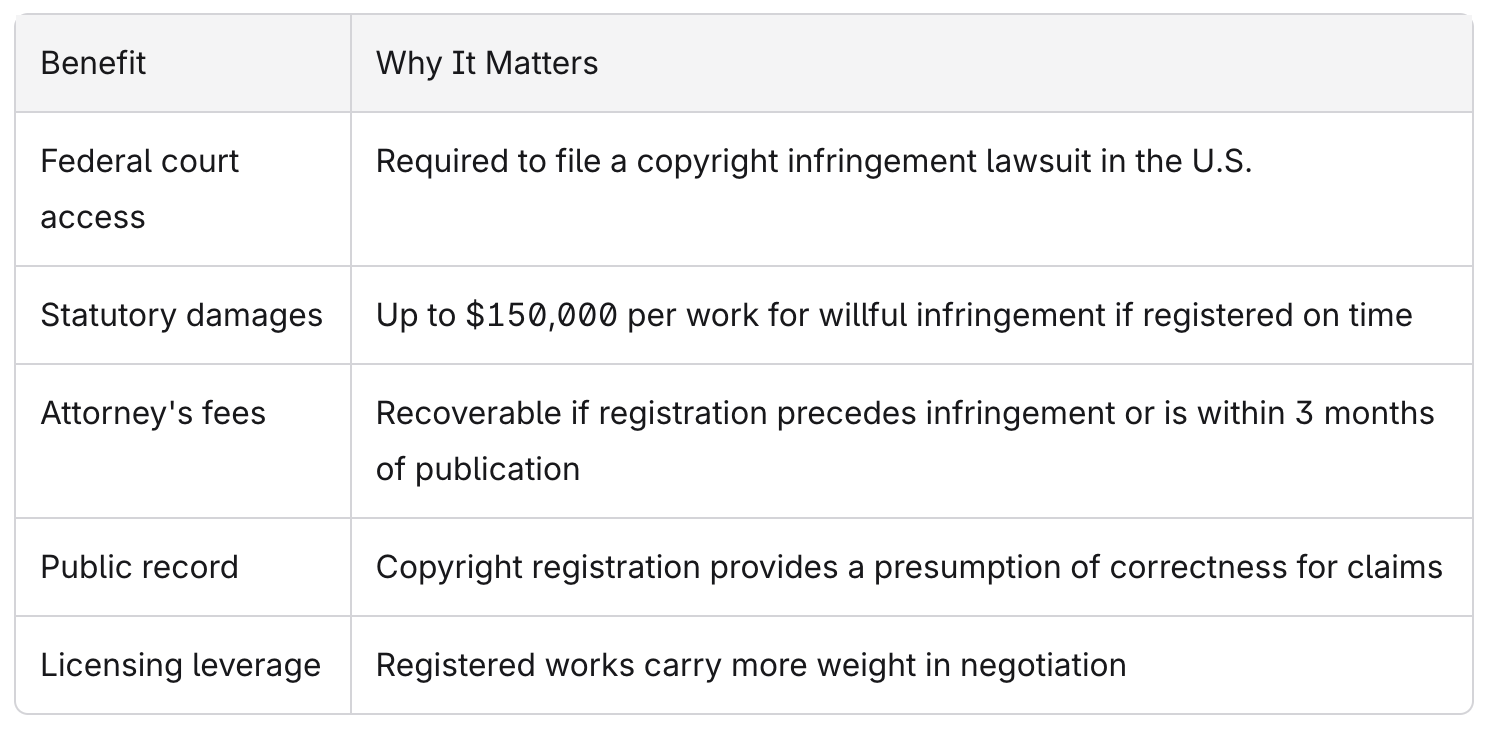
The U.S. Copyright Office is the only place to register copyrights, and it issued over 441,500 registrations in fiscal 2023 alone. Timely registration allows seeking monetary damages in lawsuits, so timing matters. A copyright notice can deter infringement and clarify ownership even before a dispute arises.
A copyright attorney helps clients secure federal copyright registration by choosing the correct application type. This includes distinguishing between sound recording and musical compositions registrations, group registrations for short online works, and audiovisual classifications. For example, registering a 2024 online course bundle as an audiovisual work, a 2025 photography collection, or a catalog of 2020–2026 podcast episodes each requires different approaches.
Many creators file simple registrations on their own. But for larger portfolios or complex ownership chains, attorneys ensure accuracy that maximizes available legal remedies.
Fair Use, Licensing, and Using Other People's Content
Creators are often both copyright owners and copyright users, making fair use and licensing central issues. Fair use allows limited use of copyrighted material without permission, but it's narrower than most people assume.
Fair use is defined under Section 107 of the Copyright Act, and courts weigh
four factors:
- Purpose and character of use - Is it commercial or transformative? Commentary, criticism, and parody qualify as fair use more readily than straight reproduction.
- Nature of the copyrighted work - Published factual works get less protection than unpublished creative ones.
- Amount used - Short clips in a 2026 reaction video differ from re-uploading an entire film.
- Market effect - Does the use reduce the value of the original?
Fair use does not guarantee protection against copyright claims. It's a defense, not blanket permission, and disclaimers alone won't save you. Fair use is not recognized in the EU like in the US, which adds complexity for creators with international audiences. Copyright law includes exceptions and limitations such as fair use, but outcomes are uncertain until a court decides.
A copyright attorney evaluates fair use risks for specific projects and drafts license terms when fair use is uncertain. Licensing examples include using a song in a paid webinar, incorporating film clips into a 2025 course, or integrating third-party code into a commercial SaaS product. When the person authorized to grant permission is identifiable, attorneys negotiate directly with copyright owners to secure clear agreements.
Responding to Copyright Infringement of Your Work
Common infringement patterns in the 2020s include unauthorized re-uploads of courses to marketplace platforms, pirated PDFs of ebooks, full podcast feeds mirrored onto other apps, and stock photographs posted without licenses. Copyright attorneys assist clients with enforcement actions against unauthorized use of copyrighted materials at every stage.
Here's a practical escalation ladder:
- Document everything - Screenshots, timestamps, URLs, and copies of the infringing content
- Informal notice - Contact the infringer directly and request removal
- Platform tools - Use YouTube's Content ID, marketplace reporting forms, or similar systems
- DMCA takedown notice - Formal notice to the hosting platform's designated agent
- Demand letter - Attorney-drafted communication demanding cessation and potential compensation
- Litigation or settlement - When damages or scale justify court action
The stakes can be enormous. In one recent case, Anna's Archive was fined $322 million by a U.S. federal court for scraping copyrighted audio files. Meanwhile, Anthropic settled for $1.5 billion over claims that pirated books were used to train its artificial intelligence chatbot, highlighting new frontiers in innovation and copyright enforcement. AI-generated content is not protected by copyright in the US, adding another layer of complexity to how creators and platforms interact.
Special challenges arise with repeat infringers, anonymous domain owners, and offshore platforms where U.S. jurisdiction is weak. A thoughtful strategy-rather than blanket threats-protects both legal rights and your brand reputation with fans, students, consumers, and collaborators.
Key Contract Terms Creators Should Review With a Copyright Attorney
Contracts are where many creators unintentionally sign away long-term copyright and royalty rights, sometimes in exchange for modest short-term financial aid or advances. A quick review before signing can save years of regret.
Major clauses that deserve attorney review:
- Scope of license - What media, territories, and duration are covered?
- Exclusivity - Can you use your own work elsewhere, or is the license exclusive?
- Work-for-hire language - Does the contract claim ownership of everything you create?
- Royalty structures and audit rights - What percentage do you earn, and can you verify the numbers?
- Derivative works and adaptation rights - Can they turn your book into a film, course, or app without your consent?
- Termination or reversion clauses - When do rights revert to you if the deal ends?
Concrete examples include a 2026 publishing deal for a nonfiction book that seeks rights in "all formats including audio, translation, and future media," a 2024 streaming platform license for a video library granting exclusive global rights in perpetuity, or a brand course partnership for internal corporate training where neither party clarifies who controls what.
A copyright attorney can propose redlines that limit territory, duration, and format. They explain trade-offs and help creators decide when to push back, walk away, or accept certain terms based on long-term strategy. Even standard-form contracts from large platforms or agencies may be negotiable, especially for creators with established audiences or valuable catalogs. Works entering the public domain after their protection term expires can't be reclaimed, so getting contract terms right the first time is essential.
Costs, Financial Aid, and Making Legal Help Affordable
Many creators assume copyright attorneys are unaffordable. In reality, targeted legal help is often more accessible than expected, and the cost of not getting advice can be far higher.
Typical fee models include:
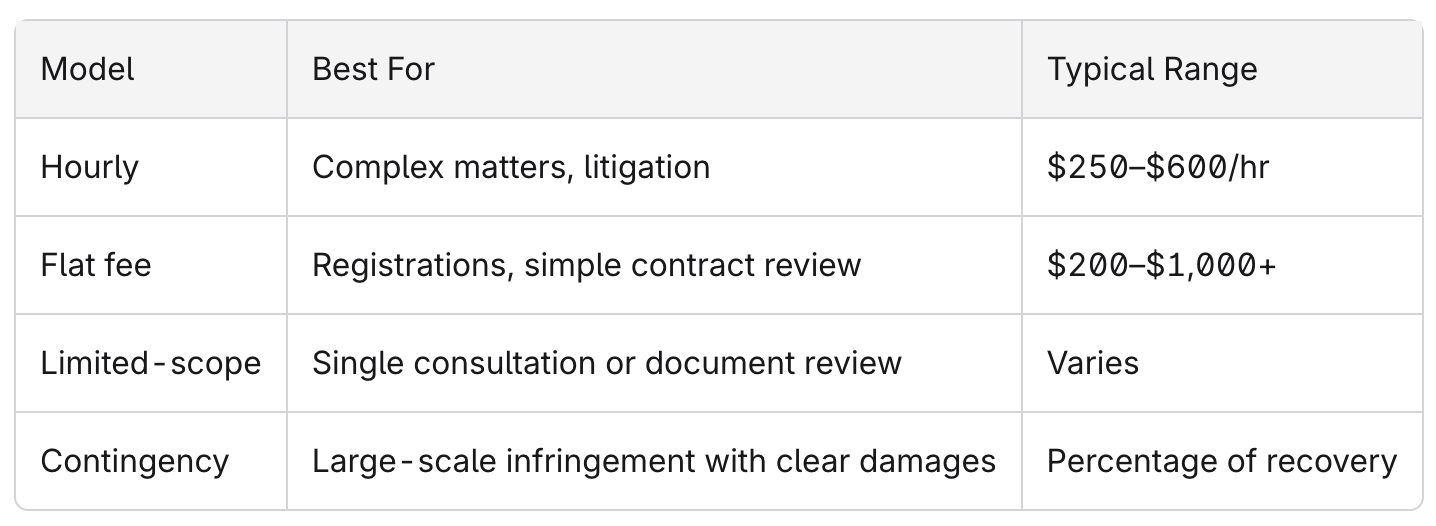
A DMCA takedown or cease-and-desist letter might cost between $200 and $1,000. Contract review or license negotiation costs more. Full litigation can run into tens or hundreds of thousands.
Practical ways to manage costs:
- Prioritize the highest-risk issues (ownership disputes, large licensing deals)
- Prepare your documents and questions before meetings
- Use templates for low-risk situations and reserve attorney time for complex matters
- Explore law school clinics, nonprofit legal organizations for arts and authors, and sliding-scale services where available
Initial consultations with copyright attorneys often provide insights into their approach and help you gauge fit before committing. Many offer a free or low-cost first meeting.
View legal spend as an investment in protecting future revenue from original works rather than a pure expense. Content that earns across many years-courses, books, music catalogs-justifies early protection. Marketing your work confidently requires knowing your rights are secure.
Choosing the Right Copyright Attorney for Your Creative Business
Not all attorneys focus on copyright or intellectual property, and creators benefit from lawyers who are interested in and familiar with online content, platforms, and digital revenue models. Factors for choosing a copyright attorney include relevant experience and communication style.
Practical checklist:
- Experience with your type of work (courses, podcasts, books, music, software)
- Understanding of platform policies, DMCA practice, and digital content enforcement
- Comfort with both counseling and litigation if escalation becomes necessary
- Transparent cost estimates and responsiveness
Questions to ask in an initial consultation:
- How do you approach fair use risk for clients in my industry?
- What's your experience with licensing for streaming, online learning, or global distribution?
- What are typical timelines and costs for registration, contract review, or enforcement?
- Can you share any relevant case studies or published articles?
Check bar membership, disciplinary history, and any published webinars or articles related to copyright principles and digital content. An attorney who explains complex topics clearly and writes about them publicly is often someone who can serve creator clients well.
Build an ongoing relationship rather than only calling when a crisis hits. Regular check-ins keep your contracts, policies, and enforcement strategy aligned with your evolving business and organization goals. The familiar symbols of copyright protection-the © notice, registration certificates, clear contracts-all work better when guided by someone who understands your creative vision.

Request Copyright Protection Guidance from Masterly Trademarks
If you're a creator, author, podcaster, or course owner ready to protect your work, now is the time to request copyright protection guidance. While this article provides a comprehensive overview, professional, customized advice is often necessary to protect specific catalogs of original works-especially when they intersect with broader intellectual property and brand issues.
At Masterly Trademarks, we specialize in protecting brands like yours from silent threats. Our comprehensive trademark monitoring services are designed to help you identify potential risks, act quickly against infringement, and maintain full control of your intellectual property. Whether you're looking for ongoing watch services, legal counsel, or cease and desist letter support, we have the tools and experience to safeguard your brand.
Our team works with clients across creative businesses, digital products, and online brands to ensure that ownership, licensing, and enforcement align with long-term goals. We rely on deep experience with copyright, trademarks, and related IP services to deliver value at every stage.
Contact us today at (972) 236-5051 to schedule your free consultation and discover how monitoring can protect your trademark and copyright-related rights.
Early legal guidance-combined with smart copyright protection and monitoring-helps creators focus on what matters most: making great work, growing your audience, and building a business that lasts. Don't wait for an infringement battle to write the rules. Take control now.
You might also like