The Legal Tools You Need to Enforce Online Brand Protection and Trademark Rights

Online Brand Protection Begins with Legal Strategy

In today's digital world, your brand can be compromised with a single click. Unauthorized use, knockoff websites, and social media impersonators can quickly erode your credibility. That’s why online brand protection must be more than just a marketing concern—it needs to be a legal priority.


At Masterly Trademarks, we help clients understand the tools available to protect and enforce their trademark rights online. Whether you're facing trademark infringement, false advertising, or misuse of your brand name, knowing your legal options is the first step to taking back control.


Understanding the Scope of Trademark Rights Online

Your trademark rights don't stop at storefronts or product packaging. In fact, digital channels are where most modern infringement occurs. If you're using your trademark in commerce and it's registered with the United States Patent and Trademark Office, you already have the foundation to take legal action against unauthorized use.


Even without full trademark registration, common law rights may apply depending on your usage and geographic scope. These rights allow you to enforce your claims against copycats in federal and state courts.


Legal Tools to Enforce Your Trademark Rights

There are several legal mechanisms available to enforce your intellectual property rights and protect your brand in the online space. These tools vary in formality, reach, and speed of action.

Here are some of the most effective tools:

  • Cease-and-desist letters
  • DMCA takedown notices
  • UDRP complaints for domain names
  • Litigation in federal or state courts
  • TTAB proceedings at the trademark trial and appeal board


Each of these tools serves a specific purpose depending on the nature of the infringement and your overall brand protection strategy.


Cease-and-Desist Letters: Your First Line of Defense

A well-crafted cease-and-desist letter is often the fastest and most cost-effective way to stop an infringer. These legal notices put the offending party on alert that they are violating your trademark or brand assets and must stop immediately.

When sent by our trademark team, these letters:

  • Outline your trademark ownership
  • Detail the specific unauthorized use
  • Reference relevant trademark law
  • Offer a deadline for compliance


Most recipients comply to avoid further legal action, making this a powerful tool when used strategically.


The Role of DMCA Takedown Notices

If your brand or artistic works are being used without permission on websites, e-commerce platforms, or social media, a DMCA takedown is often your next step. This legal mechanism, backed by the Digital Millennium Copyright Act, allows intellectual property owners to demand the removal of infringing content.


Platforms like YouTube, Facebook, Amazon, and Shopify respond quickly to valid DMCA requests. This is a highly effective method for removing counterfeit listings, plagiarized descriptions, or copied imagery.


Going to Court: Litigation for Serious Infringement

When informal methods fail or when damages are significant, trademark litigation in federal court becomes necessary. Our attorneys counsel clients on when litigation is warranted and represent them through every phase.

Litigation may be used to:

  • Stop counterfeit operations
  • Pursue false advertising claims
  • Address domain hijacking
  • Enforce rights over trade dress or service marks


Litigation gives your claims weight and often results in damages, injunctive relief, and even permanent takedowns.


TTAB Proceedings: Fighting from the Registry

For disputes related to the trademark registration itself, the Trademark Trial and Appeal Board (TTAB) is the battleground. If another party files a mark similar to yours, we help clients initiate an opposition or cancellation proceeding.


These proceedings help prevent confusion and protect your spot on the trademark office registry. Your brand's long-term strength depends on defending your space in the market.


Domain Names and UDRP Complaints

Bad actors often register domain names similar to your brand to mislead consumers. These acts, known as cybersquatting, are both misleading and illegal under the Uniform Domain-Name Dispute-Resolution Policy (UDRP).

UDRP complaints can help you reclaim:

  • Imitation domain names
  • Misspelled variations of your brand
  • Domains used in phishing or scam operations


With UDRP, you don't always need to go to court. It's a fast, cost-efficient way to enforce your brand rights globally.
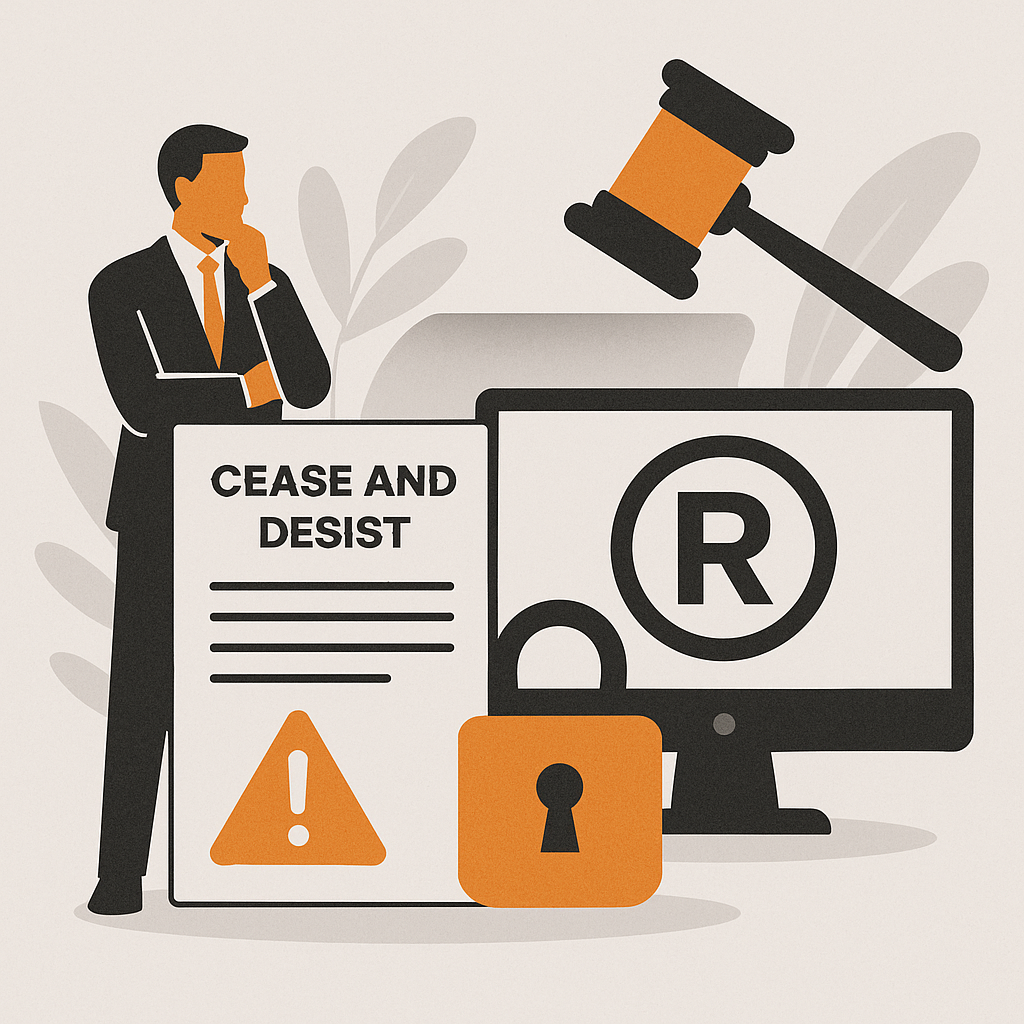
A flat-style digital illustration using orange, black, and gray tones to represent online brand protection and trademark enforcement. The scene features a businessman in a suit thoughtfully examining a large “Cease and Desist” letter with a warning symbol. Beside him, a computer monitor displays the registered trademark symbol (®), while a padlock and a judge’s gavel emphasize legal authority and content security. Stylized leaf shapes in the background add a modern, professional touch.


Building and Maintaining Trademark Portfolios

Protecting your online brand isn’t just about reacting—it’s about proactive ownership. At Masterly Trademarks, we help businesses build strong trademark portfolios through smart registration and monitoring practices.

A portfolio includes:

  • Trademarks for your core brand
  • Related service marks
  • Alternate logos and taglines
  • Key product and campaign names


The broader your portfolio, the easier it is to stop copycats and assert legal rights.


Monitoring for Infringement in Real Time

Ongoing brand protection requires vigilance. We use tools and systems that continuously scan the web for signs of infringement on behalf of our clients marks.

Monitoring includes:

  • Brand impersonation on social platforms
  • Counterfeit goods in e-commerce
  • Unauthorized use of your brand names
  • Competitors mimicking your marketing


Early detection allows for faster enforcement and less damage to your brand's reputation.


Legal Support in Foreign Jurisdictions

If your business operates internationally, infringement may occur outside the U.S. We work with foreign associates to ensure your intellectual property protection extends globally.

We can help you:

  • File in foreign trademark offices
  • Coordinate litigation abroad
  • Monitor international ip assets
  • Respond to global infringements


Whether you're dealing with European sellers or counterfeiters in Asia, our trademark team supports you across borders.


When to Involve an Attorney

While some actions like DMCA notices can be self-initiated, most effective enforcement requires the experience of attorneys who understand trademark law and litigation.

An attorney helps you:

  • Determine the best strategy for enforcement
  • Navigate state courts and federal courts
  • Manage responses to appeal board rulings
  • Provide practical advice tailored to your brand's needs


Our lawyers work directly with clients to ensure every move is calculated, compliant, and impactful.


Protecting Brand Value for the Long Term

Your brand is more than just a name. It’s a collection of trust, value, and experience you’ve built with your customers. Legal enforcement is how you protect that investment.


By using legal tools to defend your identity, you're preserving the integrity of your company, your goods or services, and your relationship with customers.


The True Cost of Ignoring Online Infringement

Inaction in the face of trademark infringement can result in:

  • Lost revenue to counterfeiters
  • Confused or misled customers
  • Damaged brand reputation
  • Weakened legal claims in the future


Online unfair competition is relentless. The sooner you act, the easier it is to shut it down and prevent long-term harm.


How Masterly Trademarks Assists Clients with Enforcement

At Masterly Trademarks, we don’t just register your trademark—we help you protect and enforce it. Our team works closely with businesses of all sizes to implement tailored enforcement plans.

We:

  • Conduct availability searches
  • File and manage trademark registration
  • Draft and send cease-and-desist letters
  • Initiate TTAB and court proceedings
  • Collaborate with foreign associates for international cases


Our goal is to give your brand the legal power it needs to thrive.


Speak with Our Attorneys About Online Brand Protection

Your online brand deserves more than surface-level security. At Masterly Trademarks, we offer experienced legal support to assist clients in defending their brand through proven legal tools, including DMCA takedowns, cease-and-desist actions, and court litigation.


If you’re facing misuse of your trademarks, or just want to build a proactive brand protection plan, we’re ready to guide you through the next stage.

Contact us at (972) 236-5051 to schedule a free consultation. Let’s put the legal power behind your brand and ensure your identity remains yours—online and worldwide.

(972) 236-5051

You might also like

Copyright notice guidance for protecting original creative work.
By Amber Aniston August 14, 2026
A copyright notice is one of the simplest tools a business can use to protect original content, yet many creators skip it entirely. Here is how to write one, where to place it, and why it still matters. Why Copyright Notices Still Matter in 2026 Copyright protection is automatic upon creation of a work. The moment you write a blog post, design a logo, or record a video, that work is protected by copyright under US law. No filing, no fee, no stamp required. But "protected" and "easy to enforce" are two different things, and a visible copyright notice closes the gap between them. Consider a concrete scenario. A small consulting firm publishes a 3,000-word guide on its website in 2026. A competitor copies it verbatim and posts it on their own site. If the original page carries a clear notice in the website footer ("© 2022–2026 Horizon Analytics LLC. All Rights Reserved."), the firm has immediate evidence that the copyright infringer had notice of ownership. Under Section 401(d) of the Copyright Act, that notice blocks the "innocent infringement" defense, which could otherwise reduce damages. Without the notice, the competitor might argue they were unaware the content had an owner. A copyright notice is not the same as copyright registration with the US Copyright Office, and it is not a takedown request or a lawsuit. It is a signal and a piece of evidence, not a remedy. This article focuses on US copyright law after the Berne Convention implementation (March 1, 1989), while noting where international practice runs parallel. By the end, you will be able to write and place a professional copyright notice on your site, app, or publication. What Is a Copyright Notice? (And What It Is Not) A copyright notice is a short copyright statement placed on or near a work that informs users the work is protected and identifies who owns it. A complete copyright notice typically contains three core elements: the copyright symbol (©), the year of first publication, and the copyright owner's name. An optional rights statement like "All Rights Reserved" can follow. A notice is not copyright registration, not a license defining how others may reuse your work, and not a legal agreement. It informs the public of your ownership rights, but it does not substitute for the formal registration process or enforcement action. Copyright protection does not require the inclusion of a notice in the US after March 1, 1989, when the United States joined the Berne Convention. Before that date, omitting a notice on works published could push content into the public domain. Today, notice is optional. Yet businesses, publishers, and software companies worldwide still use notices on websites, mobile apps, books, and software because the practical benefits remain strong. Copyright Law Basics Behind a Copyright Notice To understand why notices carry weight, start with how copyright protection arises. Under US copyright law, protection begins automatically when an original work is fixed in a tangible form, whether that is a written page, a digital file, or a sound recording. Copyright protects original works like music and literature, covers artistic works including paintings and photographs, and extends to architectural works, literary works, and even sculptural work. Copyright does not protect ideas, only their expression. The copyright owner may be the individual author, a company (for works made for hire), or an assignee. The Copyright Act grants exclusive rights to reproduce, distribute, display, perform, and create derivative works. A notice helps signal these rights to the public and removes ambiguity about ownership. Copyright lasts for the author's life plus 70 years after the author's death. Works made for hire have copyright for 95 years from publication. Copyright for works created before 1978 varies in duration. Copyright law allows owners to enforce their rights against infringers, but enforcement requires monitoring, registration, and sometimes litigation. The US Copyright Office handles copyright registration and recordation, which is separate from simply adding a copyright symbol or statement. Key Elements of an Effective Copyright Notice Most modern copyright notices follow a simple pattern. A notice includes the © symbol, year, and owner's name. For example: "© 2026 Masterly Trademarks. All rights reserved." The sections below break down each element with specific formatting and examples for websites, documents, and other publications. Copyright Symbol or Word A copyright notice must include the copyright symbol ©. The symbol is universally recognized and recommended for use across all formats. Alternatively, the word "Copyright" or the abbreviation "Copr." satisfies the statute. Most practitioners use © because it is compact and one of the most familiar symbols in publishing. Typing tips: on Windows, press Alt+0169 on the numeric keypad. On macOS, press Option+G. The shorthand "(c)" (a letter c in parentheses) is not the same Unicode character and is not a legal substitute, though some software auto-replaces it. For sound recordings, use the ℗ symbol instead of ©. That symbol designates rights in the phonorecord itself, separate from any underlying musical composition, and is defined in Section 402 of the Copyright Act. Copyright Year (or Range of Years) The copyright date should only state the year of publication. The year of first publication indicates when the work was first published or made publicly available. For a website, this is typically the year the site or its key content went live. When to use a range: if your website or app receives continuous updates, a date range like "© 2018–2026" signals active maintenance. For static works (a printed report, a one-time PDF), the original publication year alone is sufficient. An inaccurate or obviously outdated year does not automatically forfeit copyright protection, but it can undermine professionalism and weaken deterrence. Copyright Owner's Name A copyright notice should include the copyright owner's name, specifically the legal name of the individual or entity that holds the rights. Use the full registered business name that appears in contracts and on invoices. Concrete examples: © 2026 Olivia Chen © 2022–2026 Horizon Analytics LLC © 2026 City of Dallas For joint authorship, list all owners. For works made for hire, the employer or commissioning party is the copyright owner, not the individual who created the work. Pen names are acceptable if they are reasonably connected to the real owner. Optional Rights Statement A copyright notice can include a statement of rights like "All Rights Reserved." Under US copyright law, all rights are reserved by default, even without the phrase, but including it reduces confusion about what is permitted. Variations by business goal: "All rights reserved. No part of this publication may be reproduced without prior written permission." "Some rights reserved; see license page." "Licensed under CC BY-NC 4.0." Avoid overbroad claims that conflict with fair use or other limitations in the Copyright Act. A rights statement that overreaches does not expand your legal rights and may invite scrutiny. How to Write a Copyright Notice Step by Step Follow this sequence: Identify the owner. Determine who legally owns the work. Use their full legal name. Pick the year. Use the year of first publication. For continuously updated content, use a range ending in the current year. Choose a rights statement. Decide whether to include "All Rights Reserved" or reference a specific license. Assemble. Place them in order: symbol, year, owner, rights statement.
Work for hire agreement outlining ownership of contractor creative work.
By Amber Aniston August 14, 2026
Protect your business by understanding work for hire agreements. Learn how to secure copyright ownership of contractor creative work, avoid common mistakes, and ensure your intellectual property rights before payment.
DMCA takedown documentation and evidence preparation for content removal.
By Amber Aniston August 13, 2026
Learn what businesses and creators should document before sending a DMCA takedown notice. Covers copyright ownership evidence, infringement documentation, platform rules, and when to get attorney-guided support.

Book a Service Today