Trademark Portfolio Management for Multi-Brand Companies

Trademark portfolio management is the coordinated process of tracking, protecting, maintaining, and enforcing every trademark your organization holds - registered, pending, and unregistered - across products, services, and territories. For multi-brand companies operating across the U.S., EU, and global markets in 2026, this discipline goes far beyond filing trademarks one by one. A trademark portfolio includes registered and unregistered trademarks, and managing them as a system is what separates resilient brand owners from those exposed to preventable losses.
The urgency is real. Global trademark filing activity remains enormous, with approximately 15.2 million classes filed in 2023–2024 according to WIPO data. Online infringement accelerates faster than ever, and frequent M&A activity shifts brands between entities - often without proper assignments. Effective trademark portfolio management aligns IP assets with business goals, and a well-managed portfolio maximizes brand value and prevents costly disputes.
This article is for executives, in-house counsel, and law firms responsible for complex brand portfolios. You will learn what a strong portfolio strategy looks like in practice, what commonly goes wrong, and how professional guidance reduces risk and cost.
From Brand Portfolio Strategy to Trademark Portfolio Management

Every brand portfolio strategy has a legal counterpart. The way your company structures its brands - branded house, house of brands, or hybrid - directly determines how many trademarks you need, where to file, and how aggressively to enforce. Brand architecture defines relationships between brands in a portfolio, and those relationships dictate the scope and complexity of your trademark program.
Consider Marriott, which managed 30 hotel brands after acquiring Starwood in 2016. Each brand required its own registrations, ownership recordals, and enforcement playbook. Contrast that with a mono-brand tech company filing a single word mark and logo globally. A multi-brand strategy allows reaching a broader market segment, but it multiplies trademark obligations exponentially. Research consistently shows that 70% of a company's revenue often comes from 25% of its brands, which means prioritization matters.
A brand portfolio strategy maximizes market coverage and minimizes overlap - but only when trademark registration plans mirror those strategic decisions. When marketing launches a new brand extension without legal clearance in key jurisdictions, the result is exposure, rebrand costs, and lost time. A trademark strategy should align with overall brand and business objectives at every stage.
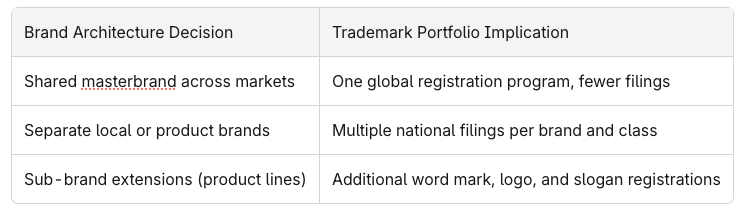
A winning brand portfolio strategy begins when business planning and legal protection move in the same direction.
Core Components of an Effective Trademark Portfolio
Most multi-brand portfolios contain several building blocks that must be intentionally designed and documented. The main asset categories include word marks (house marks, product names, slogans), figurative marks such as logos, non-traditional marks (trade dress, colors, sounds where allowed), and defensive or blocking marks filed to prevent competitors from occupying adjacent space.
Ownership records form the backbone of enforcement. Each mark should be tied to the correct legal entity, with a clear chain of title covering assignments, mergers, and license arrangements. After acquisitions, companies must record assignments with the relevant registries - failure to do so can block enforcement or complicate licensing. Companies should know the current status of each trademark at all times.
International coverage requires deliberate choices. International trademark registration often utilizes the Madrid Protocol, but some jurisdictions like Canada or Brazil favor direct national filings due to stricter local requirements. From a lifecycle perspective, every mark moves through application, examination, publication, opposition, registration, and then ongoing obligations - use requirements, renewals, and proof of use. Consistent use of trademarks strengthens rights and brand recognition over the life of each registration.
Trademark Renewal Management, Deadlines, and Use Requirements

Trademark renewal management is where many portfolios quietly fail. After registration, ongoing obligations determine whether your rights survive - and missing a single deadline can erase years of investment. Proactive maintenance is vital for safeguarding intellectual property assets.
The U.S. maintenance timeline for a standard federal registration works as follows:
Year 5–6: First Maintenance Checkpoint - File a Section 8 Declaration of Use proving the mark is in actual commerce. Failure results in cancellation.
Year 9–10: Combined Renewal - File a combined Section 8 and Section 9 renewal. Grace periods exist but carry surcharges. This cycle repeats every ten years.
Madrid Protocol Registrations - International registrations renewed via WIPO every ten years do not substitute for local maintenance events. U.S. designations from Madrid still require Section 8 and 9 filings independently. Monitoring trademark renewals helps avoid legal risks and losses across both systems.
For EU marks, EUIPO renewals follow a ten-year cycle with a six-month grace period and 25% surcharge for late filing. No proof of use is required at renewal, though non-use can trigger revocation in separate proceedings.
Best practices for your renewal calendar include centralized docketing with automated reminders at 12, 6, and 3 months before each deadline. Docketing systems help track renewal deadlines and ensure compliance. Tracking payment confirmations helps manage trademark renewal deadlines, and comprehensive data verification reduces trademark renewal risk.
Regular review of actual use is essential. Delete goods and services no longer in use, avoid overclaiming that invites cancellation challenges, and file non-use declarations only when truly excusable. 1.5 million trademarks are under management by Clarivate alone - the scale of modern portfolios demands disciplined systems, not spreadsheets.
Monitoring, Enforcement, and Risk Control Across a Portfolio
Registration is only the beginning. Trademarks must be monitored for potential infringements and unauthorized use - and for multi-brand organizations, that monitoring must operate at scale. Effective management tracks competitors and monitors for infringing marks across every priority market.
Key monitoring layers include:
- Watch services - Formal trademark watches against newly published filings in priority jurisdictions to catch confusingly similar marks early
- Online marketplace and domain monitoring - Detecting counterfeit sellers, typosquatters, and unauthorized use on e-commerce platforms
- Social media monitoring - Tracking handles and brand mentions when launching new offerings or entering new customer segments
Companies should conduct clearance searches before adopting new trademarks. A centralized intake process for new product names - with mandatory clearance checks before packaging, app releases, or marketing campaigns - prevents conflicts before they begin. Best practices for managing trademarks include regular audits and monitoring at every stage.
Real-world scenario: A global consumer goods company discovered in 2025 that a copycat brand had launched under a nearly identical name in Southeast Asia. Because the company lacked a registration in that market, enforcement options were limited to customs enforcement and cease-and-desist letters - a far more expensive and uncertain path than a timely filing would have been.
Useful KPIs to track include number of conflicts identified pre-launch, successful oppositions, and average response time to infringement reports.
Governance, Ownership Records, and Collaboration with Law Firms

Strong portfolio management depends on governance: clear roles, accurate ownership records, and structured collaboration with law firms. Legal counsel should coordinate trademark strategy across departments - brand, product, marketing, and finance.
Ownership records should document the current owner entity, chain of title including assignments and mergers, and license arrangements with subsidiaries or distributors. Licensing agreements can monetize underused trademarks for revenue generation when brands are being phased out or repositioned. Regular portfolio audits help identify underused or outdated trademarks that drain resources without delivering value.
Common failure points after mergers include brands housed in different subsidiaries with inconsistent owner names between registrations and packaging, or unrecorded assignments that delay enforcement. These gaps create risk that third parties or licensees may attempt to claim rights.
In-house teams should provide law firms with centralized instructions and harmonized filing strategy across jurisdictions. Periodic portfolio audits - ideally every Q1 - should cover coverage gaps, ownership issues, unused marks, and upcoming deadlines. Structured collaboration also controls outside counsel spend by preventing duplicate searches, overlapping defensive filings, or missed renewals requiring costly reinstatement. Law firms can leverage over 50 years of trademark maintenance expertise, and 200+ trademark professionals are available for trademark maintenance support across major global platforms.
Building a Forward-Looking Filing Strategy and When to Seek Professional Help
There is a clear line between reactive filing - protecting marks only after marketing selects them - and a proactive filing strategy aligned with three- to five-year brand portfolio roadmaps. The companies that invest in forward-looking coverage protect strong brands before competitors or counterfeiters force their hand.
Prioritize core house marks and key product brands, countries driving 80% of revenue plus high-risk markets, and classes of goods and services reflecting realistic expansion plans. Strategic questions matter: where will you expand by 2028? Which brands might you divest? Which will go direct-to-consumer? These answers determine where to renew, where to file new, and where to let non-core marks lapse.
Contact Masterly Trademarks today to request a comprehensive trademark portfolio review. Whether you need help managing renewals, resolving ownership records, or developing a strategic filing plan, our experienced team is ready to support your brand’s growth and protection. Take the crucial step to unlock stronger trademark control and avoid costly risks. Visit https://www.masterlytrademarks.com/ or call (972) 236-5051 to get started.
You might also like