When to Use a Trademark Office Action Attorney
Receiving a trademark Office Action from the United States Patent and Trademark Office can be discouraging, especially if you believed your application was ready for registration. Many business owners are unsure whether the refusal is minor, whether additional information is needed, or whether the application is at risk of being abandoned. A missed deadline or an incomplete response may delay registration or affect your trademark rights. Working with an experienced trademark office action attorney helps you understand the issues, evaluate your options, and prepare a strategic response.
Masterly Trademarks represents businesses, entrepreneurs, and organizations responding to substantive and procedural Office Actions issued by the USPTO. Whether you need a USPTO office action lawyer to address legal refusals or a trademark refusal attorney to evaluate complex trademark issues, our attorneys provide practical legal guidance designed to protect your brand and move your application forward whenever possible.
A timely and well-prepared response can make an important difference in the trademark registration process.
Why You Should Contact a Trademark Office Action Attorney Early
Many applicants assume an Office Action means their trademark application has been denied.
In reality, an Office Action is often a request for additional information, clarification, or legal argument before the examining attorney decides whether registration should proceed.
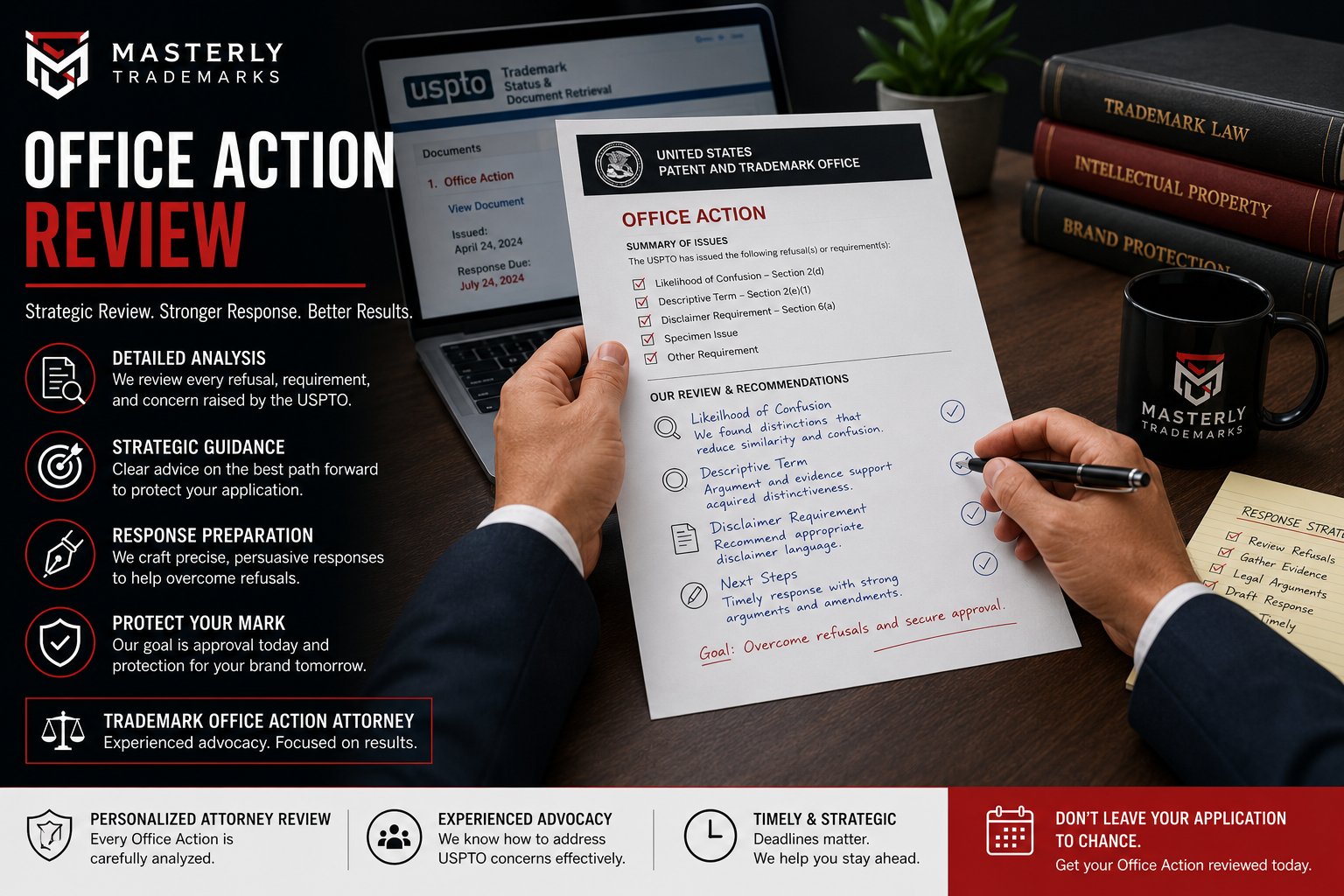
An experienced trademark office action attorney helps businesses understand the specific issues identified by the USPTO and develops an appropriate legal strategy based on the facts of each application.
Early legal review helps applicants avoid unnecessary delays and procedural mistakes.
Understanding a USPTO Office Action
Every trademark application is reviewed by a USPTO examining attorney.
If questions arise during that review, the examining attorney may issue an Office Action explaining the legal or procedural concerns that must be addressed before the application can continue.
A knowledgeable USPTO office action lawyer reviews the examining attorney's findings, explains what they mean, and prepares responses that directly address the issues raised.
Every Office Action deserves careful legal evaluation.
Why Businesses Work With a Trademark Refusal Attorney
Not every refusal involves the same trademark application challenges.
Some Office Actions involve technical corrections, while others require legal arguments supported by evidence and trademark law.
A skilled trademark refusal attorney helps businesses understand the nature of the refusal and prepares responses designed to address the examining attorney's concerns based on the client’s unique circumstances.
Each application requires an individualized legal strategy.
Addressing a Likelihood of Confusion Refusal
One of the most common substantive refusals involves likelihood of confusion.
The USPTO may conclude that a pending application is too similar to an existing registered trademark or previously filed application for related goods or services.
Masterly Trademarks carefully reviews the cited registrations, evaluates the legal issues, and prepares arguments supported by applicable trademark law when appropriate.
Every likelihood of confusion analysis depends on the specific facts of the application.
Responding to Descriptiveness Refusals
Another common issue involves descriptiveness.
The USPTO may determine that a proposed trademark merely describes the goods or services rather than identifying their commercial source.
Our attorneys review the examining attorney's reasoning, evaluate available legal arguments, and determine the most appropriate response based on the specific trademark and supporting evidence.
Understanding the basis of the refusal is essential before responding.
Resolving a Specimen Refusal
Some Office Actions involve a specimen refusal.
In these situations, the examining attorney concludes that the submitted specimen does not properly show use of the trademark in commerce according to USPTO requirements.
Masterly Trademarks reviews the submitted materials, evaluates available options, and prepares responses that address the concerns identified by the examining attorney.
Proper documents are an important part of the registration process.
Making an Identification Amendment
An Office Action may also request an identification amendment.
This often involves clarifying or revising the description of the goods or services covered by the application.
Our attorneys prepare amendments that comply with USPTO requirements while helping businesses maintain trademark protection consistent with their branding objectives.
Accurate identification helps avoid unnecessary delays during examination.
Understanding the Six-Month Deadline
A non-final office action commonly carries a six-month deadline for submitting a complete response.
Failure to respond within the required period generally results in abandonment of the application unless other procedures apply.
The first office action is often issued at this stage, giving applicants a chance to address issues before any final refusal.
Masterly Trademarks carefully monitors deadlines and handles each official notice from the USPTO promptly so clients remain in compliance with USPTO requirements.
Meeting every filing deadline is an essential part of protecting your application.
Protecting Your Brand Throughout the Registration Process
A trademark application often represents months or years of planning, branding, and business development, and it often reflects the trademark goals of a growing brand or business.
An Office Action should not be viewed as the end of the registration process but as an opportunity to address the examining attorney's concerns with experienced legal guidance while avoiding the legal and business risks of a weak response.
Our attorneys help businesses and companies respond strategically while protecting the long-term value of their brands.
Every response should support both registration and future business growth.
Why Businesses Choose Masterly Trademarks
Businesses choose Masterly Trademarks because we provide attorney-guided trademark representation on behalf of clients facing office actions, focused on practical business solutions.
Our services include:
- Representation from an experienced trademark office action attorney
- Guidance from a knowledgeable USPTO office action lawyer
- Representation by a trademark refusal attorney
- Responses involving likelihood of confusion
- Legal analysis of descriptiveness refusals
- Assistance with a specimen refusal
- Preparation of an identification amendment
- Management of the six-month deadline
- Strategic legal guidance throughout the trademark examination process
- Dedicated service for trademark office action responses
Every client receives personalized legal advice tailored to the facts of the application, the client’s intent, and the goals of the business.
Frequently Asked Questions
What does trademark office action response service cost?
Many trademark attorneys offer flat fee options for responding to office actions. Our firm uses transparent flat-fee pricing: non-final substantive responses start at approximately $1,500, final office action responses at approximately $2,000, and minor procedural responses at approximately $1,000, with pricing depending on the type of refusal, the complexity of the response, and whether the goal is securing federal trademark registration. These fees are separate from USPTO government filing fees, which run approximately $250–$350 per class. We provide a complete cost breakdown before you commit, so there are no surprises.
How quickly can you respond to my trademark office action?
We review every new case within 24–48 hours of contact. Responses to office actions are typically due within six months (three months from issuance, with a possible three-month extension). For most clients, we prepare and file a complete response within 4–6 weeks, though urgent situations can be accommodated faster. We'll also evaluate whether filing for an extension makes strategic sense to allow time for thorough evidence gathering.
What happens if my office action response is unsuccessful?
If a final office action is issued and your application is rejected, you may still have several options. You can file a Notice of Appeal with the Trademark Trial and Appeal Board, or you can submit a request for reconsideration. These proceedings can resemble litigation between the parties and require strategic evaluation.
You can also submit a new application for a revised trademark, which may involve updating product packaging or marketing materials, or explore negotiating co-existence with conflicting mark owners. We discuss realistic expectations for each path, including success rates, costs, and timelines, so you can make an informed decision. The USPTO recommends using an attorney to navigate these trademark application processes - and we'll guide you through every option, including matters that may be resolved through reconsideration, appeal, or alternative filing strategies depending on the circumstances.
Have Your Trademark Office Action Reviewed
Every day you wait to respond to your USPTO office action brings you closer to abandonment - and losing the trademark rights you've worked to build. A U.S.-licensed attorney is recommended for filing with the USPTO, and our team has the expertise and track record to properly submit your filing through legitimate USPTO procedures so your application has the best chance of being approved. Don't let a fixable legal issue derail your trademark registration process; a strategic response can improve your chances of getting your mark approved and preserving your trademark rights.
Masterly Trademarks
Website:
https://www.masterlytrademarks.com/
Phone:
(972) 236-5051
You might also like