What a Trademark License Agreement Should Protect
Allowing another company to use your trademark can create valuable business opportunities, but it can also introduce significant legal and business risks if the agreement is not carefully prepared. Your brand represents your reputation, customer trust, and years of investment. A poorly written licensing agreement may create confusion, weaken your trademark rights, or lead to disputes that affect your business. Working with an experienced trademark licensing attorney helps businesses protect their intellectual property while supporting responsible brand growth.
Masterly Trademarks represents business owners, entrepreneurs, and organizations that license trademarks, logos, product names, and service brands. Whether you need a trademark license agreement lawyer to prepare a new agreement or a brand licensing attorney to review an existing arrangement, our attorneys provide practical legal guidance tailored to your business objectives.
Protecting your trademark means protecting the value of your business.
Why You Should Work With a Trademark Licensing Attorney
Licensing a trademark involves much more than giving another business permission to use a name or logo.
A licensing agreement establishes legal rights, business responsibilities, and expectations for both parties. Without careful planning, misunderstandings may affect your trademark rights and your company's reputation.
An experienced trademark licensing attorney helps businesses prepare agreements that clearly define each party's responsibilities while protecting valuable intellectual property.
Careful planning today helps reduce legal disputes tomorrow.
Why Trademark Licensing Matters for Intellectual Property
Many businesses expand by allowing trusted partners, distributors, manufacturers, or affiliates to use their trademarks.
A properly prepared agreement allows a business to grow while maintaining control over how its brand is presented to customers.
Masterly Trademarks works with clients to develop licensing strategy and trademark portfolio management that support both business growth and long-term trademark protection.
Every licensing relationship deserves careful legal planning.
Working With a Trademark License Agreement Lawyer
Every licensing arrangement is different.
Some agreements involve product manufacturing, while others involve retail sales, promotional partnerships, franchise relationships, or service providers.
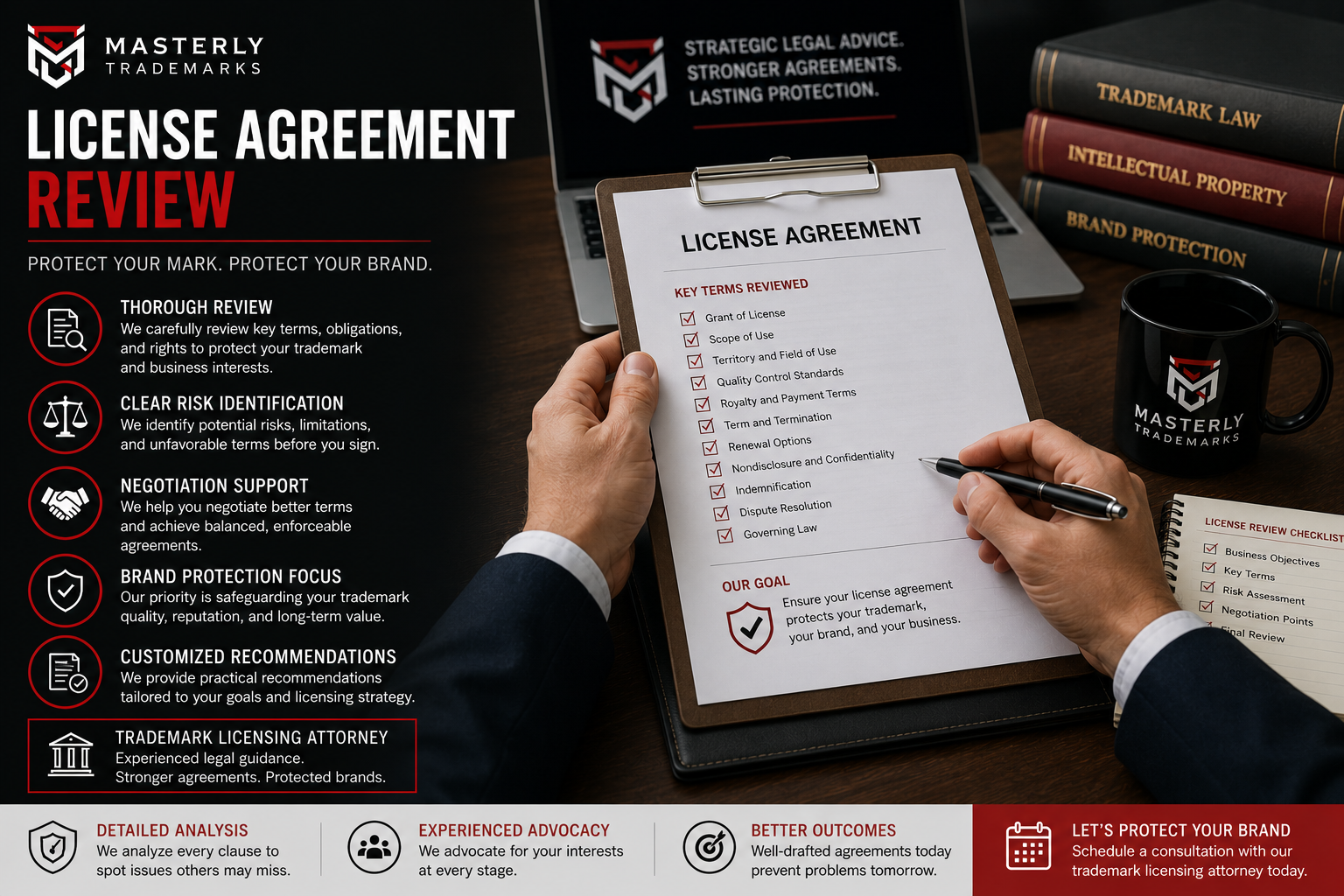
A knowledgeable trademark license agreement lawyer reviews the specific goals of the parties, helps with negotiation of terms that match their business goals, and prepares a formal contract that reflects the unique needs of each business.
Customized agreements provide greater clarity than generic forms.
Protecting Your Brand With a Brand Licensing Attorney
Your trademark is often one of your company's most valuable business assets.
A skilled brand licensing attorney helps businesses protect their trademarks while allowing carefully controlled use by approved licensees.
Maintaining legal protection requires more than granting permission to use a brand. It requires thoughtful legal planning that supports both compliance and long-term brand value.
Strong legal guidance helps preserve your intellectual property.
Establishing Quality Control
One of the most important parts of many licensing agreements involves quality control.
Trademark owners often establish standards governing how products or services are presented under the licensed brand.
Maintaining appropriate quality standards helps preserve customer confidence and protect the legal strength of the trademark itself.
Masterly Trademarks helps businesses develop licensing provisions that support consistent brand presentation.
Defining the Licensed Territory in Joint Ventures
A licensing agreement should clearly define the approved territory where the trademark may be used.
Some licenses apply nationwide, while others are limited to particular states, countries, or distribution channels.
Clearly defining geographic rights helps reduce misunderstandings between the parties.
Careful drafting provides greater certainty throughout the relationship.
Structuring Royalties
Many licensing agreements include provisions governing royalties.
The agreement should explain how payments are calculated, when they are due, what records may be required to verify compliance, and how amounts are determined by the contract terms, the benefits the parties want from a particular royalty structure, and, where relevant, the value of related patents tied to the licensed rights.
Some businesses also use licensing arrangements alongside financing plans to support commercialization or growth.
Careful negotiation can affect revenue expectations and the value of the licensed intangible assets.
Our attorneys prepare licensing agreements that clearly address financial obligations while supporting productive business relationships.
Clear expectations help reduce future disputes.
Establishing the Term of the Agreement
Every licensing agreement should define its term.
The agreement should identify when the license begins, how long it remains in effect based on the useful life of the licensed rights, and whether renewal options are available.
Clearly stated terms help both parties understand the duration of the business relationship.
Proper planning supports long-term stability.
Planning for Termination
Business relationships sometimes change over time.
A licensing agreement should explain the circumstances that may lead to termination, including the responsibilities of each party after the agreement ends and how any dispute will be handled if the relationship ends or breaks down.
Termination provisions may also address whether any continued use requires prior consent and which post-termination obligations survive the agreement.
Addressing these issues before problems arise helps reduce uncertainty if the relationship changes.
Related commercial contracts, including supply agreements, may also need coordinated termination terms when trademark use is tied to product manufacture or distribution.
Preparation provides greater clarity for everyone involved.
Protecting Against Trademark Infringement with Federal Trademark Registration
Licensing agreements should also address potential infringement concerns.
The agreement may establish procedures for reporting suspected unauthorized use, protecting trademark rights, and responding to potential violations, including enforcement disputes in federal courts, proceedings before the Trademark Trial and Appeal Board, and domain-name matters under ICANN's UDRP as companies seek to protect their marks online and offline.
Anti-counterfeiting strategies may also include efforts to seek seizure of counterfeit goods when appropriate.
Masterly Trademarks helps businesses prepare agreements that support ongoing protection of valuable intellectual property.
Protecting your trademark requires continued attention.
Preserving Goodwill
A successful trademark represents years of customer confidence and positive business relationships.
That reputation, often referred to as goodwill, is one of the most valuable assets associated with a trademark.
Licensing agreements should help preserve goodwill by ensuring that goods or services sold under the brand, and materials owned or controlled by the licensor, continue reflecting the standards customers expect.
Protecting goodwill helps strengthen long-term brand value.
Why Businesses Choose Masterly Trademarks for Extensive Experience
Businesses choose Masterly Trademarks because we provide attorney-guided trademark services focused on protecting valuable brands, supporting responsible business growth, and helping clients work with a U.S.-licensed attorney on broader trademark portfolio management and infringement-related matters.
Our services include:
- Representation from an experienced trademark licensing attorney
- Guidance from a knowledgeable trademark license agreement lawyer
- Strategic advice from a brand licensing attorney
- Drafting provisions involving quality control
- Defining licensed territory
- Structuring royalties
- Establishing the agreement term
- Planning for termination
- Addressing potential infringement
- Protecting trademark goodwill
- Support for in-house trademark searches and portfolio management as part of ongoing brand protection, including the knowledge needed to handle online and technology-related trademark issues
- Cybersecurity laws can affect intellectual property protection in digital licensing matters, including data protection and privacy disclosures, and Duane Morris brings over a decade of cybersecurity experience to this area
- Coordination with global relationships with law firms when international trademark protection is needed
- Attorney-guided support on online advertising and branding issues, including comparative and false advertising matters, clearance of advertising copy and content, promotions such as sweepstakes and contests, and guidance on mobile marketing regulations
Every licensing agreement is prepared based on the client's business objectives, industry, and long-term branding strategy.
Legal Counsel That Supports Business Growth and Trademark Licensing
Trademark licensing involves many aspects of a business relationship beyond simply allowing another company to use a brand. Our attorneys counsel clients and assist clients with a broad range of trademark licensing matters, including commercial transactions, brand expansion, and agreements involving certain types of products and services.
As businesses adopt other technologies, expand into new markets, or increase book sales and branded merchandise, trademark agreements should evolve to support those changes. We work closely with each team to address licensing issues specifically related to their industry while helping them manage growing business demand, brand integration, and day-to-day operations.
Whether your organization is managing a single trademark or an expanding portfolio, we prepare agreements that promote clarity, protect intellectual property, and reflect the parties' mutual respect for the brand. Our legal services also consider practical business concerns such as staffing, labor relationships where applicable, and the important job your trademarks perform in building customer recognition and long-term business value.
Frequently Asked Questions
How much does trademark licensing legal representation cost?
Cost depends on several factors: the complexity of the mark, number of products or services involved, number of territories, exclusivity provisions, and whether international counsel is required. We offer transparent fee structures including hourly rates, flat fees for defined scope engagements, and blended arrangements. An initial consultation allows us to assess your situation and provide a clear estimate before work begins.
How long does it take to negotiate a trademark licensing agreement?
Simple domestic agreements can typically be drafted and finalized within a few weeks. Complex international or exclusive deals - particularly those involving multiple territories, significant royalties, coordination with foreign counsel, or broader commercial relationships such as strategic alliances - may take several months. Factors that influence timeline include the responsiveness of both parties, the extent of due diligence required, and whether existing disputes or competing claims must be resolved, including when mediation or arbitration affects timing as the parties are negotiating resolution. Timing can also depend on development issues when a license involves technology, software, or regulated products such as devices. Expedited options are available for urgent licensing needs.
What protections should be included in trademark licensing agreements?
Every well-drafted licensing agreement should include quality control provisions that preserve brand integrity, clearly defined territorial restrictions, and exclusivity terms that match the business relationship, while also aligning with applicable act-based requirements and other laws affecting trademark use and enforcement. Agreements involving digital branding, software, or online content may also need added copyright and other ip protection provisions, including when marks appear alongside music or other creative assets.
Termination rights for material breach, insolvency, or failure to meet minimum sales thresholds are essential. Audit rights allow the licensor to verify royalty statements and sales data. Ownership issues can also extend to materials created by contractors and in employment relationships. Online use can also raise copyright registration, ownership, and user-generated content concerns, and the DMCA may affect enforcement within a domain name system context. For international agreements, jurisdiction clauses, governing law provisions, and cross-border tax structures must also be addressed.
Rapid technology changes, AI tools, phishing, fraudulent emails, and privacy or data-protection disclosures can create additional legal issues that the agreement should address under applicable laws. Some licensing structures also intersect with resources, manufacturing systems, or other operational arrangements depending on the business. The specific protections depend on the nature of the asset, the industry, and the parties involved - which is why working with an attorney who has deep experience in these agreements matters.
Discuss a Trademark Licensing Agreement
Licensing your trademark can create valuable opportunities for growth, but every agreement should be carefully prepared to protect your intellectual property, your reputation, and your long-term business interests.
Masterly Trademarks provides experienced legal guidance from a trademark licensing attorney for businesses seeking to license valuable brands. Whether you need a trademark license agreement lawyer, advice from a brand licensing attorney, assistance establishing quality control, defining territory, structuring royalties, setting the agreement term, planning for termination, addressing potential infringement, or protecting your trademark goodwill, our attorneys are prepared to help with negotiating and enforcing trademark licensing agreements, including for clients who seek licensing structures that fit broader business relationships such as technology partnerships and related commercial arrangements.
Masterly Trademarks
Website: https://www.masterlytrademarks.com/
Phone: (972) 236-5051
You might also like