Copyright Notice: What It Is, How to Write One, and Where to Use It
A copyright notice is one of the simplest tools a business can use to protect original content, yet many creators skip it entirely. Here is how to write one, where to place it, and why it still matters.
Why Copyright Notices Still Matter in 2026
Copyright protection is automatic upon creation of a work. The moment you write a blog post, design a logo, or record a video, that work is protected by copyright under US law. No filing, no fee, no stamp required. But "protected" and "easy to enforce" are two different things, and a visible copyright notice closes the gap between them.
Consider a concrete scenario. A small consulting firm publishes a 3,000-word guide on its website in 2026. A competitor copies it verbatim and posts it on their own site. If the original page carries a clear notice in the website footer ("© 2022–2026 Horizon Analytics LLC. All Rights Reserved."), the firm has immediate evidence that the copyright infringer had notice of ownership. Under Section 401(d) of the Copyright Act, that notice blocks the "innocent infringement" defense, which could otherwise reduce damages. Without the notice, the competitor might argue they were unaware the content had an owner.
A copyright notice is not the same as copyright registration with the US Copyright Office, and it is not a takedown request or a lawsuit. It is a signal and a piece of evidence, not a remedy. This article focuses on US copyright law after the Berne Convention implementation (March 1, 1989), while noting where international practice runs parallel. By the end, you will be able to write and place a professional copyright notice on your site, app, or publication.
What Is a Copyright Notice? (And What It Is Not)
A copyright notice is a short copyright statement placed on or near a work that informs users the work is protected and identifies who owns it. A complete copyright notice typically contains three core elements: the copyright symbol (©), the year of first publication, and the copyright owner's name. An optional rights statement like "All Rights Reserved" can follow.
A notice is not copyright registration, not a license defining how others may reuse your work, and not a legal agreement. It informs the public of your ownership rights, but it does not substitute for the formal registration process or enforcement action.
Copyright protection does not require the inclusion of a notice in the US after March 1, 1989, when the United States joined the Berne Convention. Before that date, omitting a notice on works published could push content into the public domain. Today, notice is optional. Yet businesses, publishers, and software companies worldwide still use notices on websites, mobile apps, books, and software because the practical benefits remain strong.
Copyright Law Basics Behind a Copyright Notice
To understand why notices carry weight, start with how copyright protection arises. Under US copyright law, protection begins automatically when an original work is fixed in a tangible form, whether that is a written page, a digital file, or a sound recording. Copyright protects original works like music and literature, covers artistic works including paintings and photographs, and extends to architectural works, literary works, and even sculptural work. Copyright does not protect ideas, only their expression.
The copyright owner may be the individual author, a company (for works made for hire), or an assignee. The Copyright Act grants exclusive rights to reproduce, distribute, display, perform, and create derivative works. A notice helps signal these rights to the public and removes ambiguity about ownership.
Copyright lasts for the author's life plus 70 years after the author's death. Works made for hire have copyright for 95 years from publication. Copyright for works created before 1978 varies in duration. Copyright law allows owners to enforce their rights against infringers, but enforcement requires monitoring, registration, and sometimes litigation. The US Copyright Office handles copyright registration and recordation, which is separate from simply adding a copyright symbol or statement.
Key Elements of an Effective Copyright Notice
Most modern copyright notices follow a simple pattern. A notice includes the © symbol, year, and owner's name. For example: "© 2026 Masterly Trademarks. All rights reserved." The sections below break down each element with specific formatting and examples for websites, documents, and other publications.
Copyright Symbol or Word
A copyright notice must include the copyright symbol ©. The symbol is universally recognized and recommended for use across all formats. Alternatively, the word "Copyright" or the abbreviation "Copr." satisfies the statute. Most practitioners use © because it is compact and one of the most familiar symbols in publishing.
Typing tips: on Windows, press Alt+0169 on the numeric keypad. On macOS, press Option+G. The shorthand "(c)" (a letter c in parentheses) is not the same Unicode character and is not a legal substitute, though some software auto-replaces it.
For sound recordings, use the ℗ symbol instead of ©. That symbol designates rights in the phonorecord itself, separate from any underlying musical composition, and is defined in Section 402 of the Copyright Act.
Copyright Year (or Range of Years)
The copyright date should only state the year of publication. The year of first publication indicates when the work was first published or made publicly available. For a website, this is typically the year the site or its key content went live.
When to use a range: if your website or app receives continuous updates, a date range like "© 2018–2026" signals active maintenance. For static works (a printed report, a one-time PDF), the original publication year alone is sufficient. An inaccurate or obviously outdated year does not automatically forfeit copyright protection, but it can undermine professionalism and weaken deterrence.
Copyright Owner's Name
A copyright notice should include the copyright owner's name, specifically the legal name of the individual or entity that holds the rights. Use the full registered business name that appears in contracts and on invoices.
Concrete examples:
- © 2026 Olivia Chen
- © 2022–2026 Horizon Analytics LLC
- © 2026 City of Dallas
For joint authorship, list all owners. For works made for hire, the employer or commissioning party is the copyright owner, not the individual who created the work. Pen names are acceptable if they are reasonably connected to the real owner.
Optional Rights Statement
A copyright notice can include a statement of rights like "All Rights Reserved." Under US copyright law, all rights are reserved by default, even without the phrase, but including it reduces confusion about what is permitted.
Variations by business goal:
- "All rights reserved. No part of this publication may be reproduced without prior written permission."
- "Some rights reserved; see license page."
- "Licensed under CC BY-NC 4.0."
Avoid overbroad claims that conflict with fair use or other limitations in the Copyright Act. A rights statement that overreaches does not expand your legal rights and may invite scrutiny.
How to Write a Copyright Notice Step by Step
Follow this sequence:
- Identify the owner. Determine who legally owns the work. Use their full legal name.
- Pick the year. Use the year of first publication. For continuously updated content, use a range ending in the current year.
- Choose a rights statement. Decide whether to include "All Rights Reserved" or reference a specific license.
- Assemble. Place them in order: symbol, year, owner, rights statement.

Adapt the same pattern for videos (end credits), blog posts (footer or byline area), and software interfaces ("About" screens). Keep formatting consistent across all your copyrighted materials.
Where to Put Your Copyright Notice (Websites, Apps, and Beyond)
The placement of a copyright notice varies depending on the type of work being published. Placement should be visible, predictable, and consistent. In most cases, one notice for an entire website or app is acceptable, but high-value assets like downloadable PDFs or slide decks should carry their own notice. Placement does not create copyright protection, but it helps demonstrate that users were aware of the copyright holder's claim.
Website Copyright Notice Placement
Copyright notices should be placed in the footer of websites. The most common place for a website copyright notice is the global footer, visible on every page in a small but legible font. Pair it with links to your Terms of Use and Privacy Policy.
Example footer for 2026: "© 2020–2026 Masterly Trademarks. All rights reserved." with adjacent legal links. For long-form guides, downloadable resources, or gated content, consider adding a separate publication notice within the document itself.
Mobile Apps and Software Interfaces
Standard locations within mobile apps include the "About" screen, settings page, or splash screen. A 2026 iOS or Android app might display the notice alongside version information and trademarks. The copyright owner's name in the notice should match the publisher name in major app stores. Desktop software can place notices in the "About" dialog, installer screens, or main window footer.
Emails, PDFs, Presentations, and Other Content
Marketing and transactional email templates often include a short notice in the footer. For PDFs, whitepapers, and pitch decks, place the notice on the cover page and in the document footer.
Example for a downloadable 2026 industry report: "© 2026 Insights & Co. No part of this report may be reproduced without written permission."
For video content, place a notice in the end credits or video description on hosting platforms. This is especially relevant for motion picture content or branded video series.
Benefits and Limits of Using Copyright Notices
Including a copyright notice can have practical and legal advantages, even though modern copyright laws make it optional.
Core benefits:
- A copyright notice helps deter unauthorized copying or use of the work. Copyright notices deter unauthorized use of your content by signaling active ownership.
- A copyright notice can defeat claims of innocent infringement in legal disputes, because the infringer cannot argue they were unaware.
- Having a copyright notice helps prove ownership in court and copyright notices can increase damages awarded in infringement cases.
- Including a copyright notice may save on legal fees by simplifying the evidentiary burden early in a dispute.
Limits: A notice does not guarantee successful litigation, does not prevent all copying, and does not replace formal copyright registration. Pair notices with contracts, licenses, monitoring, and appropriate legal advice as part of a broader copyright protection strategy.
Copyright Notices vs. Copyright Registration and Other Tools
A copyright notice and copyright registration serve different purposes. Copyright registration is not mandatory but offers legal benefits: only after registering a US work with the Copyright Office can the owner file suit in US courts and access statutory damages and attorney's fees. A website copyright notice alone does not create registration, but using both together strengthens protection and enforcement options.
A notice is also distinct from DMCA takedown notices, cease-and-desist letters, and Terms of Use clauses. Each tool addresses a different stage of intellectual property protection. Businesses that want to legally protect their creative works should treat the notice as the first layer, not the only one.

Examples of Copyright Notices for Common Business Uses
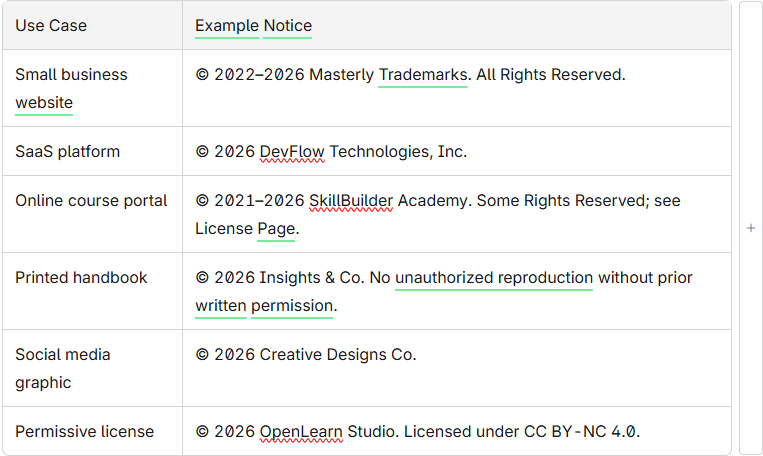
Do not copy another company's notice verbatim if it would misstate the correct copyright owner, year, or rights granted. Adjust every element to reflect your actual ownership.
FAQs About Copyright Notices for Businesses and Creators
Is a copyright notice legally required? No. Copyright protects original works as soon as they are created and fixed in a tangible medium. Under certain circumstances, omitting a notice may allow an infringer to claim innocence, but the underlying protection still exists.
How often should I update the copyright year? Update the year when you publish new or revised content. For active websites, a range ending in the current year (e.g., 2020–2026) is standard. Static works keep the original date.
Can I copy someone else's wording? You can use standard templates (the word copyright, year, owner structure is widely recognized), but you must use your own correct owner name, year, and rights statement.
Does a notice override fair use? No. Fair use under the Copyright Act applies regardless of whether a notice is present.
Is a single English-language notice acceptable globally? Under the Berne Convention, countries respecting the treaty do not require formalities for protection. An English notice is generally acceptable. In the EU, copyright lasts 70 years after the author's death. Canada's copyright lasts for the author's life plus 70 years. For high-stakes foreign markets, consult local counsel.
Can artificial intelligence content be covered by a notice? A notice alone does not determine what is protectable. The US Copyright Office has stated that works with sufficient human authorship may receive copyright protection, but wholly AI-generated output may not qualify. The notice asserts a claim of ownership; the subject of protectability is a separate legal question.
What if my content is copied despite having a notice? Document the infringement, verify your registration status, and consider a cease-and-desist letter or DMCA takedown request. A notice strengthens your position but does not replace legal action when needed.
Next Steps: Strengthening Your Copyright Protection Strategy
A copyright notice costs nothing to add and takes minutes to write. Before you publish your next page, blog post, or app update, confirm that your notice includes the correct © symbol, the accurate year or date range, your legal owner name, and a rights statement that matches your actual licensing intent. Then consider whether registration and broader brand protection should follow.

Masterly Trademarks helps creators and businesses align copyright notices with broader trademark and brand protection strategies. To discuss copyright protection and how it fits with your trademarks, visit masterlytrademarks.com or call (972) 236-5051. For specific copyright registration questions or cross-border copyright laws, consulting qualified counsel is an important next step.
You might also like