How Competitors Use Your Brand Online And What You Can Do to Stop It


The Silent Threat to Your Online Identity

In today's digital-first business environment, online brand protection is no longer optional—it's a critical survival strategy. Many business owners assume their federal trademark registration shields them completely. But while trademark registration offers legal protections, enforcement requires active vigilance. Competitors and bad actors exploit this gap, using your brand names, logos, or domain names to steal traffic, confuse your customers, or damage your brand's reputation.


How Competitors Hijack Your Brand Online

Digital spaces make it easy for others to manipulate or mimic your brand without your consent. This is more than unethical—it’s trademark infringement. Here are a few ways this plays out:

  • Buying confusingly similar domain names to redirect your traffic.
  • Copying design marks and brand elements on counterfeit websites.
  • Using similar marks in ads to mislead search engines and audiences.
  • Imitating your social media platforms to trick followers.
  • Listing counterfeit products on e-commerce sites using your brand name.


All of these tactics fall under potential trademark infringements and can create devastating consumer confusion.


The Real-World Risks of Inaction

Failing to implement trademark monitoring services can result in:

  • Revenue loss due to diverted traffic or counterfeit sales.
  • Damaged brand reputation caused by poor-quality knockoffs.
  • Legal costs incurred to fight infringement after the damage is done.
  • Loss of competitive edge in your specific industries.


Even small businesses are not immune. In fact, they often lack the resources for legal battles, making early detection and timely action even more critical.


How Trademark Monitoring Services Protect Your Brand

At Masterly Trademarks, our trademark monitoring service is built to identify potential threats before they escalate. Our tools provide:

  • Timely alerts on similar marks or new trademark applications.
  • Tailored insights for your trademark portfolio, including business name and design marks.
  • Monthly reports that track trademark activity across online platforms, search engines, and social media platforms.


Our monitoring services act as a first line of defense, allowing businesses to respond quickly with the help of experienced legal counsel.


Federal Trademark Registration Is Only Step One

Trademark registration with the trademark office gives you ownership, but not oversight. Once registered, brands must actively monitor trademark applications, opposition filings, and new uses of confusingly similar marks.

Without active watch services, your trademark can suffer from trademark dilution, where unauthorized use weakens the distinctiveness of your marks, especially in specific industries with saturated markets.


What Makes Monitoring Essential in 2025

With the explosion of e-commerce and digital marketing, brand infringement happens faster and more globally than ever. Masterly Trademarks provides:

  • Global coverage across jurisdictions and platforms.
  • Unified platform access for viewing your brand risks.
  • Reliable results without false positives that waste time.
  • Ongoing support from trademark lawyer partners to interpret alerts.


These services are crucial for large portfolios and startups alike. Even one unmonitored threat can erode years of branding and marketing effort.


Monitoring in the Age of Social Media and E-Commerce

Your brand is more than a name—it's an identity that lives across platforms. Monitoring must extend beyond the trademark office to include:

  • Instagram, TikTok, and LinkedIn impersonators.
  • Look-alike sellers on Amazon, Etsy, and Alibaba.
  • Paid ads using your brand keywords.
  • Unauthorized app listings and plug-ins.


These areas require tailored insights from seasoned professionals who can identify potential risks and recommend strategic actions.


Stop Infringement Before It Starts

Waiting until a violation hits your desk means you're already playing defense. With Masterly Trademarks, you can:

  • Protect your brand proactively.
  • Identify potential threats through robust scanning.
  • Get access to legal services for timely enforcement.
  • Make data-informed decision making for marketing and expansion.


This is not just intellectual property law. This is smart business.
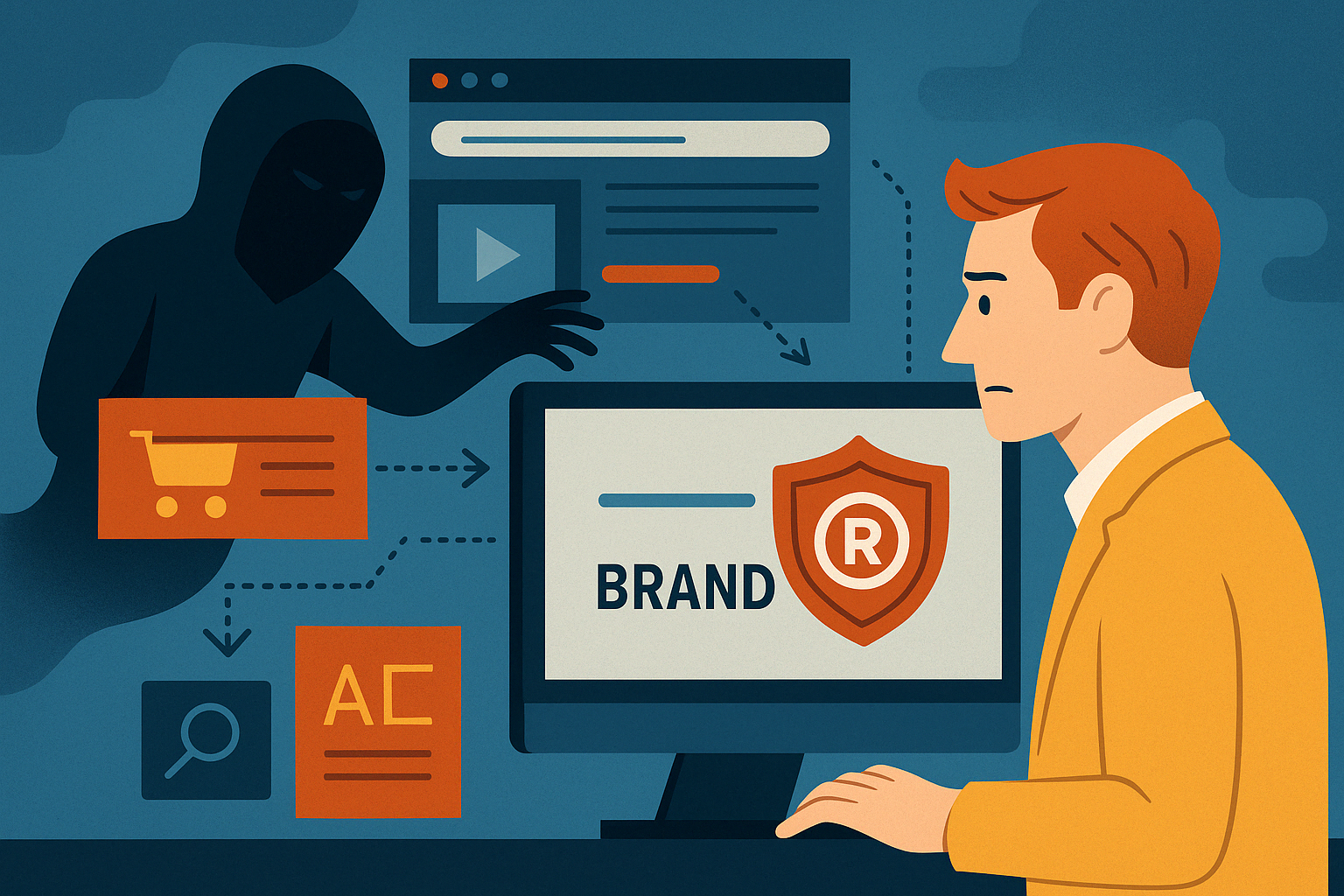
A concerned businessman in a yellow suit watches a computer screen displaying a registered trademark shield and the word “Brand.” On the left, a hooded figure reaches toward counterfeit icons representing e-commerce, search engines, and web content, symbolizing online brand hijacking and trademark infringement.


Trusted Tools Backed by Legal Expertise

Our monitoring combines AI-based search with human-led analysis to catch:

  • Spelling variants
  • Logo manipulation
  • Cross-industry trademark conflicts
  • Coordinated counterfeit networks


Each alert is vetted for legitimacy and urgency. You'll never be left with noise—only actionable insights that matter to your business.


Customized Strategies for Every Business Type

From fashion retailers to SaaS providers, each industry faces unique challenges. We build customized brand protection plans for:

  • E-commerce brands
  • Law firms
  • Startups with pending trademark applications
  • Enterprises managing registered and unregistered marks


We ensure your trademark portfolio is safeguarded across channels and geographies.


The Masterly Trademarks Advantage

Choosing Masterly Trademarks means you receive:

  • Personalized trademark watch plans
  • Insightful analysis, not automated fluff
  • Legal alignment with current trademark law and regulations
  • Seamless integration into your brand and legal team


Don’t let competitors use your hard-earned identity against you.


It Only Takes One Infringement to Lose Consumer Trust

Unauthorized use isn't just an annoyance—it's a threat to your entire operation. One instance of brand confusion can:

  • Reduce customer trust
  • Harm SEO rankings
  • Lead to public backlash on social media


Acting quickly with Masterly Trademarks helps avoid these fallout effects.


Every Second Counts in Online Brand Protection

Online platforms update by the minute. Counterfeiters move fast. Without monitoring, your brand is at risk 24/7. That's why our tools deliver:

  • Daily scans for potential infringements
  • Keyword-based tracking for business name misuse
  • Alerts for similar logos and taglines


This level of protection turns risk into resilience.


The Hidden Battles Over Your Brand: How to Protect Brands from Potential Conflicts Online

In the digital marketplace, every second your business operates without active defense is an opportunity for competitors to exploit your identity. From mimicking your logos to registering lookalike domain names, bad actors create potential conflicts that threaten your growth, reputation, and customer trust. To effectively protect brands, business owners must go beyond simple registration and adopt proactive strategies that include monitoring and enforcement. Identifying and resolving these conflicts early keeps your brand strong and your message clear—before confusion turns into costly legal disputes.


Contact Us Today for a Free Consultation

Your brand is one of your most valuable business assets—and it deserves powerful protection. At Masterly Trademarks, we help you stay ahead of competitors, copycats, and counterfeiters with proactive trademark monitoring and online brand protection strategies tailored to your needs. Whether you're a new startup or managing a complex trademark portfolio, we deliver monitoring services and legal counsel that identify, analyze, and neutralize potential threats to your identity.


Contact us at (972) 236-5051 to book a free consultation. Let us answer your questions, review your trademark registration status, and show you how Masterly Trademarks can help protect your brand with precision and urgency.

(972) 236-5051

You might also like

Copyright notice guidance for protecting original creative work.
By Amber Aniston August 14, 2026
A copyright notice is one of the simplest tools a business can use to protect original content, yet many creators skip it entirely. Here is how to write one, where to place it, and why it still matters. Why Copyright Notices Still Matter in 2026 Copyright protection is automatic upon creation of a work. The moment you write a blog post, design a logo, or record a video, that work is protected by copyright under US law. No filing, no fee, no stamp required. But "protected" and "easy to enforce" are two different things, and a visible copyright notice closes the gap between them. Consider a concrete scenario. A small consulting firm publishes a 3,000-word guide on its website in 2026. A competitor copies it verbatim and posts it on their own site. If the original page carries a clear notice in the website footer ("© 2022–2026 Horizon Analytics LLC. All Rights Reserved."), the firm has immediate evidence that the copyright infringer had notice of ownership. Under Section 401(d) of the Copyright Act, that notice blocks the "innocent infringement" defense, which could otherwise reduce damages. Without the notice, the competitor might argue they were unaware the content had an owner. A copyright notice is not the same as copyright registration with the US Copyright Office, and it is not a takedown request or a lawsuit. It is a signal and a piece of evidence, not a remedy. This article focuses on US copyright law after the Berne Convention implementation (March 1, 1989), while noting where international practice runs parallel. By the end, you will be able to write and place a professional copyright notice on your site, app, or publication. What Is a Copyright Notice? (And What It Is Not) A copyright notice is a short copyright statement placed on or near a work that informs users the work is protected and identifies who owns it. A complete copyright notice typically contains three core elements: the copyright symbol (©), the year of first publication, and the copyright owner's name. An optional rights statement like "All Rights Reserved" can follow. A notice is not copyright registration, not a license defining how others may reuse your work, and not a legal agreement. It informs the public of your ownership rights, but it does not substitute for the formal registration process or enforcement action. Copyright protection does not require the inclusion of a notice in the US after March 1, 1989, when the United States joined the Berne Convention. Before that date, omitting a notice on works published could push content into the public domain. Today, notice is optional. Yet businesses, publishers, and software companies worldwide still use notices on websites, mobile apps, books, and software because the practical benefits remain strong. Copyright Law Basics Behind a Copyright Notice To understand why notices carry weight, start with how copyright protection arises. Under US copyright law, protection begins automatically when an original work is fixed in a tangible form, whether that is a written page, a digital file, or a sound recording. Copyright protects original works like music and literature, covers artistic works including paintings and photographs, and extends to architectural works, literary works, and even sculptural work. Copyright does not protect ideas, only their expression. The copyright owner may be the individual author, a company (for works made for hire), or an assignee. The Copyright Act grants exclusive rights to reproduce, distribute, display, perform, and create derivative works. A notice helps signal these rights to the public and removes ambiguity about ownership. Copyright lasts for the author's life plus 70 years after the author's death. Works made for hire have copyright for 95 years from publication. Copyright for works created before 1978 varies in duration. Copyright law allows owners to enforce their rights against infringers, but enforcement requires monitoring, registration, and sometimes litigation. The US Copyright Office handles copyright registration and recordation, which is separate from simply adding a copyright symbol or statement. Key Elements of an Effective Copyright Notice Most modern copyright notices follow a simple pattern. A notice includes the © symbol, year, and owner's name. For example: "© 2026 Masterly Trademarks. All rights reserved." The sections below break down each element with specific formatting and examples for websites, documents, and other publications. Copyright Symbol or Word A copyright notice must include the copyright symbol ©. The symbol is universally recognized and recommended for use across all formats. Alternatively, the word "Copyright" or the abbreviation "Copr." satisfies the statute. Most practitioners use © because it is compact and one of the most familiar symbols in publishing. Typing tips: on Windows, press Alt+0169 on the numeric keypad. On macOS, press Option+G. The shorthand "(c)" (a letter c in parentheses) is not the same Unicode character and is not a legal substitute, though some software auto-replaces it. For sound recordings, use the ℗ symbol instead of ©. That symbol designates rights in the phonorecord itself, separate from any underlying musical composition, and is defined in Section 402 of the Copyright Act. Copyright Year (or Range of Years) The copyright date should only state the year of publication. The year of first publication indicates when the work was first published or made publicly available. For a website, this is typically the year the site or its key content went live. When to use a range: if your website or app receives continuous updates, a date range like "© 2018–2026" signals active maintenance. For static works (a printed report, a one-time PDF), the original publication year alone is sufficient. An inaccurate or obviously outdated year does not automatically forfeit copyright protection, but it can undermine professionalism and weaken deterrence. Copyright Owner's Name A copyright notice should include the copyright owner's name, specifically the legal name of the individual or entity that holds the rights. Use the full registered business name that appears in contracts and on invoices. Concrete examples: © 2026 Olivia Chen © 2022–2026 Horizon Analytics LLC © 2026 City of Dallas For joint authorship, list all owners. For works made for hire, the employer or commissioning party is the copyright owner, not the individual who created the work. Pen names are acceptable if they are reasonably connected to the real owner. Optional Rights Statement A copyright notice can include a statement of rights like "All Rights Reserved." Under US copyright law, all rights are reserved by default, even without the phrase, but including it reduces confusion about what is permitted. Variations by business goal: "All rights reserved. No part of this publication may be reproduced without prior written permission." "Some rights reserved; see license page." "Licensed under CC BY-NC 4.0." Avoid overbroad claims that conflict with fair use or other limitations in the Copyright Act. A rights statement that overreaches does not expand your legal rights and may invite scrutiny. How to Write a Copyright Notice Step by Step Follow this sequence: Identify the owner. Determine who legally owns the work. Use their full legal name. Pick the year. Use the year of first publication. For continuously updated content, use a range ending in the current year. Choose a rights statement. Decide whether to include "All Rights Reserved" or reference a specific license. Assemble. Place them in order: symbol, year, owner, rights statement.
Work for hire agreement outlining ownership of contractor creative work.
By Amber Aniston August 14, 2026
Protect your business by understanding work for hire agreements. Learn how to secure copyright ownership of contractor creative work, avoid common mistakes, and ensure your intellectual property rights before payment.
DMCA takedown documentation and evidence preparation for content removal.
By Amber Aniston August 13, 2026
Learn what businesses and creators should document before sending a DMCA takedown notice. Covers copyright ownership evidence, infringement documentation, platform rules, and when to get attorney-guided support.

Book a Service Today