Likelihood of Confusion: How Trademark Conflicts Are Decided
Likelihood of confusion is the central question in most trademark disputes. It decides whether the USPTO will register a new mark, and it decides whether one business is infringing another's trademark. If two marks are similar enough, and used on related enough goods or services, that relevant consumers would likely believe they come from the same source, the law treats that overlap as a problem. In trademark practice, these questions come up for trademarks and service marks alike, and for any trademark or trade dress a business relies on to identify its goods or services.
This guide explains what likelihood of confusion means, where it appears in the Lanham Act, the factors federal courts and the USPTO use to evaluate it, the role of actual confusion and reverse confusion, and practical steps for choosing a mark that avoids conflict. It is general information about United States trademark law, not legal advice about any specific mark.

What Is Likelihood of Confusion?
Likelihood of confusion asks whether an appreciable number of ordinarily prudent purchasers are likely to be confused about the source, sponsorship, or affiliation of goods or services because of the similarity of two marks. The test does not require proof that anyone was actually confused. It asks what is likely under all the circumstances, based on how a reasonable consumer would encounter the marks in the marketplace.
The phrase comes directly from the Trademark Act of 1946, known as the Lanham Act. It appears in two key places:
- Registration. Section 2(d), 15 U.S.C. § 1052(d), allows the USPTO to refuse registration of a mark that so resembles a registered mark, or a mark previously used in the United States and not abandoned, as to be likely, when used on the applicant's goods, to cause confusion, or to cause mistake, or to deceive.
- Infringement. Section 32, 15 U.S.C. § 1114, makes a person liable for using a copy or colorable imitation of a registered mark where such use is likely to cause confusion. Section 43(a), 15 U.S.C. § 1125(a), extends similar protection to unregistered marks and trade dress.
In practice, to prove trademark infringement the owner of a mark generally must show that it has valid rights in the mark and that the defendant's use creates a likelihood of confusion. That is why trademark likelihood of confusion is the core issue in nearly every trademark infringement case, and why consumer confusion is what trademark law is designed to prevent.
Who Decides Likelihood of Confusion?
Two different decision makers apply the test:
- The USPTO. When you file a trademark application, an examining attorney searches the register for conflicting marks. If the proposed mark is too close to a registered mark or prior pending application for related goods or services, the examiner issues a Section 2(d) refusal. The Trademark Trial and Appeal Board (TTAB) hears appeals and oppositions.
- Federal courts. In trademark infringement lawsuits, federal courts apply a multi-factor test. Each federal circuit has its own list of factors, but the lists overlap heavily.
The DuPont Factors Used by the USPTO
Many people ask, "What are the 13 DuPont factors?" The USPTO and TTAB apply the factors listed in In re E. I. du Pont de Nemours & Co., 476 F.2d 1357 (C.C.P.A. 1973). The court stated that the following, when of record, must be considered:
- The similarity or dissimilarity of the marks in their entireties as to appearance, sound, connotation, and commercial impression.
- The similarity or dissimilarity and nature of the goods or services.
- The similarity or dissimilarity of established, likely-to-continue trade channels.
- The conditions under which and buyers to whom sales are made, such as impulse versus careful, sophisticated purchasing.
- The fame of the prior mark (sales, advertising, length of use).
- The number and nature of similar marks in use on similar goods.
- The nature and extent of any actual confusion.
- The length of time during and conditions under which there has been concurrent use without evidence of actual confusion.
- The variety of goods on which a mark is or is not used (house mark, family mark, product mark).
- The market interface between the applicant and the owner of a prior mark, such as consent agreements.
- The extent to which the applicant has a right to exclude others from use of its mark on its goods.
- The extent of potential confusion, whether de minimis or substantial.
- Any other established fact probative of the effect of use.
Not every factor matters in every case. In practice, in most USPTO refusals, the first two factors, similarity of the marks and relatedness of the goods or services, carry the most weight.
The Sleekcraft Factors Used in the Ninth Circuit
Federal courts use similar tests. A well known example is the Ninth Circuit's eight factors from AMF Inc. v. Sleekcraft Boats, 599 F.2d 341 (9th Cir. 1979):
- Strength of the mark.
- Proximity of the goods.
- Similarity of the marks.
- Evidence of actual confusion.
- Marketing channels used.
- Type of goods and the degree of care likely to be exercised by the purchaser.
- Defendant's intent in selecting the mark.
- Likelihood of expansion of the product lines.
Other circuits have their own lists, such as the Polaroid factors in the Second Circuit. The factors listed by each court are not a checklist where the side with more factors wins. Courts weigh the factors based on the facts, and no single factor is decisive in every case. One factor may dominate in one dispute, while other factors control in another.
Key Factors in the Likelihood of Confusion Analysis
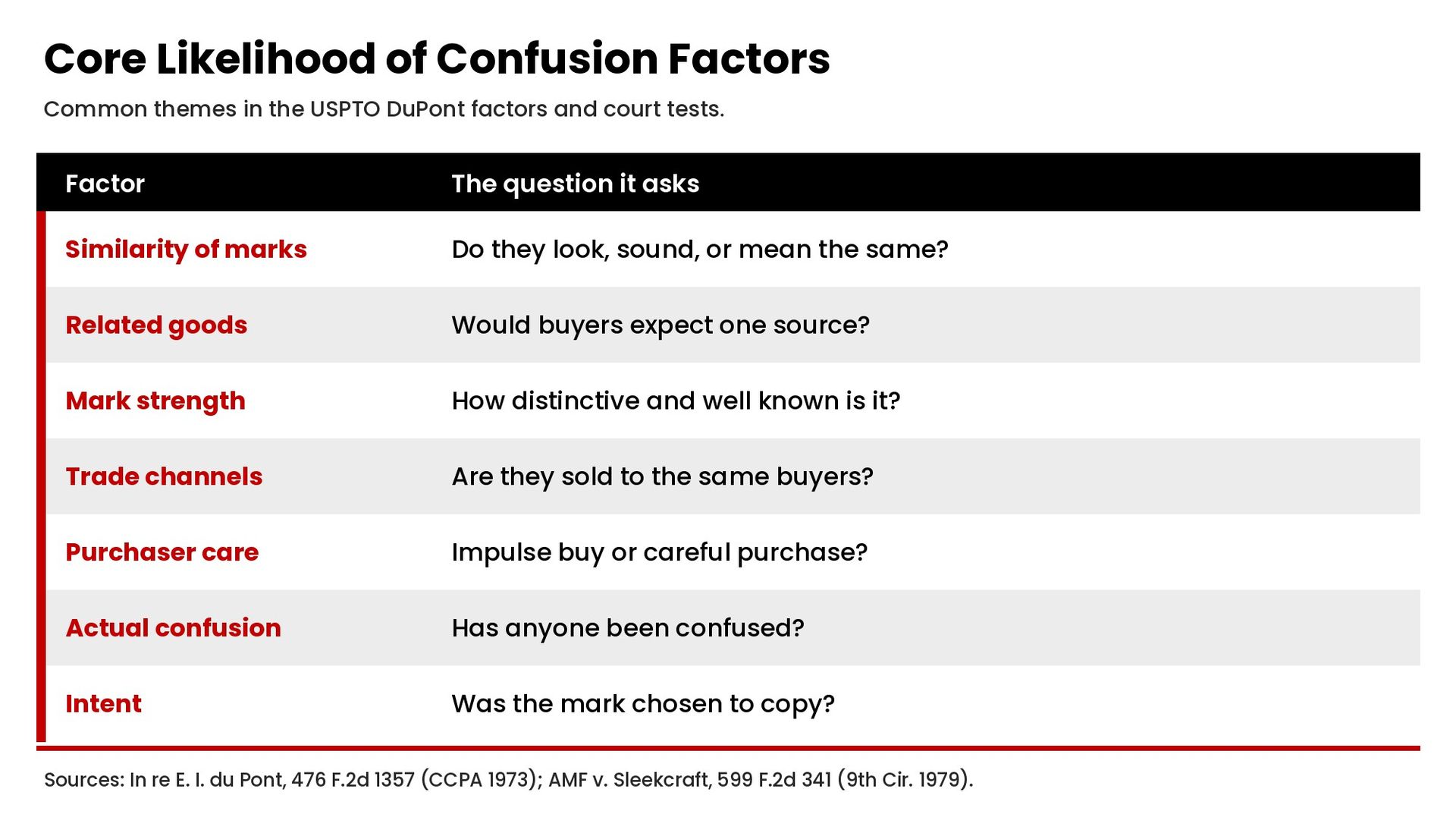
Although the lists differ, the confusion analysis usually turns on a handful of core questions.
Similarity of the marks
Marks are compared in their entireties for appearance, sound, meaning, and commercial impression. Marks can be similar even if they are not identical. Two marks that sound alike, look alike, or carry the same meaning can create confusion. Highly similar marks on related goods are the most common reason the USPTO determines that a likelihood of confusion exists. The test is not whether the marks can be distinguished side by side, but whether consumers who encounter them separately would likely assume a connection.
Examples of the kinds of similarity examiners consider:
- Sound: marks that sound alike when spoken, even if spelled differently.
- Appearance: marks with similar letters, structure, or design elements.
- Meaning: marks that translate to the same word or convey the same idea.
- Commercial impression: the overall impression a mark creates in the minds of relevant consumers.
Relatedness of the goods or services
The goods or services do not need to be identical. The question is whether consumers would expect them to come from the same source. Competing products sold side by side are the clearest case, but related goods can also qualify. For example, clothing and accessories, or restaurant services and packaged food products, may be considered related in some cases depending on the evidence.
A common misunderstanding involves trademark classes. The USPTO groups goods and services into international classes for administrative purposes. Marks registered in different classes can still conflict if the goods or services are related, and filing in different classes does not by itself avoid a refusal. Marks in the same class may not conflict if the goods are unrelated.
Strength of the mark
Strong marks receive broader protection. A fanciful or arbitrary mark, such as an invented word, is stronger than a descriptive mark. Commercial strength also matters: the more consumers recognize a particular brand, the more likely they are to assume a connection with similar trademarks. Courts determine strength from the evidence. On the other hand, if many similar marks are already used on similar goods, consumers may have learned to distinguish them, and the plaintiff's mark may receive narrower protection.
Marketing channels and purchaser care
Courts consider whether the goods are sold through the same marketing channels to the same type of customers. When the plaintiff's mark and the defendant's mark reach the same buyers in the same places, confusion is more likely. Expensive goods bought by careful, sophisticated purchasers are less likely to cause confusion than inexpensive items bought on impulse.
Actual confusion
Evidence of actual confusion, such as misdirected customer calls, emails, reviews, orders, or sales records showing customers asking for the wrong company, can be strong evidence that confusion exists. Surveys of relevant consumers are another common form of evidence of whether a use constitutes likelihood of confusion. However, actual confusion is not required. Courts recognize that it can be hard to find, especially when the marks have coexisted for a short time.
Defendant's intent
If the defendant chose its mark with the intent to trade on the plaintiff's reputation, courts may infer that confusion is likely. Good faith is not a complete defense, though. A business can infringe even if it never intended to confuse consumers.
Forward Confusion and Reverse Confusion
Most trademark confusion cases involve forward confusion: consumers believe the newer user's goods come from the prior owner of the mark. Reverse confusion is the opposite. It happens when a larger, newer user saturates the market so that consumers believe the smaller prior owner's goods come from, or are connected with, the larger company. Courts in many circuits recognize reverse confusion as a form of trademark infringement.
What Words Can't Be Trademarked?
Likelihood of confusion is only one reason a mark may be refused. Section 2 of the Lanham Act lists other grounds, including marks that consist of or comprise deceptive matter, flags or insignia of the United States or other nations, and names of particular living individuals without their written consent. Marks that are merely descriptive of the goods or primarily merely a surname may be refused unless they have become distinctive. Generic terms, such as the common name of a product, cannot function as trademarks for that product.
How to Reduce the Risk of Trademark Confusion
A little work before launch can prevent costly disputes later. Practical steps include:
- Search before you commit. Search the USPTO database and common law sources, such as business names, domain names, and social media, for similar marks on related goods or services. A search reduces risk but cannot guarantee that a mark is available.
- Choose a distinctive mark. Invented or arbitrary marks tend to be stronger and less likely to collide with existing registered marks.
- Think about future product lines. Consider whether you may expand into areas where a similar mark is already in use.
- File early. A federal application establishes a nationwide priority date once registered.
- Monitor the market. Trademark monitoring services can flag new filings and uses that may create confusion.
- Respond carefully to conflicts. If you receive a refusal or a demand letter, review the likelihood of confusion factors before responding. Learn more about trademark enforcement options.
Masterly Trademarks, a service of Masterly Legal Solutions, offers attorney-guided trademark services, including search and application support. No search or filing can guarantee registration.
Frequently Asked Questions
What is the likelihood of confusion test?
It is the legal test used to determine whether two marks are so similar, as used on their goods or services, that consumers are likely to be confused about the source. The USPTO uses the DuPont factors, and federal courts use similar multi-factor tests.
What are the key elements of a likelihood of confusion?
The most important elements are usually the similarity of the marks and the relatedness of the goods or services. Courts and the USPTO also consider mark strength, marketing channels, purchaser care, actual confusion, and intent.
Does a trademark have to be identical to cause confusion?
No. Marks that are similar in sound, appearance, or meaning can create a likelihood of confusion, especially when used on closely related goods or services.
Can two businesses use the same name in different industries?
Sometimes. If the goods or services are unrelated and consumers would not expect them to come from the same source, confusion may be unlikely. Famous marks may receive broader protection, so each situation depends on its facts.
Do I need proof of actual confusion?
No. The standard is likelihood of confusion, not actual confusion. Evidence of actual confusion can be persuasive, but it is not required.
Talk With a Trademark Attorney
Likelihood of confusion is a fact-specific analysis, and small differences in the marks, goods, or market can change the result. If you are choosing a brand name, responding to a USPTO refusal, or concerned about a similar mark, contact Masterly Trademarks, a service of Masterly Legal Solutions to request a consultation. This article from Masterly Trademarks, a service of Masterly Legal Solutions, provides general information about trademark law and is not legal advice. Reading it does not create an attorney-client relationship, and no registration or result is guaranteed.
Andrew Rhoden, Esq. is a lawyer with Masterly Legal Solutions, 3838 Oak Lawn Avenue, Suite 1000, Dallas, Texas 75219, licensed in Texas, North Carolina, and the District of Columbia.
You might also like