Trade Dress: What It Is and How to Protect It
Customers often recognize a brand before they read its name. The shape of a bottle, the color scheme on a box, or the look and feel of a retail store can tell a buyer exactly who made a product. In trademark law, that overall look has a name: trade dress. Trade dress protection is a form of legal protection that allows a business to stop competitors from copying the visual appearance that customers associate with its goods or services.
This guide explains what trade dress is, how trade dress differs from a trademark, what it takes to qualify for trade dress protection, how courts treat functionality and secondary meaning, and how a business can work toward securing trade dress protection for its brand identity. It covers the legal framework under United States law and is general information, not legal advice for any specific situation.
What Is Trade Dress?
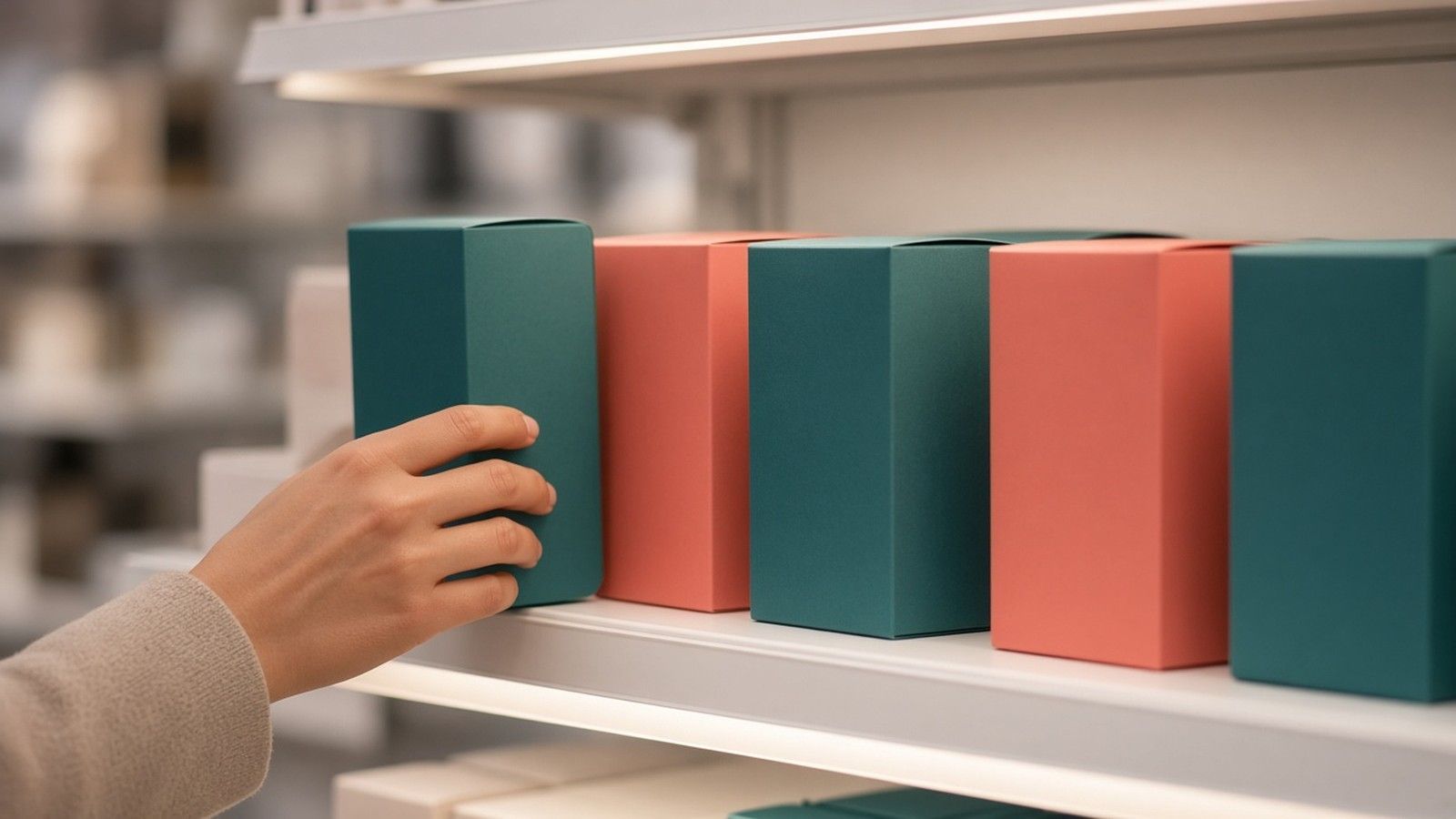
Trade dress refers to the overall visual appearance of a product or its packaging that identifies the source of the product. Put another way, trade dress refers to the visual identity of a product or service as a whole. Instead of a single word or logo, trade dress covers the total image: the combination of shape, color, design elements, texture, graphics, and layout that consumers associate with one company.
Trade dress is a form of intellectual property, and trade dress rights are intellectual property rights that can be enforced like other trademark protection. Federal law protects trade dress under the Lanham Act, the same statute that governs trademarks. Section 43(a) of the Lanham Act, codified at 15 U.S.C. § 1125(a), protects unregistered trade dress against uses that are likely to cause consumer confusion about the source of goods or services. Registered trade dress is protected through federal registration with the United States Patent and Trademark Office (USPTO), the patent and trademark office that also registers word marks and logos.
Common trade dress elements include:
- Product packaging: the shape, colors, and graphics of a box, bag, label, or bottle.
- Product design: the distinctive shape or configuration of the product itself.
- Retail store and restaurant decor: the layout, color scheme, signage style, and interior design of a retail store or restaurant.
- Color: a single color used in a distinctive way, in some cases.
- Overall presentation: the combination of visual elements and aesthetic elements that together create a cohesive visual identity.
The key idea is source identification. Consumer perception is what matters. Trade dress protection is not about rewarding good design. It is about preventing consumer confusion so that buyers can rely on the product's appearance to know who stands behind it.
Trade Dress Examples
Many people ask for examples of trade dress. The U.S. Supreme Court has discussed several well known examples:
- Restaurant decor. In Two Pesos, Inc. v. Taco Cabana, Inc.(1992), the trade dress at issue was the festive look of a Mexican restaurant chain, including its exterior colors, patio, and interior decor.
- Product color. In Qualitex Co. v. Jacobson Products Co. (1995), the Court held that a green-gold color on dry cleaning press pads could be protected as a trademark, but only upon a showing of secondary meaning.
- Product design. In Wal-Mart Stores, Inc. v. Samara Brothers, Inc.(2000), the trade dress at issue was the design of a line of children's clothing.
- Bottle shape. In the same Wal-Mart opinion, the Court used the classic glass Coca Cola bottle as an example of a hard case, since a bottle may be packaging for some consumers and part of the product for others.
Other commonly cited examples include distinctive retail store layouts and product packaging color schemes. These examples show that protected trade dress can protect almost any visual aspect of how a product or service is presented, as long as the legal requirements are met.
How Trade Dress Differs From a Trademark
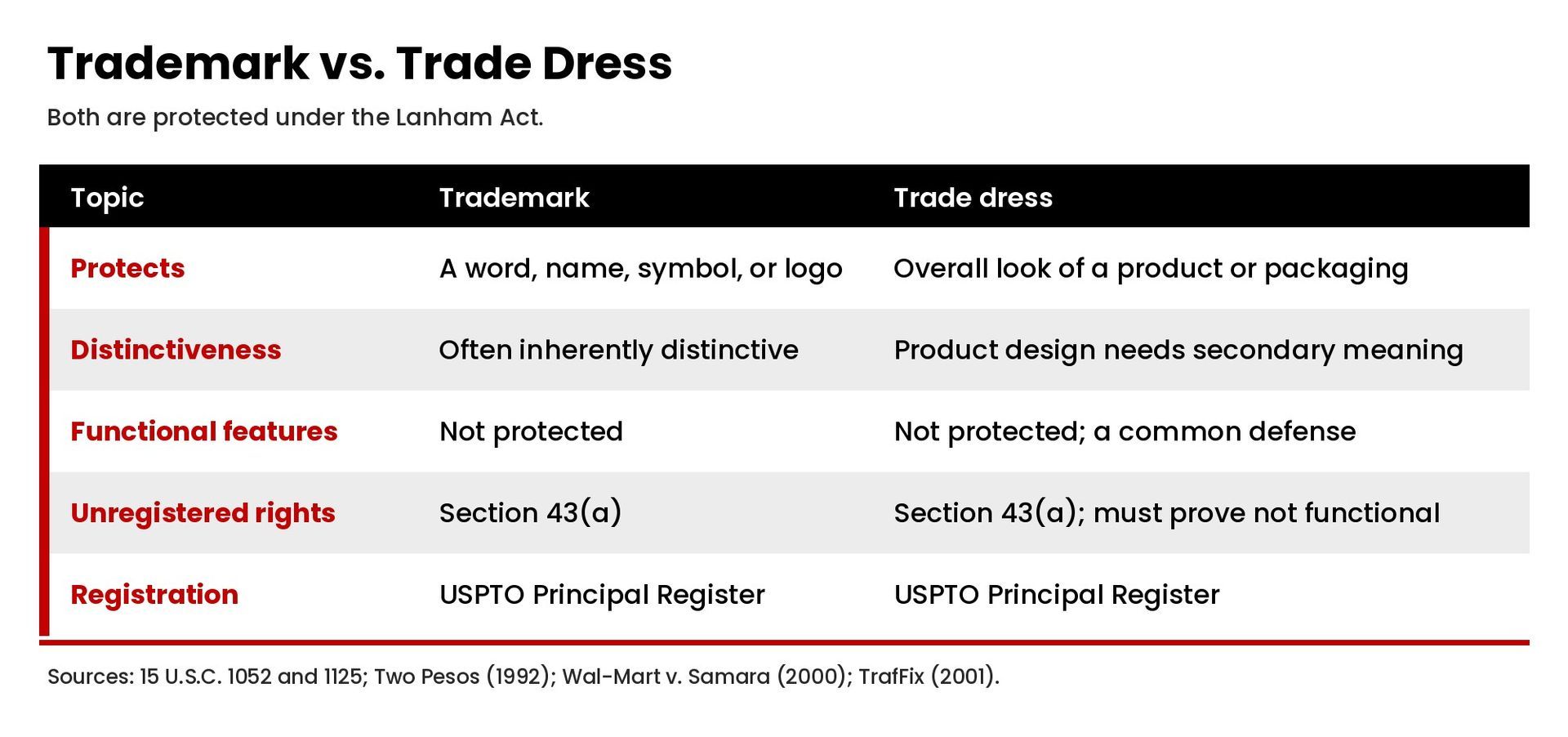
Trade dress and trademarks are closely related. Both fall under trademark law, both give owners exclusive rights against confusing uses, both protect source identifiers, and both are enforced through claims for trademark infringement and unfair competition. The main difference is scope.
A trademark is usually a word, name, symbol, or logo. Trade dress covers the overall look and feel of a product, its packaging, or a business environment. A soft drink company might own a trademark in its brand name and separate trade dress rights in the shape of its bottle and the color scheme on its cans. Both support brand recognition and customer loyalty.
Here is how trade dress differs in practice:
- What is protected: a trademark protects a specific mark; trade dress protects a combination of visual elements.
- Proof of distinctiveness: many word marks can be inherently distinctive, while product design trade dress always requires proof of secondary meaning.
- Functionality: trade dress claims face a functionality defense more often, because product shapes and features can serve useful purposes.
- Registration: both can be registered, but trade dress applications often require drawings and descriptions that define exactly which features are claimed.
Trade dress is also different from other intellectual property rights. Patents protect inventions and new designs for a limited term. Copyrights protect original creative works. Trade secrets protect confidential business information. Trade dress protection can last as long as the trade dress continues to identify the source and is not functional.
Requirements for Trade Dress Protection
To win a trade dress infringement claim, the owner generally must show three things: the trade dress is distinctive, it is not functional, and the defendant's use is likely to cause consumer confusion.
1. Distinctiveness: inherently distinctive or secondary meaning
Trade dress must be distinctive, meaning it identifies the source of the product. There are two ways to get there.
Inherently distinctive trade dress. Some trade dress is inherently distinctive because its intrinsic nature serves to identify a particular source. In Two Pesos, the court ruled that trade dress which is inherently distinctive is protectable under Section 43(a) without a showing that it has acquired secondary meaning. Product packaging and restaurant decor can be inherently distinctive, while product design cannot be inherently distinctive under current Supreme Court law.
Acquired secondary meaning. Other trade dress becomes protected trade dress only after consumers associate it with a single source. This is called secondary meaning, or acquired distinctiveness. In Wal-Mart v. Samara Brothers, the Court held that in an action for infringement of unregistered trade dress, a product's design is distinctive, and therefore protectable, only upon a showing of secondary meaning. The Court reasoned that consumers usually see even unusual product designs as making the product more useful or appealing, not as identifying who made it.
Evidence of acquired secondary meaning can include long and exclusive use, advertising that highlights the trade dress, sales volume, unsolicited media coverage, consumer surveys, and evidence of intentional copying. For registration, the Lanham Act allows the USPTO to accept proof of substantially exclusive and continuous use as a mark for the five years before the claim of distinctiveness as prima facie evidence that the mark has become distinctive ( 15 U.S.C. § 1052(f)).
2. Non-functionality
Trade dress law does not protect functional features. Features that are deemed functional stay available to every competitor. A feature is functional if it is essential to the use or purpose of the article or if it affects the cost or quality of the article. The Supreme Court has also described a functional feature as one whose exclusive use would put competitors at a significant non-reputation-related disadvantage.
The reason is fair competition. If a company could use trade dress to protect functional aspects of a product forever, it would gain a competitive advantage that patent law limits to a set term. Trade dress protection is meant to protect brand identity, not useful product features.
Two rules make functionality especially important:
- For unregistered trade dress, the person asserting protection has the burden of proving that the trade dress is not functional (15 U.S.C. § 1125(a)(3)).
- In TrafFix Devices, Inc. v. Marketing Displays, Inc.(2001), the Supreme Court held that a utility patent is strong evidence that the features claimed in it are functional. A business that once patented a feature carries a heavy burden if it later claims that feature as trade dress.
The Lanham Act also bars registration of any matter that, as a whole, is functional (15 U.S.C. § 1052(e)(5)).
3. Likelihood of consumer confusion
The final element is consumer confusion. The owner must show that the infringing party's similar trade dress is likely to confuse consumers about the source, sponsorship, or affiliation of the goods or services. Courts weigh factors such as the strength of the trade dress, how similar the two presentations are, how closely related the products are, the channels of trade, evidence of actual confusion, and the intent of the party that adopted the similar trade dress. The specific factors vary by federal circuit.
Registered Trade Dress vs. Unregistered Trade Dress
Trade dress rights can exist without registration. Section 43(a) of the Lanham Act protects unregistered trade dress, and many trade dress disputes involve unregistered trade dress. However, federal registration on the Principal Register offers practical advantages:
- Burden of proof: the special burden in Section 1125(a)(3), which requires the owner to prove non-functionality, applies to unregistered trade dress.
- Public notice: registration puts competitors on notice of the claimed trade dress elements.
- Defined scope: a trade dress application requires the owner to describe and depict the specific features claimed, which can make the trade dress rights clearer in later legal disputes.
- Enforcement tools: registration is generally recognized by online marketplaces and is useful when sending cease and desist letters.
Registration is not automatic. Product design applications usually require evidence of acquired distinctiveness, and the USPTO examines whether the claimed features are functional. No search or application guarantees that a registration will issue.
Securing Trade Dress Protection for Your Brand
Securing trade dress protection starts long before a dispute. Trade dress protection rewards planning. Brand owners who plan ahead are in a better position to show that their trade dress identifies the source and that consumers associate it with their company's reputation.
Define the trade dress elements
Identify the specific visual elements you want to protect. Write down the color scheme, shapes, packaging layout, and design elements that make up the overall visual appearance. Courts and the USPTO expect a precise description, not a general claim to a style.
Separate function from brand
Review each feature and ask whether it serves a useful purpose. Features that improve how a product works, lower its cost, or affect quality are less likely to qualify. Arbitrary, ornamental choices that do not affect function are better candidates for trade dress protection.
Use the trade dress consistently
Consistent use across product packaging, product design, advertising, and your retail store or website builds consumer recognition and brand loyalty with a loyal customer base. Changing the look frequently makes it harder to prove secondary meaning.
Build evidence of secondary meaning
Advertising that calls attention to the trade dress, sometimes called "look for" advertising, can help consumers associate the look with your brand. Keep records of advertising spend, sales, media coverage, and any instances where consumers recognize the trade dress.
Consider federal registration
Where the trade dress qualifies, an application with the USPTO can strengthen trade dress rights. A trademark services consultation can help evaluate whether the trade dress is ready for registration or whether more evidence of acquired distinctiveness is needed.
Monitor the market
Similar trade dress can appear in stores, online marketplaces, and social media. Trademark monitoring services can help brand owners spot potential conflicts early, before they cause consumer confusion or weaken brand recognition.
What to Do If You Suspect Trade Dress Infringement
If a competitor adopts a similar trade dress, the response depends on the facts. Common steps include documenting the competing product, preserving evidence of actual confusion, evaluating the strength of your trade dress, and reviewing whether it is registered or unregistered. Many trade dress disputes begin with cease and desist letters, while others require litigation in federal court. Learn more about trademark enforcement options. Because outcomes depend on evidence of distinctiveness, functionality, and confusion, no result can be promised in any trade dress dispute.
Why Trade Dress Matters for Brand Identity
Trade dress plays a central role in brand identity. A recognizable trade dress lets customers find your product on a crowded shelf, supports brand loyalty, and protects the market presence a business has invested in. It is often one of the most valuable assets a consumer brand owns, alongside its trademarks, and it reinforces brand identity every time a customer sees the product or service.
Trade dress plays a second role too: ensuring fair competition. By limiting protection to non-functional, source-identifying features, trade dress law lets competitors make similar products while preventing them from copying the look that tells consumers who made the original.
Frequently Asked Questions
Can you give me some examples of trade dress?
Examples discussed by the U.S. Supreme Court include the decor of a restaurant chain (Two Pesos), the green-gold color of dry cleaning press pads (Qualitex), the design of a children's clothing line (Wal-Mart v. Samara Brothers), and the shape of the classic Coca-Cola bottle, which the Court mentioned as a hard case.
Is trade dress the same as a trademark?
Trade dress is a type of trademark protection. A trademark usually protects a word, name, or logo, while trade dress protects the overall look of a product, its packaging, or a business environment.
Do I have to register trade dress to protect it?
No. Unregistered trade dress can be protected under Section 43(a) of the Lanham Act. However, the owner of unregistered trade dress must prove that the trade dress is not functional, and registration offers public notice and other practical benefits.
Is a trade secret considered intellectual property?
Yes. Trade secrets are a form of intellectual property, along with trademarks, trade dress, patents, and copyrights. Trade secrets protect confidential information, while trade dress protects a visible appearance that consumers recognize.
How long does trade dress protection last?
Trade dress protection can last as long as the trade dress remains distinctive, non-functional, and in use. Federal registrations must be maintained and renewed according to USPTO requirements.
Talk With a Trademark Attorney
A trademark attorney at Masterly Legal Solutions can help you evaluate trade dress protection and your legal rights. Every trade dress question turns on its own facts: what the trade dress looks like, how long it has been used, whether its features are functional, and how consumers perceive it. If you are building a brand and want to understand your trade dress rights, contact Masterly Trademarks, a service of Masterly Legal Solutions to request a consultation. This article from Masterly Trademarks, a service of Masterly Legal Solutions, provides general information about trademark law and is not legal advice. Reading it does not create an attorney-client relationship, and no registration or result is guaranteed.
Andrew Rhoden, Esq. is a lawyer with Masterly Legal Solutions, 3838 Oak Lawn Avenue, Suite 1000, Dallas, Texas 75219, licensed in Texas, North Carolina, and the District of Columbia.
You might also like