Logo Trademark: When a Design Mark Needs Separate Federal Protection
Your business name may already be protected, but your logo carries unique value.
Customers often recognize your colors, shapes, symbols, lettering, or overall visual design before they even read the business name. A logo trademark protects that specific visual design used to identify your goods or services, and it may need separate federal protection from your business name when those visual elements are central to your brand.
This visual identity appears on websites, packaging, products, signs, social media, advertising, uniforms, and digital platforms. Protecting it matters because the logo often carries the brand recognition, customer trust, and legal leverage you would lose if others used a confusingly similar design.
Masterly Trademarks helps business owners, creators, and organizations evaluate whether their design needs separate protection, understand how logo trademarks differ from word marks, and navigate the key steps involved, including trademark searches, filing, specimen requirements, class selection, and attorney-guided support through registration and ongoing management.
A Logo Can Be a Valuable Separate Brand Asset
A company name and logo often work together but are distinct trademark assets.
A word mark protects the wording itself—words, letters, or other identifying elements. A logo or design mark protects the specific visual presentation, stylization, symbol, image, or combination of design and wording. Other branding elements include slogans, packaging, and other commercial uses.
This distinction matters when customers strongly associate your business with its visual identity.
For example, a restaurant may have a recognizable emblem, a tech company a unique symbol on products, a content creator a visual brand on merchandise, or a nonprofit a logo used for fundraising and events.
In these cases, the design itself becomes valuable intellectual property, separate from patents, as customers identify the business by that design, supporting its own trademark rights.
Therefore, a trademark logo strategy should consider more than just whether the business name is registered.
Word Mark vs. Logo Mark: How the Difference Affects Protection
Many business owners assume one trademark filing protects all brand versions.
That’s not always true.
The USPTO distinguishes between standard-character marks and special-form marks. A standard-character mark protects the wording without a specific font, style, color, or design. A special-form mark covers stylized wording, design elements, or other visual features.
Choosing between a word mark versus logo mark depends on which part of the brand matters most and how it’s used.
Some businesses value the name itself; others rely on a distinctive logo recognized even without the business name. Many brands may want protection for both.
A trademark attorney can evaluate your brand and advise if a separate logo trademark application fits your protection strategy.
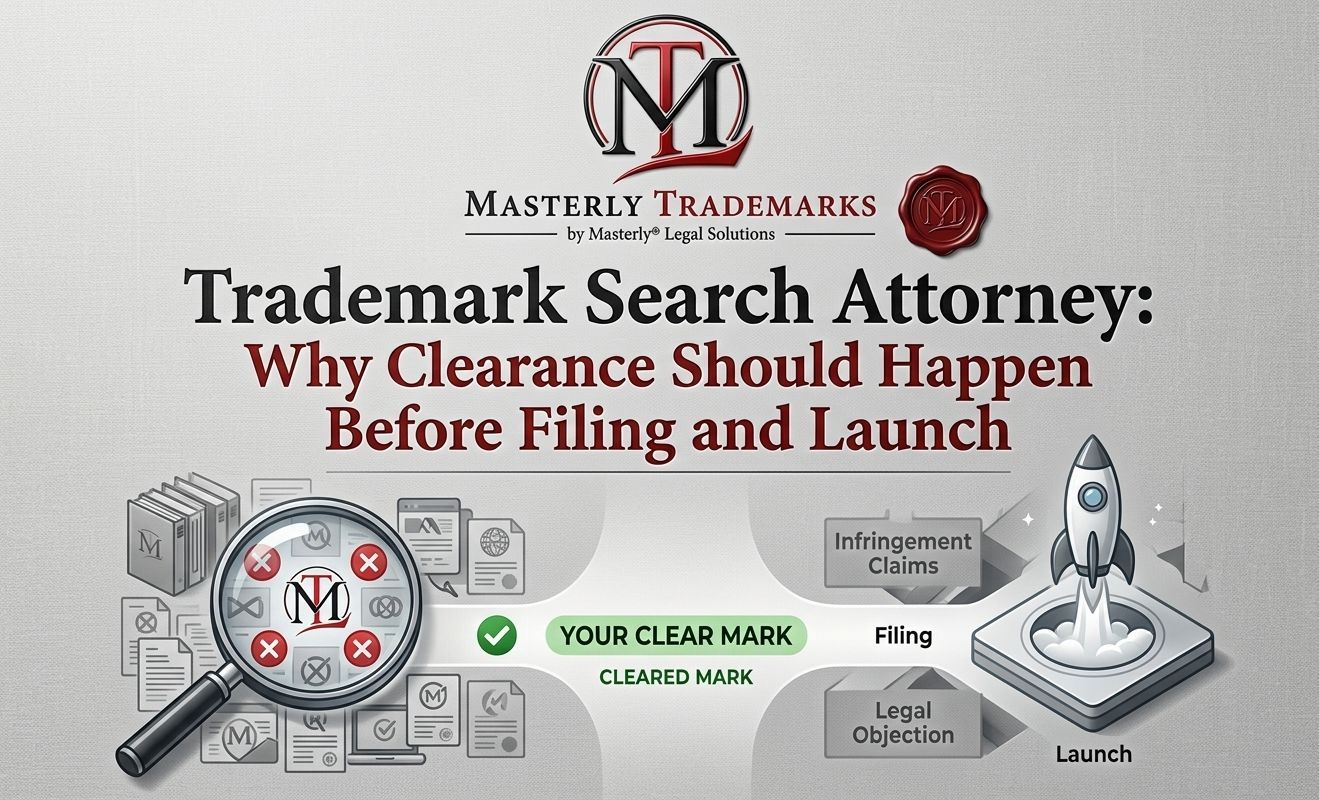
A Logo Trademark Search Is More Than Just a Name Check
Searching for a name and searching for a design mark are different.
A logo may include shapes, symbols, patterns, or other visuals that need separate review.
The USPTO uses design search codes and supports image-based searches to identify similar marks. Conflicts can arise from overall appearance, meaning, or commercial impression, not just exact copies.
Professional review is essential.
A logo that seems original may resemble existing marks in related markets, raising infringement concerns.
Masterly Trademarks evaluates designs and conducts thorough trademark searches before filing. Separate federal registration strengthens legal rights against unauthorized use by granting exclusive nationwide ownership and clearer notice of your claim.
The goal is to identify risks early so you can make informed decisions.
Design Mark Registration Should Match the Logo You Want to Protect
The image filed with your trademark application is critical.
For a special-form application, the drawing defines the design you seek to register.
If your company uses multiple logo versions—full-color, black-and-white, simplified icons, horizontal or stacked layouts, or different typography—not all versions may be covered by one application.
Before filing, a trademark attorney can review which version you use most, what to protect, and whether a comprehensive search reveals conflicts. This helps avoid office actions or delays.
This is especially important during rebranding or when visual identity changes are planned, as filing around a soon-to-be replaced design may not align with your broader strategy.
The Logo Specimen Must Show Actual Trademark Use
For applications requiring proof of use, the logo specimen is vital.
A specimen shows how your trademark is used in commerce with the goods or services listed. It differs from the drawing, which depicts the mark you claim.
Having a polished logo file alone doesn’t prove trademark use in commerce.
USPTO rules require the specimen to meet specific guidelines, including JPG format, pixel dimensions, and file size limits.
The specimen must match the goods or services involved and reflect real marketplace use.
If your logo’s style changes materially, you may need a new filing instead of relying on the original application.
Masterly Trademarks reviews your actual use and advises on proper specimen and trademark symbol use to avoid delays or office actions.
Trademark Class Selection Defines Your Protection Scope
A logo trademark isn’t registered in isolation.
Your application must specify the goods or services linked to your mark.
The USPTO organizes these into international classes.
A software company, clothing brand, consulting firm, restaurant, or entertainment business may all use different classes even if registering the same logo.
Choosing the right classes is about accurately reflecting your business, not maximizing quantity.
The ® symbol is used only for federally registered trademarks, while the ℠ symbol indicates service marks. These symbols provide legal notice and help prevent unauthorized use.
Fees vary based on classes and filing basis.
Masterly Trademarks evaluates your products or services to craft an application aligned with your commercial activities.
Separate Logo Trademark Protection Matters When Design Has Independent Recognition
Some logos become recognizable without the company name.
This makes the design itself a valuable asset.
Customers may see your symbol on apps, packaging, storefronts, social media, events, or merchandise and immediately connect it to your business.
When a design has or will develop this recognition, separate protection deserves consideration.
A logo trademark is also important when you use the design independently from the wording—such as an app icon, product emblem, or merchandise graphic.
The logo can be licensed to others while you retain ownership.
Each class affects fees, so accuracy is key.
These realities should guide your legal strategy and help avoid future disputes.
Your Logo Shapes Your Business Reputation
Visual branding influences how customers remember and recognize your business.
Your logo appears in thousands of interactions with customers, partners, vendors, employees, and the public.
If another business uses a similar design in a related market, it can cause confusion and weaken your brand’s distinction.
This impacts brand clarity and customer trust.
Logo protection is more than paperwork; it safeguards your identity and reputation.
Separate protection helps reduce risks and supports licensing or enforcement if needed.
Masterly Trademarks Offers Comprehensive Logo Trademark Services
Business owners shouldn’t navigate trademark rules, design codes, class selection, specimen requirements, and federal applications alone.
Masterly Trademarks provides attorney-guided services to protect names, logos, slogans, and other brand assets.
We help evaluate your design, conduct searches, identify goods and services, review specimens, and prepare your application strategy.
While no outcome is guaranteed, and we do not promise or guarantee registration, federal registration supports enforcement, helps intercept counterfeit goods, and strengthens your position in litigation.
Our goal is to file a trademark that reflects the brand you are building.
Trademark Law Treats Words and Designs as Different Brand Elements
Under trademark law, you can protect various source identifiers, and a trademark can function as a sign identifying source: words, logos, symbols, or their combinations.
This matters when your business uses both a name and a visual logo.
A word mark protects names or phrases broadly, while a design mark protects the visual presentation specifically.
If your logo has independent value, separate protection is essential.
This is crucial for businesses relying heavily on visual recognition across packaging, websites, apps, signage, merchandise, and advertising.
Logo Protection Helps Distinguish Your Brand From Competitors
A strong logo helps consumers recognize your business quickly.
This recognition separates you from competitors offering similar goods or services.
If another business uses a visually similar identity, it can cause marketplace confusion and weaken your brand’s uniqueness.
A logo trademark strategy helps evaluate whether your visual design needs separate federal protection.
Trademark rights depend on the mark, goods or services, market context, and law—not on claiming exclusive ownership of every similar shape, color, or design.
Use Registered Trademark Symbols Correctly
Businesses often ask when to use the ® symbol.
This symbol indicates federal registration with the USPTO for specific goods or services.
It should not be used before registration is granted.
Before registration, use ™ for goods and ℠ for services to claim trademark rights.
A trademark attorney can guide you on proper symbol use based on your mark’s status.
Filing Fees Are One Factor in Registration
Consider the USPTO fees involved in filing.
Fees vary by application type, classes, and goods or services.
The total cost also depends on legal work required.
A lower-cost filing isn’t always best if it fails to protect your valuable brand assets.
For example, deciding between a word mark and a separate logo trademark filing should consider the importance of each asset, not just filing costs.
Masterly Trademarks helps evaluate whether separate protection is right before you apply.
Logo Trademark Registration Protects a Specific Part of Your Brand Identity
For many businesses, the logo is a central part of the company's brand identity.
Customers may recognize a symbol, stylized name, or visual design before they read any other information about the company. When that design becomes important to how consumers identify the source of goods or services, trademark registration may deserve consideration.
A logo trademark can be one part of a broader strategy for protecting a company's intellectual property rights.
The important question is not simply whether the business has a logo. It is whether the design is being used as a trademark and whether separate protection supports the company's business goals.
Masterly Trademarks helps businesses and organizations seeking protection for important brand assets evaluate those issues before filing.
The United States Patent and Trademark Office Reviews Federal Applications
Federal trademark applications are handled by the United States Patent and Trademark Office, commonly called the USPTO or Patent and Trademark Office.
The federal trademark office reviews applications to determine whether they satisfy registration requirements. An application may also encounter legal issues during examination that require a response before the mark can move forward.
Submitting an application does not mean the mark has been approved.
That distinction matters for business owners who assume filing and registration are the same thing.
Masterly Trademarks provides attorney-guided assistance throughout the application process, including preparation, filing, and responses to USPTO issues when appropriate.
A Single Application Does Not Automatically Protect Every Version of a Brand
A common misconception is that a single application automatically protects the business name, logo, slogan, and every future version of the company's branding.
Trademark protection does not necessarily work that way.
The application identifies the mark for which the applicant is specifically requesting protection. A standard-character word mark and a stylized logo can represent different filing strategies.
For that reason, trademark owners may have reasons to protect both a word mark and a design mark when each has independent value.
The potential benefit of a separate logo filing depends on how the company uses the design and how important that visual identity is to the business.
Federal Filing Fees Should Be Considered as Part of the Strategy
Federal trademark applications involve required fees paid to the USPTO.
The applicable filing fee can depend on the application and the goods or services covered. Businesses seeking protection in more than one class may also face different fee considerations.
Those costs should be understood before filing, but fees should not be the only factor driving the strategy.
Choosing a filing approach solely because it appears less expensive can create problems if the application does not reflect the mark the business actually wants to protect.
A trademark law firm can evaluate the word mark, logo, goods, services, and business objectives together before an application is submitted.
Registration Symbols Depend on Trademark Status
Businesses also need to distinguish between trademark symbols.
The registered trademark symbol, ®, is generally used after a mark has obtained federal registration through the United States Patent and Trademark Office for the relevant goods or services.
Before federal registration, businesses may use TM to identify a claimed trademark. For services, the service mark symbol, SM, may also be used.
Using a symbol does not create the same rights as federal registration.
For trademark owners, the proper symbol should reflect the actual status of the mark rather than suggest that federal registration has been granted when it has not.
Trademark Rights Are Not Exclusive in Every Possible Context
Federal registration can provide important legal benefits, but trademark rights should not be described as unlimited.
A trademark owner does not necessarily receive the right to use a word, phrase, symbol, or design exclusively in every industry and every context.
The scope of protection can depend on the mark, the goods or services, marketplace use, other trademark rights, and applicable law.
That is why businesses should avoid viewing a trademark certificate as ownership of a word or design for every possible purpose.
A trademark attorney can explain the protection associated with the actual registration and the company's particular circumstances.
Masterly Trademarks Handles the Federal Filing Process for Clients
Business owners do not need to become experts in USPTO procedures before protecting a logo.
Masterly Trademarks is a trademark-focused law firm providing attorney-guided services for businesses, creators, and organizations seeking federal trademark protection.
Our attorneys can evaluate the proposed logo trademark, review relevant searches, consider the relationship between the logo and word mark, identify appropriate goods and services, review specimen issues, and prepare the federal application.
If legal issues arise during the USPTO examination process, our firm can also provide guidance concerning the appropriate response.
The objective is to give businesses professional legal support from strategy through filing rather than leaving owners to have our firm lead them through federal trademark procedures themselves.

Frequently Asked Questions About Logo Trademarks
What is a logo trademark?
A logo trademark protects a visual design, stylized wording, symbol, or combination used to identify your goods or services. It is one of the many forms a trademark can take, and trademarks may appear in different forms depending on how a business presents its brand.
Is a logo trademark different from a word mark?
Yes. A word mark protects the wording itself, while a logo or special-form mark protects the visual design. The best approach depends on your brand and its use.
Should I trademark my logo separately from my business name?
Sometimes. If your logo has key visual elements or is used independently, separate protection may be worthwhile. A trademark attorney can advise.
What is a design mark search?
A design mark search checks for conflicting trademarks based on visual elements, not just wording. It helps avoid infringement risks.
What is a logo specimen?
A logo specimen shows how your logo is actually used in commerce with the goods or services you list. It must meet USPTO rules to be acceptable.
Does trademark class selection matter for a logo?
Yes. Classes define your protection’s scope based on your goods or services. Correct selection avoids an office action and affects fees.
Can Masterly Trademarks help with both word and logo marks?
Yes. We evaluate your brand and recommend whether to file one or both, considering your business goals and filing costs.
Request a Logo Trademark Strategy Consultation with a Trademark Attorney
Your logo is often the most recognizable part of your business.
If customers see your design on products, websites, packaging, apps, social media, signs, merchandise, or advertising, it may deserve separate protection.
Masterly Trademarks offers attorney-guided trademark services tailored to how your brand is used. We can advise on filing strategies, including international options under the Madrid Protocol, which may simplify the application process in some cases, while protection is still pursued country by country and subject to national laws outside the United States.
Call Masterly Trademarks at (972) 236-5051 to discuss your logo trademark and request a consultation.
You might also like