Madrid Protocol Trademark Filing: Planning International Brand Protection
Expanding your business into international markets creates new opportunities, but it also increases the risk that someone else may register or use your brand in another country. Many business owners discover too late that U.S. trademark protection does not automatically extend overseas. A carefully planned Madrid Protocol trademark filing can help support your international branding strategy while simplifying the process of seeking trademark protection in multiple countries.
At Masterly Trademarks, we help entrepreneurs, growing companies, and multi-brand organizations evaluate international trademark strategies through the Madrid System. Whether you are entering new markets or expanding an established brand, we provide experienced legal guidance focused on protecting your intellectual property across borders.
Why International Trademark Protection Matters
Your trademark represents the identity of your business wherever customers encounter your products or services.
As companies expand into new countries through online sales, international partnerships, franchising, licensing, or physical locations, protecting brand rights becomes increasingly important.
Without an international strategy, businesses may encounter:
- Brand conflicts in foreign markets
- Delays entering new countries
- Trademark registration disputes
- Licensing complications
- Increased legal uncertainty
Planning ahead helps reduce unnecessary obstacles while supporting long-term business growth.
Understanding the Madrid Protocol Trademark System
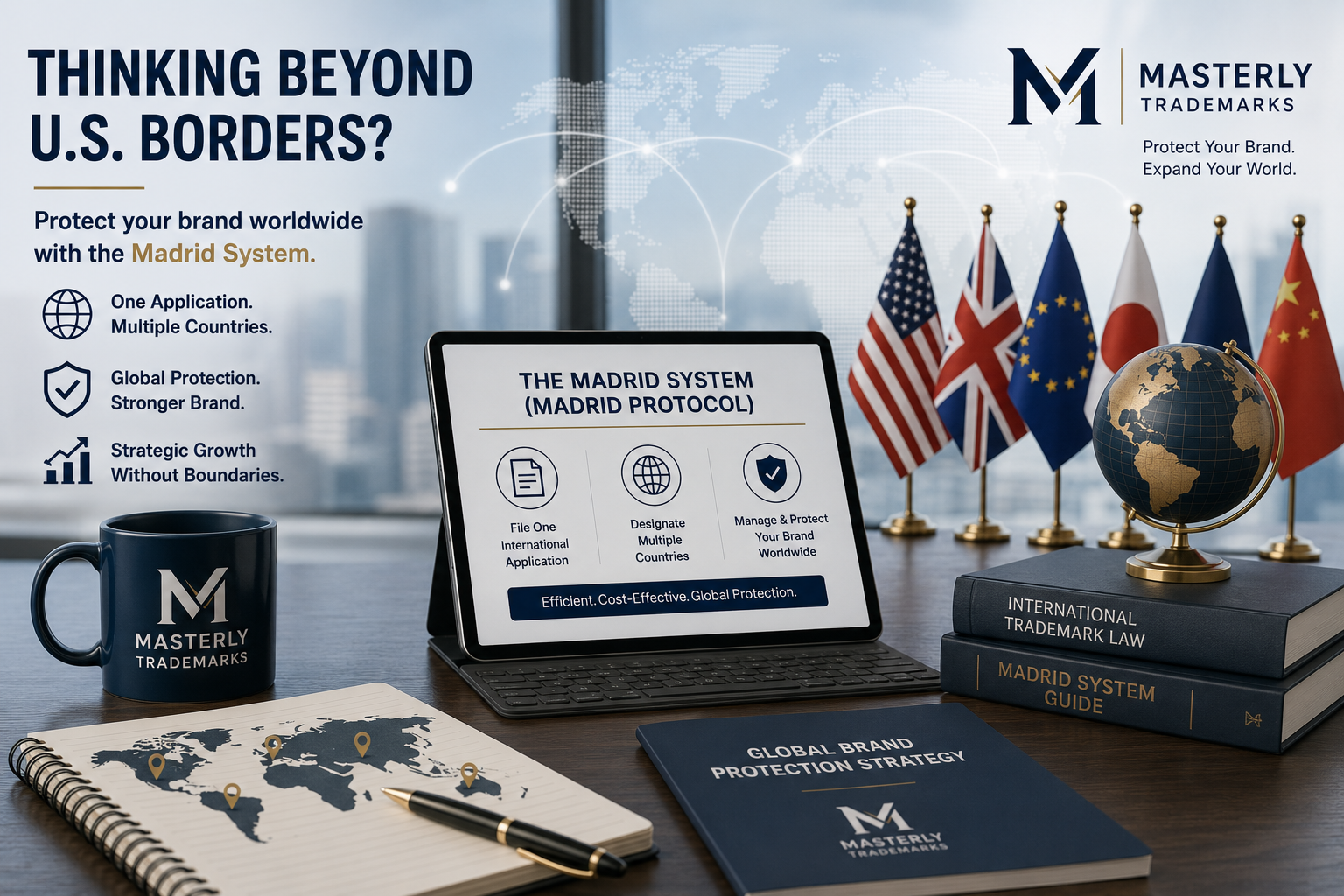
A Madrid Protocol trademark application provides a centralized, single application route to seek protection in multiple participating countries.
Rather than preparing separate initial applications in every country, eligible applicants may use the Madrid System to request protection in designated member countries based upon an existing U.S. trademark filing or registration. The Madrid System covers 133 countries, but not all countries are members of the Madrid System.
Although each designated country ultimately reviews the application under its own trademark laws, the Madrid System offers an efficient framework for managing international filings in other countries, and one filing can reduce filing costs significantly when protection is sought in multiple jurisdictions.
How International Trademark Registration Supports Business Growth
An international trademark registration strategy helps businesses prepare for expansion while protecting valuable brand assets.
International protection may become important for businesses involved in:
- Global product sales
- E-commerce
- International franchising
- Licensing agreements
- Manufacturing partnerships
- Foreign distribution
- International marketing
As your business grows, protecting your trademark in appropriate markets can become an important part of your overall intellectual property strategy.
Understanding Madrid System Filing
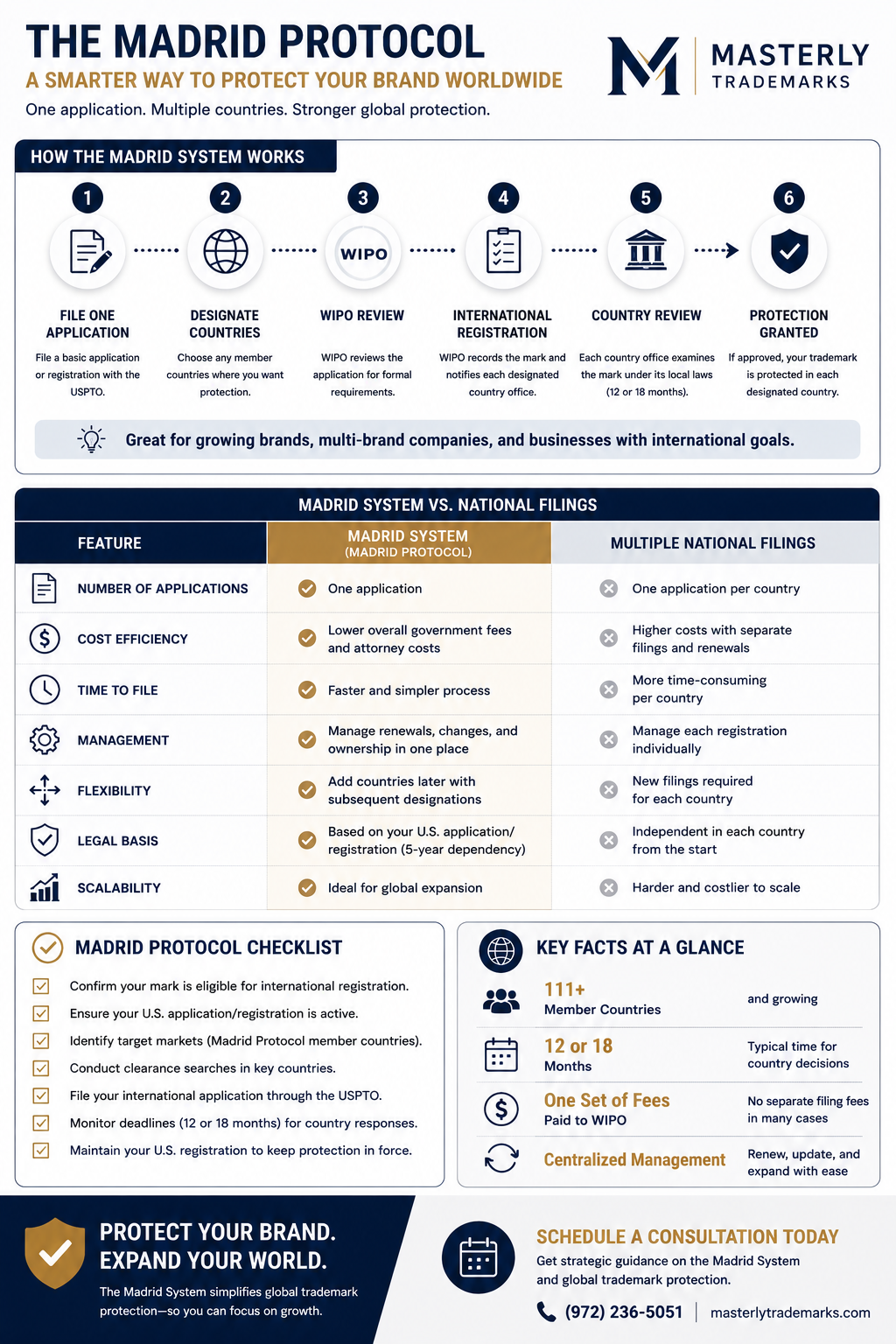
A Madrid System filing begins with a qualifying U.S. trademark application or registration and is tied to that basic registration or basic mark as the foundation for filing an international application.
Applicants file through the USPTO as the national office in their country of origin before the application is forwarded to the World Intellectual Property Organization.
The international application may be filed in one language, including English, French, or Spanish, and it includes a basic fee plus additional charges depending on the designated countries and classes.
From there, the application is transmitted to each designated member country for national examination under local laws, and each typically decides whether to grant protection within 18 months.
The Role of a WIPO Trademark Application
The international bureau of the World Intellectual Property Organization (WIPO) administers the Madrid System.
A WIPO trademark application serves as the central filing that allows applicants to request protection for a mark in multiple participating jurisdictions through one coordinated international application. After acceptance, the mark is recorded in the international register.
While the filing process is centralized, trademark rights are still evaluated separately by each designated country.
Understanding this distinction helps businesses develop realistic expectations throughout the international registration process. The centralized system also helps manage later renewals and ownership or address changes.
Why the Basic Application Matters
Every Madrid filing depends upon a qualifying basic application or registration.
The scope of protection of the international registration is tied to the underlying U.S. filing for the first five years from the registration date. If that basic application or registration fails during that period, a central attack can jeopardize the international registration and may require conversion into a national application in the relevant countries.
Carefully reviewing the U.S. application before expanding internationally helps reduce potential complications later.
Masterly Trademarks evaluates both domestic and international considerations when developing filing strategies for growing businesses.
Planning International Class Coverage
Choosing appropriate international class coverage is an important part of protecting your products and services.
Trademark protection applies only to the goods and services identified in the application.
As businesses expand into new markets or product categories, careful planning helps ensure the application reflects both current operations and anticipated growth where appropriate.
A thoughtful filing strategy considers present business activities while supporting future expansion plans.
Building a Global Brand Protection Strategy
Effective global brand protection extends beyond filing trademark applications.
Businesses should also consider:
Current Business Operations
Which countries currently generate business activity?
Future Expansion
Where does the company expect to grow over the next several years?
Brand Portfolio
Should multiple trademarks or product lines receive international protection?
Long-Term Intellectual Property Planning
How will trademark protection support licensing, franchising, partnerships, or future investments?
A coordinated legal strategy helps align trademark protection with broader business objectives.
Why Businesses Choose Masterly Trademarks
International trademark protection requires careful planning and attention to both U.S. and international filing procedures.
Masterly Trademarks represents entrepreneurs, startups, established businesses, and multi-brand organizations seeking practical legal guidance for domestic and international trademark registration.
Clients choose our firm because we provide:
Personalized International Filing Strategy
Every business has different markets, products, and expansion goals.
Comprehensive Trademark Review
We carefully evaluate domestic filings, international opportunities, and long-term branding objectives before recommending a filing strategy.
Clear Communication
We explain international trademark procedures in straightforward language so clients understand every stage of the process.
Long-Term Brand Protection
Our legal guidance focuses on protecting valuable trademarks while supporting future business growth across multiple markets
Expanding Brand Protection Across International Markets
As businesses grow beyond the United States, protecting trademarks in many countries becomes an important part of long-term intellectual property (IP) planning. The Madrid System is administered through the World Intellectual Property Organization and works alongside national trademark offices, including the United States Patent and Trademark Office, to simplify international filings. Companies seeking protection in markets such as Thailand, Trinidad and Tobago, Sudan, Sweden, Switzerland, or the Islamic Republic of Iran should carefully evaluate where trademark protection best supports their business goals. A coordinated international filing strategy helps businesses prepare for expansion while supporting participation in world trade.
Understanding Filing Costs and the Advantages of International Planning
Every international trademark strategy should consider both legal requirements and practical business needs. Depending on the countries selected, filing fees and procedural requirements will vary, making early planning especially important. One of the primary advantages of the Madrid System is that eligible applicants can seek trademark protection in multiple participating countries through a coordinated filing process rather than preparing separate initial applications for each jurisdiction. Masterly Trademarks helps businesses evaluate international filing options that align with their expansion plans while protecting valuable brands across global markets.
Frequently Asked Questions
What is a Madrid Protocol trademark?
A Madrid Protocol trademark filing allows eligible applicants to seek trademark protection in multiple participating countries through one international filing based on a qualifying domestic application or registration. The Madrid System is based on two treaties—the Madrid Agreement, which established the system in 1891, and the Madrid Protocol—and its member contracting parties together form the Madrid Union. It now covers 133 countries and lets applicants seek protection through a single international trademark application with one set of fees paid in one currency.
What is international trademark registration?
International trademark registration refers to the process of seeking trademark protection in countries outside the United States through available national or international filing systems. Applicants generally must have a connection to a member of the Madrid System through citizenship or residence in a member country, or through a real and [effective industrial] and [commercial establishment]. This route can be used to seek protection in [one or more countries] among the 133 countries covered by the system.
What is a Madrid System filing?
A Madrid System filing is an international trademark application submitted through the Madrid Protocol framework and administered by the World Intellectual Property Organization. The application process begins with a national trademark filing through a national trademark office, then moves to WIPO before examination in the countries designated. Applicants may designate one country or multiple jurisdictions, including the European Union where appropriate.
What is a basic application?
A basic application is the qualifying domestic trademark application or registration that serves as the foundation for an international Madrid Protocol filing.
Does a WIPO trademark application automatically protect my trademark worldwide?
No. A WIPO trademark application provides a centralized filing process, but each designated country independently determines whether trademark protection will be granted under its own laws.
Discuss Your International Trademark Strategy
If your business is expanding into international markets or planning to protect multiple brands overseas, your trademark strategy should grow with your business. Careful legal planning can help you evaluate available filing options, protect valuable intellectual property, and support long-term global expansion.
Masterly Trademarks represents entrepreneurs, growing businesses, and multi-brand organizations seeking experienced legal guidance for Madrid Protocol filings and international trademark protection.
Call Masterly Trademarks today at (972) 236-5051 to discuss your international trademark strategy.
You might also like