Trademark Declaration of Incontestability: When a Section 15 Filing May Strengthen a Registration
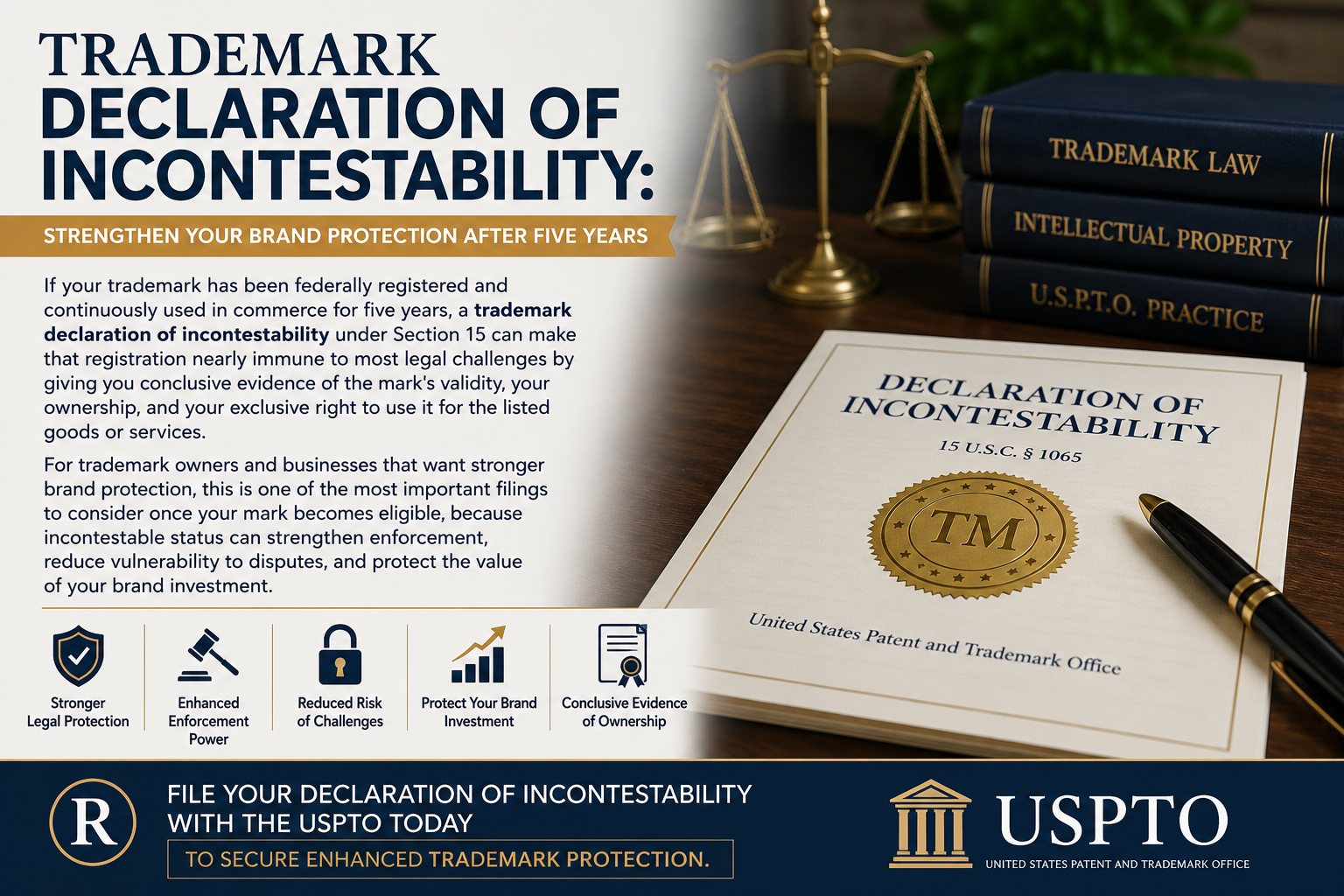
If your trademark has been federally registered and continuously used in commerce for five years, a trademark declaration of incontestability under Section 15 can make that registration nearly immune to most legal challenges by giving you conclusive evidence of the mark's validity, your ownership, and your exclusive right to use it for the listed goods or services. For trademark owners and businesses that want stronger brand protection, this is one of the most important filings to consider once your mark becomes eligible, because incontestable status can strengthen enforcement, reduce vulnerability to disputes, and protect the value of your brand investment.
This page explains who qualifies to file a Section 15 Declaration of Incontestability, when and how to file it, what legal protections it adds, where challenges still arise, and the strategic considerations to weigh before you submit.
File your Declaration of Incontestability with the USPTO today to secure enhanced trademark protection.
Why Trademark Owners Trust Section 15 Declarations
Since the Lanham Act was enacted in 1946, Section 15 declarations have provided trademark owners with one of the most effective tools in trademark law for shielding a registered mark from attack. The declaration is available exclusively to marks with five consecutive years of continuous use in commerce after the registration date - and it delivers protections that go far beyond what a standard federal registration provides.
- Blocks most common legal challenges - including descriptiveness and distinctiveness disputes that could otherwise unravel a trademark registration
- Provides conclusive evidence of the trademark's validity, ownership, and the owner's claim to exclusive right in federal court proceedings
- Proven track record - successfully filed for thousands of trademark owners since the Lanham Act's enactment, with courts consistently upholding the enhanced legal status it confers
- Upheld by the Supreme Court - in Park 'N Fly, Inc. v. Dollar Park & Fly, Inc. (1985), the Court confirmed that incontestable trademarks cannot be challenged on validity grounds such as mere descriptiveness
Why Choose Declaration of Incontestability for Your Trademark
Filing a Section 15 declaration isn't just a procedural step - it's a strategic decision that shifts the legal landscape in your favor. Here's what it does for your brand:
- Shifts the burden of proof to challengers - once your mark achieves incontestable status, anyone contesting your trademark rights must prove narrow statutory grounds like abandonment or fraud, rather than attacking the mark's inherent distinctiveness
- Eliminates vulnerability to cancellation proceedings - after the five-year mark, parties seeking to cancel your registration lose access to their most common arguments, including descriptiveness and lack of secondary meaning
- Provides business stability and peace of mind - an incontestable trademark strengthens your position in licensing negotiations, franchise agreements, and enforcement actions against infringers
- Requires only a one-time filing - there is no ongoing maintenance document specific to incontestability beyond standard trademark renewals under Sections 8 and 9, keeping your trademark registration alive with minimal additional effort
Our Declaration of Incontestability Coverage
Understanding the requirements, process, and protections of a Section 15 declaration is essential before filing. Below is a comprehensive overview of what every trademark owner needs to know about securing incontestable rights for their federally registered trademark.
Eligibility Requirements
Three core criteria must be met before you can file a Section 15 declaration:
- Principal Register registration - you can only file a Section 15 declaration for Principal Register trademarks. Trademarks on the Supplemental Register cannot achieve incontestable status, as the supplemental register is reserved for marks that have not yet demonstrated distinctiveness.
- Five years of continuous use in commerce - a Section 15 declaration requires five years of continuous use for all goods and services listed in the registration. The use must be uninterrupted and in interstate or international commerce as defined under federal trademark law.
- No adverse legal decisions or pending proceedings - there must be no final decision adverse to the owner's claim of ownership or validity, and no proceeding involving the mark currently pending before any court or the United States Patent and Trademark Office. This includes a trademark trial before the TTAB, as well as other pending matters in court or before the United States Patent and Trademark Office, and any such matter must be finally disposed of before filing.
Filing Process and Deadlines
The process to file a Section 15 declaration is straightforward but time-sensitive:
- Form submission - use the USPTO's TEAS (Trademark Electronic Application System) Declaration of Incontestability form, or opt for a combined declaration with your Section 8 maintenance filing
- Filing fee - the filing fee for a Section 15 declaration is $250 per class of goods or services as of 2026; no additional fee is required beyond this per-class charge
- Timing window - Section 8 filings are due between the fifth and sixth anniversary of registration, and the Section 15 declaration can be filed during this same window, making a combined declaration the most efficient approach
- Required information - include the registration number, registration date, a sworn statement of continuous use, confirmation of no adverse decisions or pending proceedings, and a signature under 37 CFR § 2.20
Filing a Section 15 declaration is optional and not legally required - it does not affect your renewal obligations. However, filing a Section 15 declaration is optional but recommended because the protections gained are substantial relative to the modest cost.
Legal Protections Gained
Once the patent and trademark office acknowledges your Section 15 declaration, your mark gains enhanced legal protection:
- Conclusive evidence standard - incontestable status provides conclusive evidence of trademark validity, ownership, and exclusive right to use the mark, replacing the weaker "prima facie" presumption of a standard federal registration
- Immunity from descriptiveness challenges - as confirmed in Park 'N Fly, a challenger can no longer argue that such mark is merely descriptive, even in an infringement action
- Strengthened enforcement - courts give greater weight to incontestable marks, making it easier to obtain injunctions and damages against parties using a similar mark
- Limited attack vectors - only narrow grounds survive, including genericide, abandonment, fraud in obtaining registration, and certain prior use defenses under § 33(b)
How Section 15 Declaration Works
Filing for trademark incontestability follows a clear three-step process from eligibility verification to receiving your enhanced legal status.
Step 1: Verify Eligibility
Before you file, confirm that your registered mark meets all requirements: five consecutive years of continuous use in commerce since the registration date, no final decision adverse to the owner's claim, no proceeding involving the mark pending before any court or the trademark office, including no pending trademark trial before the TTAB, and active registration on the principal register. If any goods or services listed in the registration have not been in continuous use, consider narrowing your declaration to cover only such goods or services actually used.
Step 2: File Declaration
Submit your Section 15 form through the USPTO TEAS system, pay the required filing fee of $250 per class, and provide the supporting statements under oath. Many trademark owners choose to file a combined declaration pairing Section 15 with their Section 8 maintenance filing, since both are due between years five and six. Section 8 requires proof of continuous use every ten years, and aligning the filings reduces administrative burden.
Step 3: Receive Incontestable Status
Once the USPTO processes and accepts your declaration, your mark achieves incontestable status. This means your trademark rights are now backed by conclusive evidence in any federal court proceeding - not merely a rebuttable presumption. Your enforcement capabilities are strengthened, and your brand protection extends for as long as you maintain the registration and continue use in commerce.
Success Stories
The power of an incontestable mark has been demonstrated repeatedly in federal courts, and when those rights are challenged, disputes can escalate into court litigation or a trademark trial setting:
- Illinois Tamale Company, Inc. v. LC Trademarks, Inc. (7th Cir., 2026) - in this recent appellate decision, the defendant failed to overcome the presumption of protection accorded to an incontestable mark. The court reiterated that incontestability provides high protection and that genericness challenges face a demanding evidentiary bar.
- Bullshine Distillery LLC v. Sazerac Brands, LLC (2025) - even where a challenger attempted to prove that an incontestable mark had become generic, the court reaffirmed that the burden falls squarely on the challenger. The case illustrates both the strength and the limits of incontestable status - genericness remains a valid ground, but proving it requires substantial evidence of public perception.
- Licensing and negotiation leverage - beyond litigation, trademark owners who have achieved incontestable status report stronger positioning in franchise agreements and licensing negotiations, where the enhanced legal status of the mark provides tangible assurance to business partners.
What Trademark Owners Say
This section features genuine testimonials from trademark owners who have filed Section 15 declarations. Each review reflects a real experience with the filing process and the business benefits gained from incontestable status.
[Testimonial from a business owner - including their industry, the type of mark protected, and the specific benefit they experienced, such as successful defense against a challenge or improved licensing terms.
[Testimonial from a trademark owner - describing the peace of mind and business stability that came with securing incontestable rights for their brand.]
Trademarks We Help Protect
Declaration of incontestability protection extends across every category of federally registered trademark:
- Word marks, design marks, and combination marks across all industry sectors - from technology and healthcare to retail and hospitality
- Service marks for professional and business services, including consulting, financial services, and legal practices
- Product trademarks for manufacturing, retail, and e-commerce businesses selling such goods in interstate commerce
- Certification marks and collective marks meeting specific criteria under the Lanham Act, provided they are registered on the principal register and meet the five-year continuous use requirement
Frequently Asked Questions
How much does filing a Section 15 Declaration cost?
The filing fee for a Section 15 declaration is $250 per international class of goods or services as of 2026. If your trademark covers multiple classes, each requires a separate per-class fee. No additional fee is assessed beyond this amount for the incontestability filing itself.
Can I file Section 15 with my Section 8 renewal?
Yes. The USPTO offers a combined declaration option that pairs Section 15 with your Section 8 maintenance filing. Since Section 8 filings are due between the fifth and sixth anniversary of registration - the same window when Section 15 becomes available - filing them together is the most efficient approach and ensures you don't miss the critical timing window.
What challenges can still be brought against incontestable trademarks?
Even an incontestable mark is not absolutely immune, and disputes over these issues may be litigated in court or addressed in a trademark trial before the TTAB. Limited grounds remain available to challengers, including: abandonment of the mark, fraud in obtaining the registration, the mark becoming a generic term (genericide), misrepresentation of source, certain antitrust violations, and prior use by another party before the registrant's date. According to recent legal scholarship, genericide cases have become less frequent in recent decades, but they remain the most common successful attack against incontestable marks.
Do I need an attorney to file a Section 15 Declaration?
Filing a Section 15 declaration is optional but beneficial, and while not legally required, consulting a trademark attorney is recommended for complex situations - for example, if you're unsure about eligibility requirements, if any goods or services have been discontinued, if there's been any proceeding involving your mark, or if there's a pending trademark trial. Note that this information does not create an attorney client relationship; it is provided for educational purposes only.
Request a Trademark Maintenance Review
Transform your five-year-old trademark registration into an incontestable legal asset that protects your brand investment for decades to come. Section 15 declaration makes trademark rights incontestable after five years, and the modest cost of filing delivers outsized returns in legal protection, enforcement strength, and business stability. Every year you delay is a year your mark remains vulnerable to challenges that incontestability would eliminate.
Contact a trademark attorney today to file your Section 15 declaration and secure the strongest protection available under federal trademark law.
Masterly Trademarks
Website: https://www.masterlytrademarks.com/
Phone: (972) 236-5051 .
You might also like