Trademark Dilution: What Strong Brands Should Understand About Uses That Weaken Distinctiveness
When a brand becomes famous enough to be a household name, it faces a unique kind of threat. Trademark dilution occurs when someone else's use of a similar mark weakens the distinctiveness or reputation of that famous brand, even when no consumer confusion exists. This article breaks down what dilution means, how it differs from ordinary infringement, and what established brands should know to stay ahead of risks.
Quick Answer: What Is Trademark Dilution and Why It Matters for Famous Brands
Trademark dilution is a concept in intellectual property law that protects famous marks from uses that chip away at their uniqueness or drag their reputation into unwanted associations. Unlike ordinary trademark infringement, which centers on whether consumers are likely to be confused about who makes a particular product, dilution focuses on the strength of the brand signal itself. Proving dilution does not require showing consumer confusion or direct competition between goods or services.
Here is what makes dilution distinctive as a legal concept:
Trademark dilution weakens the distinctiveness of a famous mark, even when the junior use involves completely unrelated products.
The Federal Trademark Dilution Act, enacted in 1995, created a federal cause of action specifically for owners of famous marks. It was later updated by the Trademark Dilution Revision Act of 2006.
Famous trademarks include Google, Coca-Cola, and Nike, all of which actively monitor and respond to uses that could blur or tarnish their marks.
Trademark dilution laws protect well-known marks from unauthorized use, allowing famous brands to protect their trademark across unrelated industries.
Dilution applies even if there is no consumer confusion or direct competition between the plaintiff and the defendant.
The rest of this article covers how dilution fits into trademark law, the difference between blurring and tarnishment, how courts assess fame, real-world scenarios, prevention strategies, international considerations, and when to seek professional guidance.
Foundations: How Trademark Dilution Fits Into Trademark Law
Dilution is a relatively recent layer of protection built on top of traditional trademark law. For most of its history, trademark law focused on a single mission: preventing consumer confusion and protecting source identification.
The U.S. Lanham Act, enacted in 1946, remains the core federal statute governing trade marks and trademark infringement. Its original framework revolved around the likelihood of confusion standard.
Frank Schechter's 1927 article, "The Rational Basis of Trademark Protection," argued that marks carry value beyond mere source identification. Their selling power, advertising efficiency, and uniqueness deserve protection. His ideas laid the groundwork for modern dilution theory.
Dilution concepts now appear in many jurisdictions, including the U.S., EU, India, Canada, and the UK, though each uses different terminology and legal tests. Some refer to a well known trademark or a "mark with reputation" rather than a "famous mark."
Dilution is a separate cause of action from infringement. Both can sometimes be alleged over the same conduct, but they address different harms and require different proof.

U.S. Framework: The Federal Trademark Dilution Act and Its Evolution
For brand owners with a nationwide or cross-border presence, the federal framework matters most. State statutes also exist, but federal law provides uniform protection and established precedent across the country.
- The Federal Trademark Dilution Act of 1995 amended Section 43 of the Lanham Act to create a federal cause of action for dilution of famous marks. Under the original act, a trademark owner had to prove actual dilution, meaning harm that had already occurred.
- The Trademark Dilution Revision Act of 2006 replaced the actual dilution requirement with a likelihood of dilution standard. It also refined what counts as a famous mark, clarified definitions of blurring and tarnishment, and inserted statutory exclusions for fair use, noncommercial use, and news reporting.
- Federal law, specifically 15 U.S.C. § 1125(c), governs trademark dilution in the U.S. and protects only marks that are widely recognized by the general consuming public, not just within a niche industry or limited trade channel.
- The act applies even when the allegedly diluting use involves unrelated goods or services, as long as the statutory elements are met. A company does not need to compare goods or show competition to bring a dilution claim.
What Counts as a "Famous Mark" for Dilution Protection
Fame is the gateway requirement for any federal dilution claim. Most marks, even strong ones with acquired distinctiveness, will not qualify as famous under this standard.
The legal threshold for dilution requires a mark to be widely recognized by the general public. Courts look for recognition by the general consuming public across the country, not just within a regional market or specific trade channel. A trademark must be famous to qualify for dilution protection, and fame must be recognized by the general consuming public.
Statutory factors courts consider include:
- Duration, extent, and geographic reach of advertising and publicity
- Volume of sales of goods or services under the mark
- Extent of actual recognition, often established through consumer surveys
- Whether the mark is federally registered
- Degree of exclusive use by the owner
Classic examples of famous marks cited in decisions and legislative history include Coca-Cola, Kodak, Xerox, Google, and Nike. The phrase "Kodak pianos" has been used since the early days of dilution theory to illustrate how a household name can be weakened by use on unrelated products.
By contrast, a highly distinctive but niche B2B mark might be strong enough for infringement purposes but lack the broad public recognition needed for dilution protection. Fame is always fact-specific and time-bound. Other jurisdictions use concepts like a well known mark or "reputation" within a territory, with different thresholds.

Types of Trademark Dilution: Blurring and Tarnishment
Brand dilution generally falls into two categories recognized by most modern laws. Understanding both is essential for any company concerned about protecting brand distinctiveness. There are two primary types of trademark dilution: blurring and tarnishment. Some jurisdictions also discuss free-riding, where someone exploits another's trademark reputation without authorization.
Blurring: When a Famous Mark Stops Pointing to a Single Source
Blurring dilutes distinctiveness rather than attacking reputation. It occurs when a third party uses a famous trademark on non-competing goods, causing the mark to point to multiple sources rather than one. Blurring occurs when a famous mark's uniqueness is impaired, and it weakens a famous mark's distinctiveness over time.
Consider a hypothetical: imagine a luxury watch brand called "ZYNORA," known worldwide for precision timepieces. If an unrelated company starts selling budget luggage and online courses under the name ZYNORA, consumers begin to see the name as a general label rather than a signal of a single prestigious brand. Even if no one thinks the watch company actually makes the luggage, the mental connection between ZYNORA and luxury watches erodes.
Under the 2006 U.S. TDRA, courts evaluating blurring look at factors including similarity between the defendant's mark and the plaintiff's mark, the distinctive character of the famous mark, the extent of exclusive use, degree of recognition, and whether the junior user intended to create an association. Blurring can occur even if consumers are not misled about who actually made the goods. The injury is to the uniqueness of the brand signal itself.
Tarnishment: When a Famous Mark Is Dragged into Negative Associations
Tarnishment is about reputation damage rather than simple overuse. It happens when a mark is associated with inferior products, explicit content, or offensive messages in a manner that could degrade public perception. Tarnishment harms the reputation of a famous mark by creating negative associations in consumers' minds.
Concrete examples include a famous children's toy brand's name being used for adult-themed entertainment services, or a luxury fashion mark appearing on poor-quality knockoff goods. In the well-known Moseley v. V Secret Catalogue case, the Supreme Court addressed whether an adult novelty store named "Victor's Little Secret" could tarnish the Victoria's Secret brand.
Some legal systems treat tarnishment explicitly as a form of dilution, while others fold it into broader concepts of unfair competition. Free-riding occurs when a mark benefits from another's reputation without contributing to or maintaining the goodwill behind it.

Dilution vs. Trademark Infringement: Key Differences for Brand Strategy
Established brands must understand the distinction between dilution and infringement when assessing risk and enforcement options. These are not interchangeable theories, and the evidence requirements differ substantially.
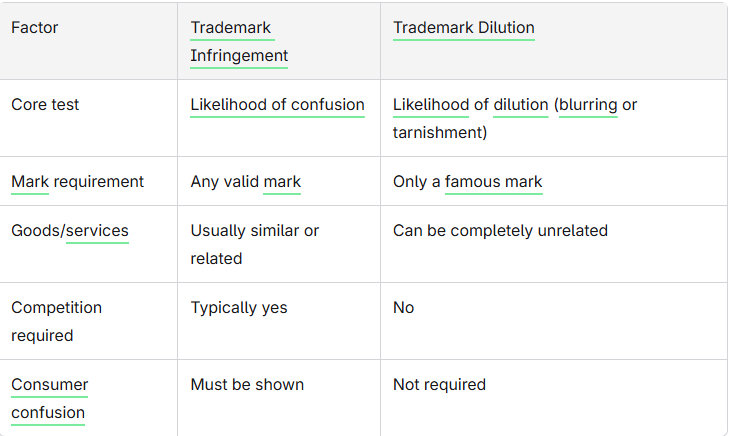
In practice, a widely recognized international fast-food chain can likely assert both infringement and a dilution claim if a smaller company adopts identical trademarks or a similar mark. A well-known regional restaurant, however, might succeed on infringement but lack the nationwide recognition to support a dilution claim in district court. In most cases, businesses assert both theories in the same dispute, but the legal thresholds are different for the plaintiff in each.
Exceptions, Defenses, and Free-Speech Considerations
Dilution law is intentionally limited by defenses to balance trademark protection with free speech and fair competition. Not every reference to a famous brand triggers liability.
Common statutory exclusions under U.S. law include:
- Fair use in comparative advertising and descriptive use
- Nominative fair use, where someone references a brand to identify its products
- News reporting and commentary
- Noncommercial use, including certain artistic and expressive works
- Parody and satire, though the boundaries are context-dependent
Courts have wrestled extensively with parody. In the dispute between Starbucks Corporation and Wolfe's Borough Coffee, the defendant sold a product called Charbucks Blend. The court had to evaluate whether the playful reference was protected expression or actionable dilution. A satirical t-shirt referencing a famous soft-drink brand to comment on consumer culture might be protected, but some uses that look humorous can still raise real legal concerns if they harm the connection between the mark and its owner.
Whether a use qualifies as fair or exempt is highly context-specific. Anyone planning a high-risk campaign using a famous mark should seek tailored legal advice rather than relying on general rules.
Real-World Business Scenarios: How Dilution Risks Appear in Practice
Recognizing potential dilution problems early can save a company significant time and expense. Here are common scenarios where dilution risks appear:
- A luxury brand over-licenses its name onto low-quality novelty items across dozens of unrelated categories. Even without a third-party infringer, the brand owner's own behavior can erode distinctiveness and weaken future enforcement.
- Someone registers a domain name or social media handle using a famous brand for content unrelated to or damaging to that brand. Trademark dilution includes unauthorized use of famous marks in digital channels, and these situations increasingly trigger enforcement action.
- A brand famous in one country encounters look-alike uses in cross-border e-commerce. Whether that violates local law depends on how each jurisdiction defines fame and what remedies exist.
- Internal teams use the mark casually as a noun or verb in marketing materials, contributing to genericization over time. This self-inflicted brand dilution can undermine the very distinctiveness that dilution protection depends on.
Brand Distinctiveness and Prevention: How Strong Brands Guard Against Dilution
Preventing brand dilution is almost always more cost-effective than responding to it after harm occurs. Dilution protection varies by jurisdiction and requires distinctiveness, so maintaining that distinctiveness is a strategic priority.
- Use brand assets consistently. Logos, word marks, and taglines should reinforce a single, clear identity across every channel.
- Implement internal brand-use guidelines explaining how to reference the mark correctly, as an adjective rather than a noun or verb. "Kleenex tissue" and "Google search" are examples of brands that actively enforce correct usage to prevent genericization.
- Build a monitoring program for online marketplaces, domain registrations, social media, and major advertising channels to spot potential blurring or tarnishment early.
- Tier enforcement strategically. Not every minor reference needs a formal legal demand, but repeated or high-profile uses that threaten distinctiveness should be evaluated promptly by the owner.
- Federal registration in the U.S. strengthens enforcement, but registration alone is not enough. Dilution prevention depends heavily on disciplined brand behavior and long-term reputation management.

International Perspectives: How Dilution Concepts Vary Across Jurisdictions
Global brands must navigate different statutory language and standards. Dilution protection varies by jurisdiction and its requirements, and dilution protection varies by jurisdiction and mark fame, so a one-size-fits-all approach does not work.
- The European Union protects marks with a "reputation" against unfair advantage and detriment to distinctive character or repute, which closely resembles U.S. dilution concepts.
- India's Trade Marks Act, 1999, particularly section 29(4), provides explicit protection for marks with a reputation against use on dissimilar goods or services without due cause.
- WIPO's guidance on well-known marks promotes international recognition of exceptional brands, but domestic statutes and case law still control outcomes within each country.
- Fame thresholds, available remedies, and how courts distinguish blurring from tarnishment differ from one jurisdiction to another. Multinational enforcement strategies must be tailored accordingly.
Famous trademarks must be widely recognized to qualify for dilution protection in any jurisdiction, but the extent of recognition required and how it is measured varies considerably.
Remedies and Strategic Enforcement Choices for Famous Marks
Understanding potential remedies helps brand owners calibrate when and how aggressively to respond to possible dilution.
- In many systems, including the U.S. federal framework, the primary remedy is an injunction, a court order to stop the diluting use. This can be obtained before serious harm occurs under the likelihood standard.
- Under certain conditions, such as willful intent to trade on a famous mark's reputation, courts may award monetary relief. This can include damages or an account of profits, depending on local law.
- Some jurisdictions and state-level laws focus more narrowly on stopping the use rather than awarding substantial financial compensation.
- Brand owners often weigh business factors before pursuing formal enforcement: public relations impact, relationship with counterparties, likelihood of success, costs, and the goodwill implications of aggressive legal action.
Remedies should be viewed as tools within a broader brand-protection strategy, not as guaranteed outcomes.
When to Seek Legal Guidance About Possible Trademark Dilution
Legal consultation works best as a preventive and strategic step, not something reserved only for active disputes.
Consider professional review when:
- You spot your famous or near-famous mark on unrelated products or services
- Your mark appears in controversial, explicit, or low-quality contexts
- You are planning a major brand extension that may interact with others' strong marks
- You want to prove that your mark has achieved the level of recognition needed for dilution protection
Facts, fame level, and jurisdiction all matter. Two similar-looking scenarios can have very different legal implications depending on where and how the mark is used. Businesses with strong or potentially famous marks should periodically audit their brand-protection posture, including registrations, monitoring, and internal usage practices.

If your brand has reached a level of significant public recognition and you want to evaluate your protection strategy, request a trademark consultation with Masterly Trademarks at (972) 236-5051. A tailored review can help you understand your options and prioritize the steps that matter most for your brand's long-term distinctiveness.
You might also like