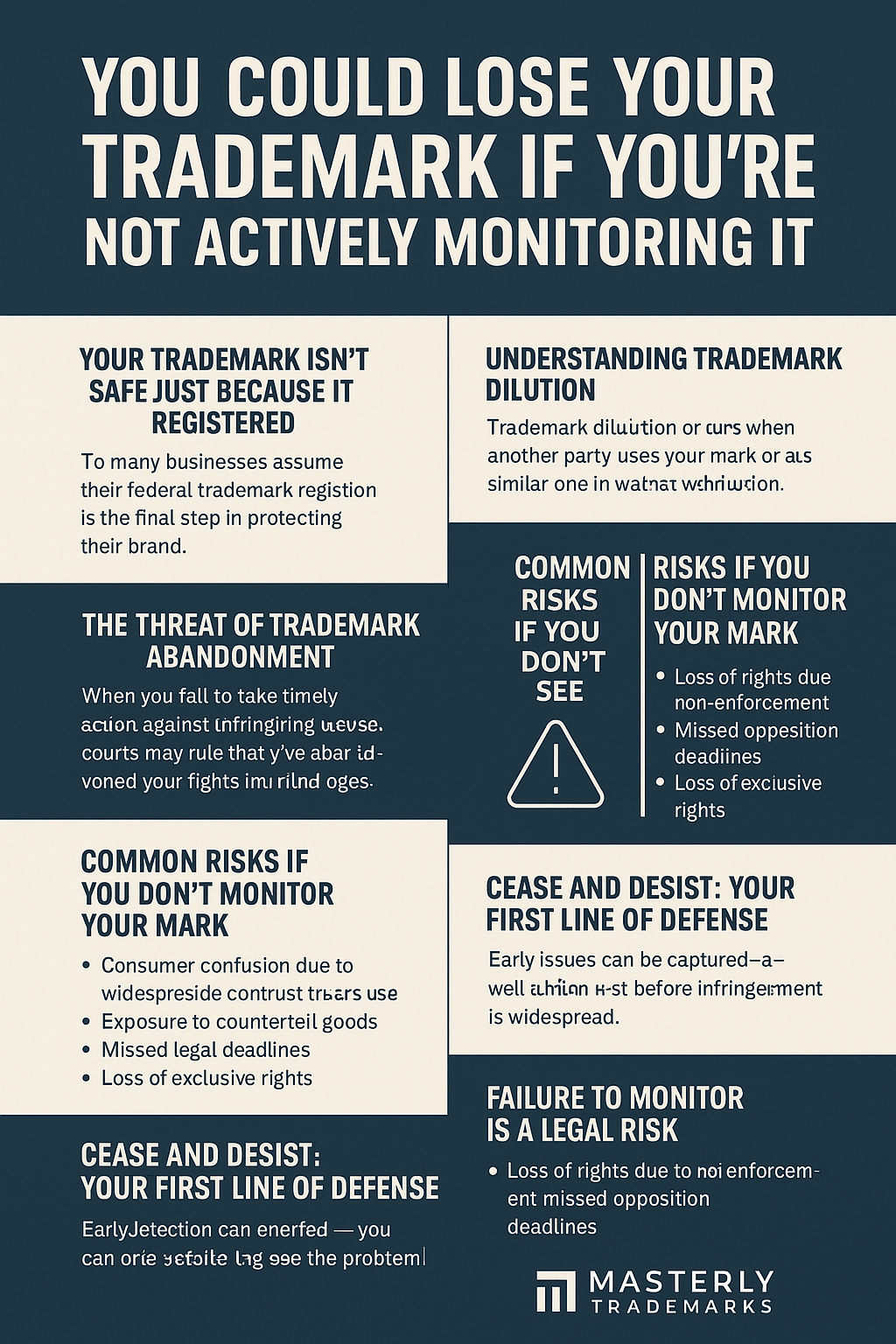
You Could Lose Your Trademark If You’re Not Actively Monitoring It
Your Trademark Isn’t Safe Just Because It's Registered
Too many businesses assume their federal trademark registration is the final step in protecting their brand. In reality, registration is only the beginning. The trademark office does not police the marketplace or stop others from using confusingly similar names or logos.
If you're not actively using a trademark monitoring service, you're leaving your intellectual property wide open to infringement and dilution. Masterly Trademarks emphasizes that continuous oversight is essential to protecting your trademark rights.
The Threat of Trademark Abandonment
A trademark is only valid if it is actively used and defended. When you fail to take timely action against infringing use, courts may rule that you've abandoned your rights. The Arizona Supreme Court and other judicial bodies have reinforced that brand owners must demonstrate ongoing interest in protecting their marks.
Without consistent monitoring, it's easy to miss infringing use or let potential threats slip by unnoticed. This could make your registered trademarks vulnerable to cancellation.
Understanding Trademark Dilution
Trademark dilution occurs when another party uses your mark or a similar one in a way that weakens its distinctiveness. This can happen even if there is no direct competition or consumer confusion. Famous marks are especially at risk.
Dilution reduces your brand's value and opens the door to counterfeit products or reputation damage. Monitoring services help identify potential trademark infringements early, before dilution becomes irreversible.
You Can’t Enforce What You Don’t See
The trademark office does not alert you to new applications that might conflict with your own. That responsibility falls to you, your legal counsel, or the trademark attorneys you hire. If you don't monitor trademark applications, you may miss your chance to oppose confusingly similar trademarks.
Early detection is key. Timely action can prevent harmful registrations and avoid costly disputes later.
Common Risks If You Don’t Monitor Your Mark
Not using a trademark monitoring service could lead to:
- Consumer confusion caused by similar trademarks or business names
- Loss of distinctiveness due to widespread unchallenged use
- Increased vulnerability to counterfeit goods
- Missed deadlines for filing oppositions or legal action
- Brand dilution and eventual loss of exclusive rights
This is especially risky for small businesses without internal legal teams or alert systems in place.
What Trademark Monitoring Actually Does
Trademark watch services scan newly filed trademark applications in the USPTO database and international registries. These systems identify potential risks and provide alerts to your team.
Effective monitoring should cover:
- Search engines and online platforms
- Domain names and social media platforms
- Trademark office filings, including global coverage
- Similar marks and design marks across industries
Our monitoring services at Masterly Trademarks deliver tailored insights and reduce false positives.
Real-Time Alerts Prevent Long-Term Problems
When you subscribe to a trademark monitoring service, you receive:
- Immediate alerts about potentially infringing or confusingly similar marks
- Monthly reports with actionable insights and legal guidance
- Early warnings about use of your trademark in domain names, ads, or social media
- Watch services adapted to your specific industries or regions
This information allows you to respond quickly, send cease and desist letters, and take legal action where needed.
Cease and Desist: Your First Line of Defense
When a potential trademark infringement is detected, a well-drafted desist letter can often resolve the issue without going to court. But you can’t send one if you’re not aware of the problem.
Monitoring systems ensure you catch issues early and act before infringement becomes widespread.
Failure to Monitor is a Legal Risk
Ignoring your trademark obligations may lead to:
- Loss of rights due to non-enforcement
- Missed opposition deadlines
- Greater difficulty proving bad faith in court
Even the most comprehensive brand protection strategy fails without continuous oversight. A law firm experienced in intellectual property can help you identify potential risks and stay compliant.
USPTO Doesn’t Do It for You
Many assume that the United States Patent and Trademark Office will flag infringements. This is not the case. The USPTO only checks for conflicts during the initial registration process. After that, you are responsible.
Monitoring trademark activity gives you control over your legal protection.
Global Brands Face Global Risks
International markets add complexity. Infringements can occur anywhere your brand has exposure. A unified platform with global coverage allows you to:
- Monitor trademark applications filed in other countries
- Detect unauthorized use of your trademarks on international platforms
- Respond quickly to emerging threats across borders
This is crucial for brands expanding into new territories.
How Monitoring Supports Legal Compliance
Trademark monitoring supports legal compliance by:
- Ensuring timely response to potential conflicts
- Helping maintain documentation for legal action
- Providing evidence of enforcement for court proceedings
Experienced attorneys can interpret results and guide next steps to keep your trademark portfolio secure.
The Cost of Inaction
Failing to monitor can lead to expensive litigation, lost revenue, and brand damage. A single missed filing or overlooked application could result in losing your mark.
Monitoring is far more cost-effective than defending against infringement or rebranding entirely.
What Makes a Monitoring Program Effective
An effective monitoring solution should offer:
- Real-time alerts with minimal false positives
- Monthly report summaries and trend tracking
- Filters by industry, region, or keyword
- Integration with your legal services or law firm support
At Masterly Trademarks, our trademark monitoring service provides all of this and more.
Examples of Missed Opportunities
Case studies show what happens when monitoring is ignored. For example:
- A fitness company lost its exclusive name due to a rival’s earlier filing
- A skincare brand missed infringing domain names that misled consumers
- A clothing line unknowingly allowed similar trademarks to dilute their reputation
Each of these could have been prevented with an alert system.
Monitoring Tools Built for Small Businesses
You don’t need a corporate legal department to protect your trademarks. Masterly Trademarks offers scalable monitoring plans for:
- Entrepreneurs
- E-commerce brands
- Content creators
- Local service providers
We help small businesses gain the same competitive edge as larger brands.
Monitoring Isn’t Just for Logos
Trademark protection applies to:
- Business names
- Slogans and taglines
- Domain names
- Product names
- App titles
Monitoring all brand assets helps build comprehensive protection.
Proactive vs. Reactive Legal Strategy
It’s far easier and less costly to prevent trademark conflicts than to resolve them. With early detection and legal counsel, you can:
- Block similar trademarks before they register
- Stop unauthorized use of your assets
- Maintain strong trademark rights with timely action
Masterly Trademarks helps you take control.
Benefits of Hiring Experienced Attorneys
Our trademark attorneys are equipped to:
- Interpret alerts and identify real threats
- Draft effective cease and desist letters
- File timely oppositions to protect your rights
- Help you build a trademark portfolio that lasts
We bridge the gap between alerts and legal action.
Tailored Insights for Your Brand
Every industry faces different threats. Our team adjusts monitoring filters to meet your specific needs. Whether you’re in healthcare, tech, fashion, or food service, we make sure your trademark watch focuses on the most relevant threats.
Competitive Edge with Constant Oversight
Monitoring isn’t just about defense. It’s a business advantage. By keeping an eye on the competition, you:
- Stay informed about new entrants
- Learn about upcoming products
- Discover copycats before they go public
This intelligence empowers your marketing and legal strategy.
The Role of Domain Name Monitoring
Your brand extends beyond trademarks. Protect your domain names by tracking:
- Typosquatting (e.g., masterlytrademaks.com)
- Competing names in new extensions (.net, .shop, etc.)
- Unauthorized use of your trademark in URLs
We help monitor and take action against bad actors.
Monthly Reporting with Actionable Insights
Our monthly reports are designed to:
- Highlight urgent alerts
- Track trends in potential threats
- Recommend immediate action or legal review
You’ll never be caught off guard by trademark activity.
Monitoring on Social Media Platforms
Your brand is exposed across multiple online platforms. We help you detect unauthorized use of your marks in:
- Usernames and profiles
- Hashtags and comments
- Advertising campaigns
Immediate action can prevent serious consumer confusion.
Staying Ahead of the Curve
Trademarks aren’t static. Trends, slang, and marketing angles shift quickly. Active monitoring ensures you adapt as the landscape evolves.
Masterly Trademarks keeps your strategy future-proof.
Missing Deadlines Means Missing Protection
When it comes to trademark protection, potential infringements don’t always come in the form of obvious copycats. Sometimes, the danger lies in subtle similarities—business names, logos, or taglines that confuse consumers and dilute your brand. If you’re not actively monitoring for new USPTO filings, you could miss your window to challenge those threats. The United States Patent and Trademark Office has applicable deadlines for opposing trademark applications that could harm your brand. If you miss those deadlines, you forfeit the opportunity to take swift legal action, and your rights may weaken as a result. Ongoing monitoring ensures you never miss a filing or fail to act against a creeping infringement.
Why You Need a Trademark Monitoring Attorney on Your Side
Hiring a trademark monitoring attorney isn’t just a legal formality—it’s a proactive strategy to protect your brand's future. While automated watch services can detect similar marks, only an experienced attorney can interpret complex trademark activity and determine which filings pose real threats. A skilled attorney will ensure you meet critical deadlines, file timely oppositions to harmful applications, and send effective cease and desist letters when necessary. They also help you navigate USPTO filings, monitor for potential infringements, and maintain your rights through consistent enforcement. At Masterly Trademarks, our attorneys offer tailored legal support that combines technology with professional insight—giving your trademark the protection it deserves.
What Makes the Best Trademark Monitoring Truly Effective
The best trademark monitoring goes beyond generic alerts—it provides real-time, relevant, and actionable data that protects your brand from all angles. At Masterly Trademarks, our monitoring services are designed to track potential infringements across multiple channels, including USPTO filings, domain names, social media platforms, and online marketplaces. We combine cutting-edge software with legal expertise to ensure you're not only aware of threats but also positioned to act on them. With timely notifications and a legal team ready to enforce your rights, our system helps you meet applicable deadlines and maintain control over your intellectual property. For brand owners serious about protection, settling for anything less than the best isn’t an option.
Strengthen Your Brand Strategy with Online Trademark Monitoring
While copyright protection helps secure your original creative works, trademark protection goes a step further by safeguarding the unique identifiers of your brand. One of the most effective ways to maintain this protection is through online trademark monitoring. This service helps businesses track the unauthorized use of their trademarks across digital platforms, domain registrations, and marketplaces. By identifying potential infringements early, you can act swiftly to protect your brand reputation and legal rights. Unlike copyright—which is typically concerned with ownership and use of content—trademark law focuses on preventing consumer confusion and maintaining brand integrity. Incorporating online trademark monitoring into your IP strategy ensures your trademarks remain exclusive and enforceable in a fast-paced digital world.
Protect Your Brand with a Trademark Monitoring Attorney Service
In the ongoing effort to distinguish and protect your intellectual property, trademarks play a vital role in securing your brand identity. While copyright law protects original works like songs or novels, trademark law ensures your brand’s name, logo, or slogan remains uniquely yours in the marketplace. To keep that protection strong, many businesses turn to a trademark monitoring attorney service. These services provide legal oversight to detect unauthorized use, confusingly similar marks, or potential infringements as soon as they arise—both online and in new trademark filings. With an experienced attorney monitoring your trademarks, you gain proactive defense and swift action to preserve your brand’s integrity and legal standing.
Don’t Let Your Trademark Slip Away
At Masterly Trademarks, we specialize in protecting brands like yours from silent threats. Our comprehensive trademark monitoring services are designed to help you identify potential risks, act quickly against infringement, and maintain full control of your intellectual property.
Whether you're looking for ongoing watch services, legal counsel, or cease and desist letter support, we have the tools and experience to safeguard your brand.
Contact us today at (972) 236-5051 to schedule your free consultation and discover how monitoring can protect your trademark rights.
You might also like