Trademark vs Copyright: What Business Owners Need to Protect and Why the Difference Matters
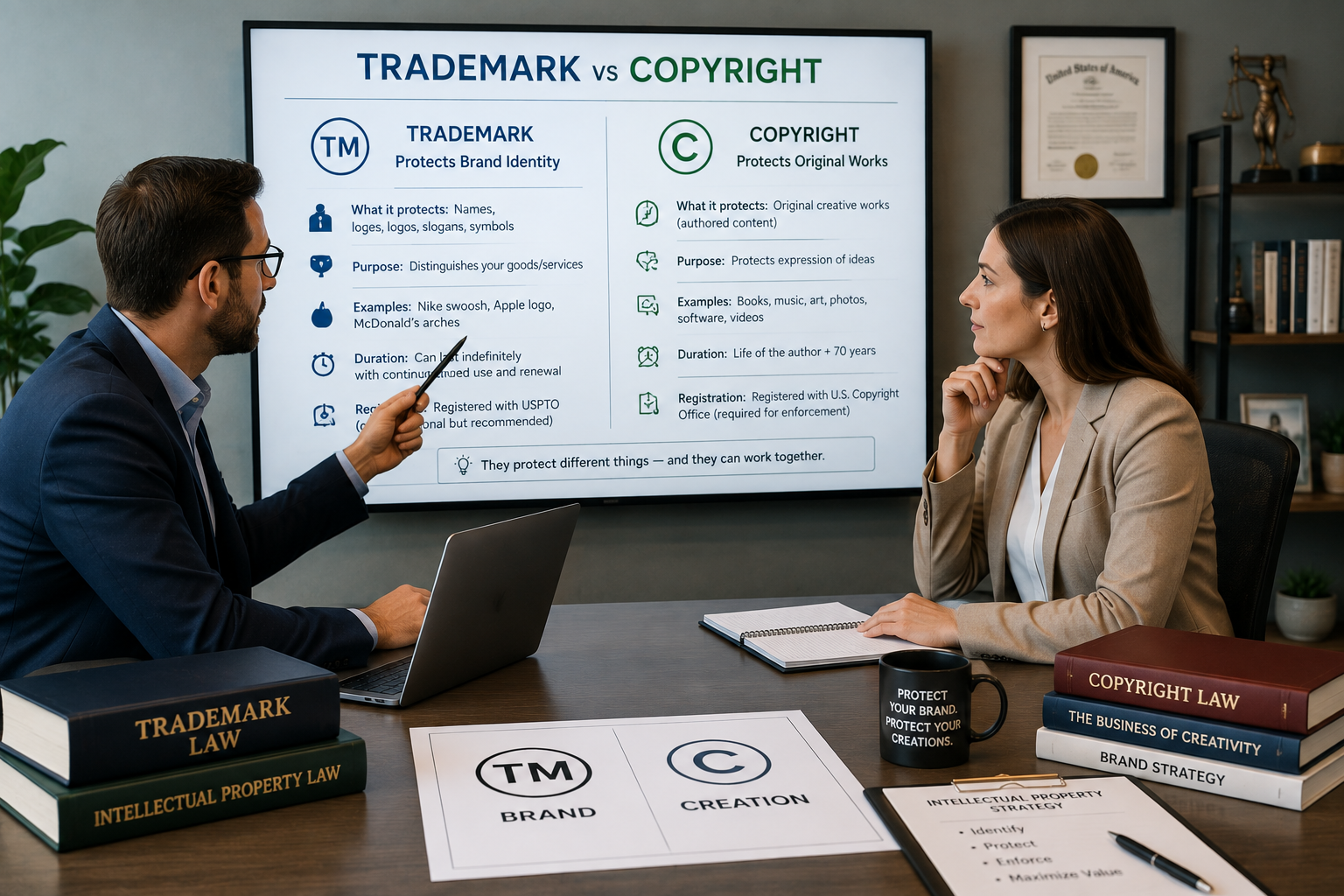
If your business creates original content, builds a brand, or launches products in the U.S. market, understanding trademark vs copyright is one of the most important IP decisions you'll make in 2026. In direct terms: copyright protects original creative works, while trademark protects brand identifiers such as names, logos, and slogans; Semrush U.S. demand data shows searches for "trademark vs copyright" are rising, which reflects how many business owners, entrepreneurs, brand managers, and creators need a clear answer before they file, launch, license, or enforce their rights.
This guide explains what each form of protection covers, the U.S. registration requirements, costs and timelines to expect in 2026, how enforcement and recent case law affect real-world decisions, and how to choose the right protection for your content, brand assets, and products. Getting this wrong can mean avoidable legal disputes, lost revenue, weaker brand visibility, or paying to protect the wrong asset under current federal rules.
Why U.S. Businesses Trust This Trademark vs Copyright Analysis
- Backed by Semrush demand data (2024–2026): Keyword search volume and keyword difficulty metrics drawn from Semrush's U.S. database confirm sustained, high-interest demand for IP comparison topics
- Verified by federal guidelines: All registration costs, timelines, and requirements reflect current USPTO fee schedules (updated August 14, 2026) and U.S. Copyright Office provisions
- Used by over 6,000 businesses for intellectual property decisions across technology, manufacturing, e-commerce, and creative sectors
- Updated with 2025–2026 case law: Including Southern District of New York rulings on AI-generated content and TTAB decisions on trademark distinctiveness
Why This Guide Leads U.S. IP Protection Decisions
Most guides on trademark vs copyright offer dictionary-level definitions without connecting the dots to real business outcomes. This guide’s aim is to connect legal decisions with what users are actually searching for, and it’s the only resource that pairs Semrush search demand insights with actionable IP law strategy based on current federal requirements.
- Semrush data meets practical IP application: We identify the best keywords and topics in the intellectual property space - phrases with high search volume like "copyright registration cost" and "trademark registration process" - and answer the exact questions users are asking search engines, so matching search intent improves relevance and helps content rank
- Real-world examples across industries: From Fortune 500 brand protection programs to startup logo filings, every recommendation helps create a clearer path from research to documented outcomes
- Cost-benefit clarity: Our analysis shows businesses that proactively register IP save an average number of $15,000 in legal fees compared to those who react after infringement occurs
- Decision framework used by IP attorneys nationwide: Step-by-step guidance that eliminates guesswork and helps you decide which protection type - or both - fits your situation
Our Intellectual Property Protection Services
Both trademarks and copyrights are forms of intellectual property (IP) in the U.S., but they protect fundamentally different things. Businesses searching for answers in this space typically need help with one or both categories. Here's a scannable comparison of what each covers and when you need it.
Trademark Protection and Keyword Research Strategy
Trademarks protect brand identifiers such as names, logos, and slogans. The primary goal of trademark law is to prevent consumer confusion in the marketplace - stopping competitors from using marks that could confuse consumers about the source of goods or services.
- What requires trademark protection: Business names, brand names, logos, taglines, product names, and distinctive trade dress used in commerce
- Federal vs. common law rights: Unregistered trademarks offer limited geographic protection. Registered trademarks provide legal advantages and stronger protection against infringement, including nationwide priority, the ability to record with U.S. Customs, and a legal presumption of validity
- Timeline and cost: Filing electronically with the USPTO costs $350 per class of goods/services. Intent-to-use applications require additional fees (~$150 per class). Expect 8–12 months from application to registration for use-in-commerce filings. Trademark rights can last indefinitely if the mark is actively used and maintained
Copyright Protection Strategy
Copyrights protect original works of authorship fixed in a tangible medium - books, music, artwork, software, photography, architectural designs, and other creative content. Copyright protection attaches automatically when an original work is created and fixed, but registration unlocks critical legal remedies.
- What needs copyright registration: Any original creative work you plan to enforce or monetize - written content, visual designs, software code, marketing materials, video, and music
- When automatic protection is enough: Copyright protects the expression of an idea but not the idea itself. Automatic rights exist upon creation, but without registration you cannot bring a federal infringement suit or claim statutory damages
- Registration outcomes: Electronic filing costs $45 for a single-author, single work (not for hire); standard applications cost $65. Copyright protection typically lasts for the life of the author plus 70 years. Copyright does not protect facts or ideas but only the particular expression of those ideas
How to Choose Between Trademark and Copyright Protection
Choosing the right IP protection isn't a simple either/or - and the process itself is a key decision-driver that determines enforcement strength, budget, and long-term brand value. Here's the framework IP attorneys use.
Step 1: Identify Your Intellectual Property Type
Start with a clear assessment. Ask: does this asset identify my brand in commerce, or is it an original creative work?
- Brand identifiers (trademark territory): Business name, logo, slogan, product line name, packaging design that signals source
- Creative works (copyright territory): Written content, visual art, photographs, music, software, architectural plans, marketing copy
- Overlap zone: A logo may qualify for both - copyright covers the artistic design; trademark covers its use as a brand identifier. Dual protection gives you broader enforcement tools
After identifying your IP category, you can target the correct registration path and budget accordingly.
Step 2: Evaluate Protection Requirements and Search Intent
Search intent is the goal behind a user's search, and the same principle applies to IP strategy - know exactly what you're trying to protect and why. In SEO, the four types of search intent are informational, navigational, commercial, and transactional. Navigational intent applies when someone is trying to reach a specific website or brand. Commercial intent means users are comparing options before a purchase, while transactional intent means they are ready to act.
- Geographic scope: Do you need protection in your local market, nationally, or in other countries? Federal trademark registration covers the entire U.S.; international coverage requires additional filings (e.g., Madrid Protocol)
- Competitive landscape: Use keyword research principles here - just as keyword difficulty indicates how hard it may be to rank for a specific keyword, evaluate how many competitors target similar marks or content in your industry. Ranking difficulty depends on several factors, including competition, domain authority, content quality, and backlinks. Because domain authority affects how hard it is to rank for keywords, high-authority domains often create high difficulty, while weaker domains can leave room to compete. Even low volume keywords can be worth targeting when the phrase is highly specific and the field is less crowded.
- Budget and enforcement capacity: Trademark litigation can run tens of thousands of dollars; copyright enforcement ranges from DMCA takedowns (low cost) to full federal litigation. Plan your budget based on the realistic threat level
Step 3: File and Maintain Your Protection
- Trademark filing and renewal: File via USPTO's electronic system. After registration, file a Section 8 declaration at year 6 ($325/class) and combined Section 8 & 9 renewal at year 10 ($650/class). Ongoing monitoring - watching for confusingly similar marks - is essential
- Copyright registration and deposit: Submit proper application, deposit copies, and pay the applicable fee. Register before or within 3 months of publication to preserve eligibility for statutory damages
- Ongoing enforcement: Track potential infringements through monitoring services, including the right tool to flag issues across your website or site if you publish content or sell online, cease & desist letters, TTAB opposition proceedings (trademark), or DMCA notices (copyright). The cost of enforcement is a factor businesses must plan for upfront
Real Protection Results and Keyword Rankings from U.S. Businesses
IP protection delivers measurable outcomes when executed properly. The numbers tell the story:
- Damage awards data (2011–2020): Average copyright infringement case awards reached approximately $7.57M in 2018, compared to ~$4.79M for trademark infringement cases in the same year - demonstrating the significant financial stakes involved
- AI-generated content disputes: In 2025–2026, the Southern District of New York permitted copyright infringement allegations for AI-generated outputs that closely resembled copyrighted works, signaling that courts are expanding enforcement boundaries
- TTAB enforcement: Recent TTAB decisions affirmed refusal of trademark registrations due to likelihood of confusion, even when consent agreements existed - reinforcing that legal action must be grounded in strong registration
- Revenue protection: Businesses with registered trademarks and copyrights consistently report faster resolution of infringement disputes and higher settlement recoveries than those relying solely on common law rights
What Our Legal Partners Say
[Space for genuine testimonials from IP attorneys and business owners who have used trademark and/or copyright protection services. Include the attorney's name, practice area, and geographic location. Focus on specific outcomes - filing costs saved, infringement cases resolved, brand value preserved. Example format:]
"[Quote about specific outcome, timeline, and value delivered]"
- [Attorney Name], [Firm], [City/State]
"[Quote about the decision-making process between trademark and copyright protection and the practical result]"
- [Business Owner Name], [Company], [Industry]
Industries and Search Engines We Cover
Different industries face different IP challenges, and each industry needs a different page and content approach depending on whether the user’s intent is informational or driven by transactional intent. Here's how trademark vs copyright protection applies across the sectors we serve:
- Technology & SaaS platforms: Logos require both trademark and copyright protection. Product names and platform brands need federal trademark registration. Software code is copyright-protected. Many SaaS firms face trademark enforcement challenges internationally, requiring knowledge of classification systems and the Madrid Protocol
- Creative agencies & content creators: High reliance on copyright for all creative output - writing, design, video, photography. Trademarks protect agency branding and series names. Registering copyrights early is critical to protect monetizable content; creating original content on a specific page with clear internal links can also support visibility and keyword rankings
- E-commerce & consumer goods: Product names, logos, and slogans need trademarks. Packaging designs can be copyrighted. Distinctive trade dress can be trademarked if it serves source identification. Running ads with protected brand elements requires clear IP ownership, especially where stronger keyword rankings can lead to more traffic when the page matches intent and buyers show clear transactional intent
- Manufacturing businesses: Product line names and brand identifiers need trademark protection. Technical documentation, marketing materials, and original design drawings are copyright territory. Dual protection for product packaging is increasingly common
Search Trends Can Show How People Describe Their Protection Needs
Search trends can help businesses understand the words and vocabulary people search when they describe trademark, copyright, and brand protection concerns. A particular keyword may have high volume, but search volume alone does not show how many people are qualified prospects or whether the term has strong traffic potential. Reviewing ranking pages and search intent can help determine which topics may drive traffic while remaining relevant to the intellectual property services people actually need.
Brand Protection Starts With Protecting Valuable Intellectual Property
Strong brand protection requires businesses to understand the intellectual property connected to their identity and creative assets. Trademark protection may apply to distinctive business names, logos, and other brand identifiers, while copyright protection can protect qualifying creative works. Understanding which protections may apply can help businesses make more informed decisions about protecting the assets that support their brand.
Frequently Asked Questions
How much does trademark vs copyright registration cost in 2026?
Trademark (USPTO, effective August 14, 2026): $350 per class for electronic filing. Intent-to-use applications add ~$150 per class for statement of use. Maintenance: $325 per class at year 6; $650 per class for 10-year renewal. Attorney fees for a straightforward application typically range from $750–$2,000+.
Copyright (U.S. Copyright Office): $45 electronic filing for single author/single work (not for hire); $65 for standard application; $125 for paper filing. Group registrations for photographs or unpublished works cost $55–$95.
Keyword search volume is a research metric used in tools such as Google Keyword Planner, not a filing-cost metric, and “what is keyword search volume” has a monthly volume of 410 globally.
DIY filing is possible for both, but professional registration reduces the risk of office actions, delays, and costly errors.
Can I protect my logo with both trademark and copyright?
Yes - and in many cases, you should. The artwork in your logo may qualify for copyright protection as an original creative work. Simultaneously, the logo as used in commerce qualifies for trademark registration as a brand identifier. Dual registration gives you broader enforcement options: copyright protects against unauthorized copying of the design itself, while trademark prevents competitors from using confusingly similar marks. The combined cost is modest relative to the enforcement advantages gained.
What happens if I don't register my intellectual property?
Without federal trademark registration: Your rights are limited to the geographic area where you've actually used the mark. There's no presumption of validity, enforcement is harder, and another business could register a similar mark federally - potentially blocking your expansion. Unregistered trademarks carry significant risk in competitive markets.
Without copyright registration: You lose the ability to file a federal infringement lawsuit for statutory damages or attorney's fees unless registration is timely (before infringement or within 3 months of publication). Automatic copyright exists, but enforcement without registration is severely limited.
The cost of not registering almost always exceeds the cost of registration - especially when you factor in litigation expenses and lost brand value.
Request a Consultation When the Business Needs to Determine the Right Protection Strategy
Choosing the right approach to brand and intellectual property protection depends on what your business needs to protect. Masterly Trademarks can help you evaluate your business names, logos, creative works, and other brand assets to determine an appropriate protection strategy.
Call Masterly Trademarks at (972) 236-5051 to request a consultation and discuss your intellectual property protection needs.
You might also like