Trademark Search Services: What a Clearance Review Should Find Before Filing
Why Trademark Search Services Matter Before You File
Adopting a new brand name, logo, or slogan is exciting, but launching without checking for conflicts can turn that excitement into an expensive problem. A trademark clearance search is a risk-reduction step designed to uncover potential conflicts before you commit to filing, branding, packaging, or marketing spend. It goes well beyond a quick database lookup. The USPTO recommends conducting a clearance search before filing an application because the likelihood of confusion with existing marks is the most common reason for refusing trademark registration.
If you are a founder, brand creator, publisher, or organization planning to adopt a new mark in 2024–2026, this article is for you. Trademark searches prevent costly legal disputes and forced rebranding, and a trademark search helps businesses protect their brand identity from day one. Professional trademark search services examine layers that a free trademark search tool simply cannot reach: similar trademarks across related goods and services, common law use, domain and social conflicts, and more.
Masterly Trademarks offers boutique, attorney-led clearance reviews built to give you a clear picture of risk before you invest in government filing fees and brand rollout. If you want answers before you file, the first step is to request a trademark clearance consultation.
What a Trademark Clearance Search Really Is (and Is Not)
A true trademark clearance search is not the same as typing your desired trademark name into a search bar and checking for direct name matches. It is a structured process where trademark search services investigate existing trademarks to prevent accidental infringement. They research brand names, logos, slogans, or designs that may already be registered or in use.
Here is how practitioners use common terms differently:
- Trademark search services - commercial offerings ranging from basic search reports to full risk evaluations.
- Trademark clearance search - a comprehensive search plus an attorney's legal opinion about risk and likelihood of confusion.
- Trademark availability search - often lighter weight, sometimes limited to checking registrations without deeper analysis.
A trademark search assesses whether a proposed mark is confusingly similar to existing marks across related goods, services, and channels of trade. A trademark search checks existing registered trademarks, but it also reaches further. Critically, trademark search services do not guarantee legal availability of a mark.
Clearance evaluates risk; it does not promise that your trademark application will be approved or that no one will ever object.
The real value lies in the difference between an automated report that lists matches and an attorney-analyzed clearance opinion that interprets what those matches mean for your business. This article focuses on clearance and search, not on filing options or the registration process itself.

Starting Point: Free Trademark Search Tools and Their Limits
A free trademark search is a useful first screen for anyone brainstorming names. Basic trademark searches can be done instantly online using tools like the USPTO's TESS system, and free searches provide basic availability checks for trademarks. Businesses can start with a preliminary search using the USPTO system to eliminate obviously taken names. Platforms like Trademarkia, the world's largest trademark search engine, let you search millions of federal records and get instant results.
However, relying solely on these tools carries real risk. Here is what they typically miss:
- Similar trademarks with different spellings, phonetic variations, or translations
- Marks in related trademark classes beyond the one you specify
- Common law use by businesses that never filed a federal or state registration
- Deeper legal analysis of whether two marks are confusingly similar
A basic search focuses on just exact matches or obvious similar names. It will not tell you whether a mark that sounds like yours in a related class poses a serious threat. Founders should use free tools early in the brainstorming process, but should not treat them as the final clearance step. The next layer is where a comprehensive trademark search comes in.
Core Components of a Comprehensive Trademark Search
A comprehensive search integrates multiple data sources and legal filters into one unified risk picture. Paid searches include detailed reports covering multiple databases, and the process is designed to find not just exact matches but confusingly similar marks across the broader landscape.
The main components include:
- Federal (USPTO) records - live, pending, and dead registrations in the USPTO database, including design codes for logos
- State trademark databases - registrations and business entity filings across all 50 states
- Common law trademark search - unregistered marks in use via trade directories, marketplace sellers, press, and industry publications
- Digital footprint - domain registrations, social media handles, and app store listings
- Phonetic, spelling, and translation filters - a phonetic search identifies marks that sound similar, and phonetic and visual analysis identifies confusingly similar marks that a keyword search would miss
Comprehensive searches include federal databases, state registries, and common-law sources. You should also select trademark type - whether it is a name, logo, sound, or slogan - because each type requires different search logic. A well-run search does not deliver a raw data dump; it is designed to save time by presenting targeted search results organized around your specific mark and the products or services you describe.
Federal and State Records: Beyond Just Exact Matches
Federal and state trademark databases should be checked during a trademark search as the primary foundation for U.S. clearance. At the federal level, a thorough search covers live and pending applications, dead or abandoned marks for context, design search codes for logo clearance, and owner details. The official USPTO database is the starting point, but a professional search goes far beyond simple keyword queries.
A skilled provider looks for phonetically similar words, misspellings, numeronyms ("4" vs. "for"), and design elements that a surface-level search would never catch. This process reduces application rejections by identifying potential blocks before you file. Informed application filing improves your chances of successful registration because you can address or avoid conflicts in advance.
At the state level, many businesses only register their mark locally or operate under a DBA filing. Even when no federal record exists, state registrations can block or complicate your use. Masterly Trademarks treats federal and state records as one layer within broader clearance analysis, not as the sole decision point.
Trademark Classes, Related Goods, and the Scope of Conflict
The Nice Classification system organizes trademark classes into 45 distinct groups covering all goods and services. Trademarks are categorized into 45 classes, but a proper clearance search does not stop at the single class you plan to file in. Trademark rights are tied to specific goods and services in particular markets, and consumers may expect a connection between related categories.
When you describe the products or services you offer, your attorney should also evaluate coordinated or related classes. Consider these examples:
- A mark for a downloadable fitness app (Class 9) might conflict with in-person fitness training services (Class 41)
- A food product brand (Class 29 or 30) could overlap with restaurant services (Class 43)
- Software for financial analysis (Class 9) may conflict with accounting or consulting services (Class 35 or 36)
Assessing risk requires legal judgment about whether consumers would likely be confused, not just whether two marks happen to share a class number. Founders who self-limit their search to a single class risk missing real conflicts that can lead to refusals or legal disputes down the road.

Common Law Trademark Search: Use That Never Reached the Register
In the U.S., many trademark rights arise simply from use in commerce, even without any registration. This makes a common law search a critical part of clearance. Trademark searches uncover potential likelihood of confusion issues that would never appear in a federal or state registry.
A common law trademark search covers:
- Business name records and DBA filings
- Industry directories and trade publications
- Online marketplace sellers (Amazon, Etsy)
- App store listings
- Press coverage and news mentions
Unregistered but widely used brands can still block or challenge later users. If a company has been using a similar name in commerce before your filing date, that prior use can create senior rights that complicate or defeat your trademark application. Automated tools often under-weight or skip common law sources entirely, while attorney-guided services incorporate them systematically.
Common law findings are especially important for local service businesses, media titles, podcasts, and niche digital brands. These results are nuanced and must be interpreted in context - geography, seniority, and extent of use all matter. Comprehensive searches can take one to two days for results precisely because this layer requires careful human review.
Digital Footprint: Domains, Social Handles, and Marketplace Use
Practical brand name clearance now includes a digital layer. Even though domain and handle checks are not formal trademark searches, they reveal real-world usage that matters for both legal risk and branding strategy.
Key digital checks include:
- Domain names - availability of .com and key alternatives, historical use of domains, and whether similar domains redirect to active brands
- Social media handles - search on platforms like Instagram, TikTok, LinkedIn, and YouTube for similar names already active in your space
- Marketplace and app stores - check Amazon, Etsy, Apple App Store, and Google Play to identify competitors using similar marks
This digital footprint assessment helps you verify whether a unique name is truly available in practice, not just on paper. Ongoing monitoring can alert businesses of similar trademarks that emerge after your initial search. And if you plan to choose from 180+ countries to file your trademark, international digital presence adds another dimension.
Masterly Trademarks integrates key digital findings into its availability assessment rather than treating them as an afterthought.
Interpreting Search Results: From Raw Data to Risk Decisions
Search data alone does not answer "Can I use this mark?" The complete picture requires legal risk analysis. An attorney weighs factors including similarity of marks, similarity of goods and services, channels of trade, strength of earlier marks, and actual marketplace conditions.
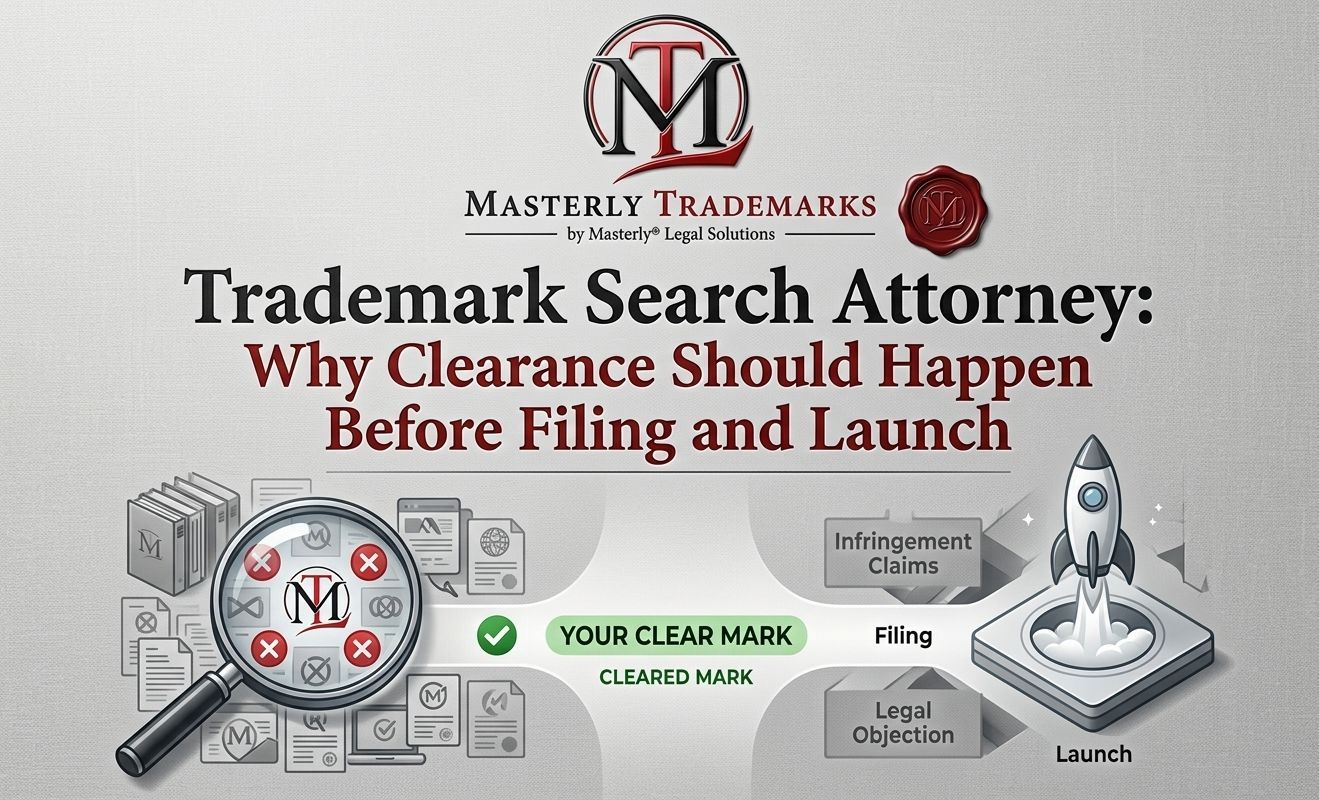
Conduct a trademark search before filing to avoid conflicts that surface mid-application or after launch. Trademark searches can prevent costly rebranding efforts post-investment. Early risk identification is one of the most important investments a brand can make - discovering a problem during the process of filing is far cheaper than discovering it after you have paid for packaging, marketing, and a site redesign.
When to Invest in Professional Trademark Search Services
Run a serious search before committing to domain purchases, packaging, or major marketing spends. Trademark searches should be done before filing applications, not after.
Situations where comprehensive search is essential:
- National product launches or multi-state expansion
- Major rebrands where protecting the new identity is critical
- Franchise models requiring consistent brand use across markets
- Media properties, podcasts, or high-visibility apps
- Companies seeking investment or preparing for acquisition
If you have multiple candidate names, professional services let you rank options by relative risk and strength, helping you identify which name gives you the best ability to register and defend. DIY checks may suffice for very low-stakes internal projects, but most public-facing brands benefit from at least one attorney-reviewed clearance search.
Masterly Trademarks is an approachable option for early-stage and growth companies that need licensed, experienced counsel without large-firm overhead or additional fees for basic consultation.

How Masterly Trademarks Approaches Trademark Clearance
Masterly Trademarks uses an attorney-led, U.S.-focused clearance workflow designed to give you a realistic view of risk before you pay to file.
Key steps in the process:
- Intake and strategy discussion - define where the mark will be used, the goods and services involved, geographic scope, and expansion plans
- Define scope - determine likely trademark classes, mark type (word, logo, slogan, design), and search parameters
- Layered searching - federal USPTO records, state registrations, common law sources, and digital checks
- Human review - combine advanced search tools with attorney judgment to evaluate similar trademarks and business context
- Written analysis - deliver findings with risk ratings, a clear explanation of the closest hits, and suggested next steps (refine the mark, proceed, or reconsider)
No guarantees or outcome promises are made. The emphasis is on informed decision-making and risk management so you can submit your application with confidence.
Ready to protect your brand before you file? Request a trademark clearance consultation with Masterly Trademarks. Call (972) 236-5051 or visit masterlytrademarks.com.

FAQs About Trademark Search Services and Clearance
Is a free trademark search enough before I file? Free searches are helpful for early screening, but they typically miss similar trademarks with different spellings, common law use, and related-class conflicts. They do not substitute for legal risk evaluation. It reduces application rejections by identifying potential blocks that a free tool would overlook.
What's the difference between a trademark search report and a legal clearance opinion? A report lists search results. A legal clearance opinion includes an attorney interpreting the data - assessing similarity, evaluating risk, and advising whether to proceed, modify, or abandon the mark.
Do I need a search if my mark is made-up or coined? Yes. Even coined marks benefit from searches. Someone else may have a similar coined term, and phonetic or visual similarity still matters. A phonetic search identifies marks that sound similar regardless of spelling. Domain and social handle conflicts are also worth checking.
Can I skip common law search if I only care about federal registration? No. Common law users with earlier use can block your registration or bring infringement claims. The USPTO considers use in commerce, not just the date you register.
Should I search before or after I file my USPTO application? Before. You want to uncover conflicts early to avoid refusals, oppositions, wasted fees, and rebranding. Filing first locks you into a mark before you understand the risk.
If I only sell in one U.S. state, do I still need a federal-style clearance search? Yes. Online reach means most businesses today engage in interstate commerce. Federal trademark registration provides broader protection, and expansion plans can be derailed by conflicts you did not anticipate.
Have a question that was not covered here? Contact Masterly Trademarks at (972) 236-5051 or visit masterlytrademarks.com for mark-specific guidance.
You might also like